Thank you for visiting SNEWPapers!
Sign up free
Portland Gazette, And Maine Advertiser
Portland, Cumberland County, Maine
What is this article about?
Hamet Bashaw of Tripoli appeals to the US for support after being abandoned following a joint military effort against his brother Yusuf, who usurped the throne. He references a treaty with General Eaton and seeks indemnification. Eaton's letter to the Navy Secretary defends the actions and expresses regret over Hamet's abandonment.
Clipping
OCR Quality
Full Text
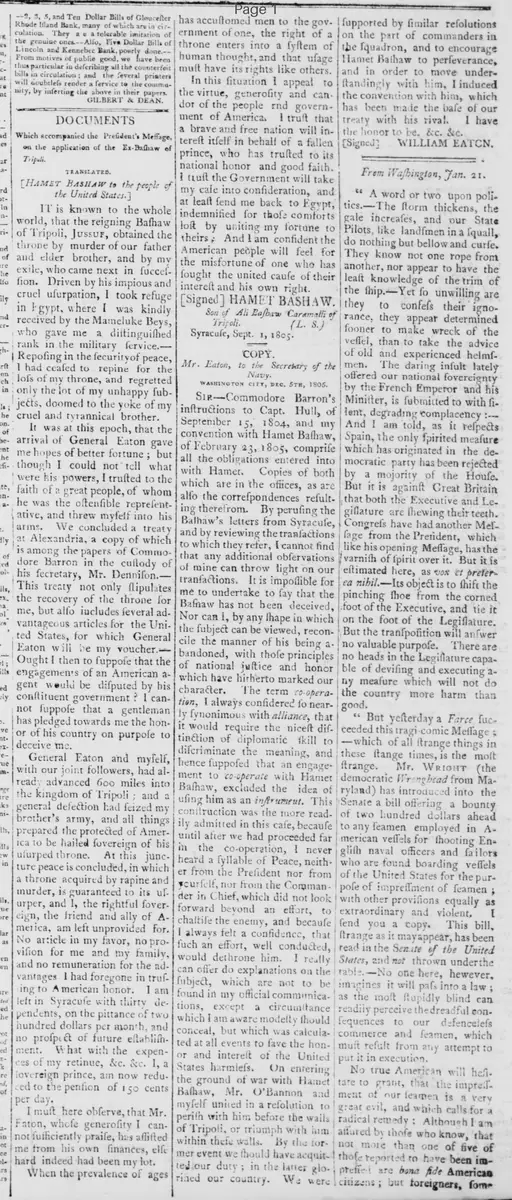
Which accompanied the President's Message, on the application of the Ex-Bashaw of Tripoli.
TRANSLATED.
[HAMET BASHAW to the people of the United States.]
It is known to the whole world, that the reigning Bashaw of Tripoli, Jusuf, obtained the throne by murder of our father and elder brother, and by my exile, who came next in succession. Driven by his impious and cruel usurpation, I took refuge in Egypt, where I was kindly received by the Mameluke Beys, who gave me a distinguished rank in the military service.—
Reposing in the security of peace, I had ceased to repine for the loss of my throne, and regretted only the lot of my unhappy subjects, doomed to the yoke of my cruel and tyrannical brother.
It was at this epoch, that the arrival of General Eaton gave me hopes of better fortune : but though I could not tell what were his powers, I trusted to the faith of a great people, of whom he was the ostensible representative, and threw myself into his arms. We concluded a treaty at Alexandria, a copy of which is among the papers of Commodore Barron in the custody of his secretary, Mr. Dennison.—
This treaty not only stipulates the recovery of the throne for me, but also includes several advantageous articles for the United States, for which General Eaton will be my voucher.—
Ought I then to suppose that the engagements of an American agent would be disputed by his constituent government ? I cannot suppose that a gentleman has pledged towards me the honor of his country on purpose to deceive me.
General Eaton and myself, with our joint followers, had already, advanced 600 miles into the kingdom of Tripoli; and a general defection had seized my brother's army, and all things prepared the protected of America to be hailed sovereign of his usurped throne. At this juncture peace is concluded, in which a throne acquired by rapine and murder, is guaranteed to its usurper, and I, the rightful sovereign, the friend and ally of America, am left unprovided for.
No article in my favor, no provision for me and my family, and no remuneration for the advantages I had foregone in trusting to American honor. I am left in Syracuse with thirty dependents, on the pittance of two hundred dollars per month, and no prospect of future establishment. What with the expenses of my retinue, &c. &c. I, a sovereign prince, am now reduced to the pension of 150 cents per day.
I must here observe, that Mr. Eaton, whose generosity I cannot sufficiently praise, has assisted me from his own finances, else hard indeed had been my lot. When the prevalence of ages has accustomed men to the government of one, the right of a throne enters into a system of human thought, and that usage must have its rights like others.
In this situation I appeal to the virtue, generosity and candor of the people and government of America. I trust that a brave and free nation will interest itself in behalf of a fallen prince, who has trusted to its national honor and good faith.
I trust the Government will take my case into consideration, and at least send me back to Egypt, indemnified for those comforts lost by uniting my fortune to theirs : And I am confident the American people will feel for the misfortune of one who has fought the united cause of their interest and his own right.
[SIGNED] HAMET BASHAW
Son of Ali Bashaw Caramalli of Tripoli.
(L. S.)
Syracuse, Sept. 1, 1805.
COPY.
Mr. Eaton, to the Secretary of the Navy.
WASHINGTON CITY, DEC. 5th, 1805.
SIR—Commodore Barron's instructions to Capt. Hull, of September 15, 1804, and my convention with Hamet Bashaw, of February 23, 1805, comprise all the obligations entered into with Hamet. Copies of both which are in the offices, as are also the correspondences resulting therefrom. By perusing the Bashaw's letters from Syracuse, and by reviewing the transactions to which they refer, I cannot find that any additional observations of mine can throw light on our transactions. It is impossible for me to undertake to say that the Bashaw has not been deceived.
Nor can I, by any shape in which the subject can be viewed, reconcile the manner of his being abandoned, with those principles of national justice and honor which have hitherto marked our character. The term co-operation, I always considered so nearly synonymous with alliance, that it would require the nicest distinction of diplomatic skill to discriminate the meaning, and hence supposed that an engagement to co-operate with Hamet Bashaw, excluded the idea of using him as an instrument. This construction was the more readily admitted in this case, because until after we had proceeded far in the co-operation, I never heard a syllable of Peace, neither from the President nor from ourselves, nor from the Commander in Chief, which did not look forward beyond an effort, to chastise the enemy, and because I always felt a confidence, that such an effort, well conducted, would dethrone him. I really can offer no explanations on the subject, which are not to be found in my official communications, except a circumstance which I am aware modesty should conceal, but which was calculated at all events to save the honor and interest of the United States harmless. On entering the ground of war with Hamet Bashaw, Mr. O'Bannon and myself united in a resolution to perish with him before the walls of Tripoli, or triumph with him within these walls. By the former event we should have acquitted our duty ; in the latter glorified our country. We were supported by similar resolutions on the part of commanders in the squadron, and to encourage Hamet Bashaw to perseverance, and in order to move understandingly with him, I induced the convention with him, which has been made the base of our treaty with his rival. I have the honor to be, &c. &c.
[SIGNED]
WILLIAM EATON.
What sub-type of article is it?
What keywords are associated?
What entities or persons were involved?
Where did it happen?
Foreign News Details
Primary Location
Tripoli
Event Date
Sept. 1, 1805
Key Persons
Outcome
peace concluded guaranteeing throne to usurper jusuf; hamet abandoned in syracuse with $200 monthly pension and no further provision.
Event Details
Hamet Bashaw, exiled rightful heir to Tripoli's throne, allied with US General Eaton via treaty at Alexandria on Feb. 23, 1805, advancing 600 miles into Tripoli with joint forces amid army defection. Peace treaty left Hamet unprovided for despite his contributions; he appeals for return to Egypt with indemnification. Eaton's letter confirms obligations and regrets abandonment, citing co-operation as alliance.