Thank you for visiting SNEWPapers!
Sign up free
Editorial
March 12, 1830
Daily Richmond Whig
Richmond, Virginia
What is this article about?
The Richmond Whig editorial criticizes Senator Thomas Hart Benton's speech for fawning over John Randolph, despite Randolph's historical opposition to Western interests, while vilifying New England. It condemns this as a tactic to stoke Southern prejudice against New England for political gain, exemplified by blaming the tariff on Yankees.
Clipping
OCR Quality
95%
Excellent
Full Text
Richmond Whig
FRIDAY MORNING, MARCH 12, 1830.
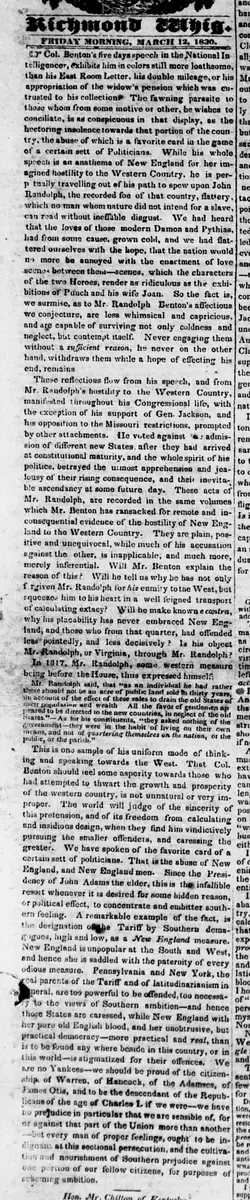
Col. Benton's five days' speech in the National Intelligencer, exhibits him in colors still more loathsome, than his East Room Letter, his double mileage, or his appropriation of the widow's pension which was entrusted to his collection. The fawning parasite to those whom from some motive or other, he wishes to conciliate, is as conspicuous in that display, as the hectoring insolence towards that portion of the country, the abuse of which is a favorite card in the game of a certain set of Politicians. While his whole speech is an anathema of New England or her imagined hostility to the Western Country, he is perpetually travelling out of his path to speak upon John Randolph, the recorded foe of that country, flattery, which no man whom nature did not intend for a slave, can read without ineffable disgust. We had heard that the loves of those modern Damon and Pythias, had from some cause, grown cold, and we had flattered ourselves with the hope, that the nation would no more be annoyed with the enactment of love scenes between the two Heroes, rendered as ridiculous as the exhibitions of Punch and his wife Joan. So the fact is, we surmise, as to Mr. Randolph. Benton's affections we conjecture, are less whimsical and capricious. and are capable of surviving not only coldness and neglect, but contempt itself. Never engaging them without a sufficient reason, he never on the other hand, withdraws them while a hope of effecting his end, remains
These reflections flow from his speech, and from Mr. Randolph's hostility to the Western Country, manifested throughout his Congressional life, with the exception of his support of Gen. Jackson, and his opposition to the Missouri restrictions, prompted by other attachments. He voted against the admission of different new States, after they had arrived at constitutional maturity, and the whole spirit of his politics, betrayed the utmost apprehension and jealousy of their rising consequence, and their inevitable ascendancy at some future day. These acts of Mr. Randolph, are recorded in the same volumes which Mr. Benton has ransacked for remote and inconsequential evidence of the hostility of New England to the Western Country. They are plain, positive and unequivocal, while much of his accusation against the other, is inapplicable; and much more, merely inferential. Will Mr. Benton explain the reason of this? Will he tell us why he has not only forgiven Mr. Randolph for his enmity to the West, but squeezes him to his heart in a well feigned transport of calculating ecstasy? Will he make known the contrary, why his placability has never embraced New England, and those who from that quarter, had offended less pointedly, and less decisively? Is his object Mr. Randolph, or Virginia, through Mr. Randolph?
In 1817, Mr. Randolph, some western measure being before the House, thus expressed himself:
Mr. Randolph said, that "as an individual he had rather there should not be an acre of public land sold in thirty years, on account of the effect of these sales to drain the old States of their population and wealth All the favor of gentlemen appeared to be directed to the new countries, in neglect of the old States."-- As for his constituents, "they asked nothing of the government-they were in the habit of living on their own means, and not of quartering themselves on the nation, or the public, or the parish."
This is one sample of his uniform mode of thinking and speaking towards the West. That Col. Benton should feel some asperity towards those who had attempted to thwart the growth and prosperity of the western country, is not unnatural or very proper. The world will judge of the sincerity of this pretension, and of its freedom from calculating and insidious design, when they find him vindictively pursuing the smaller offenders, and caressing the greater. We have spoken of the favorite card of a certain set of politicians. That is the abuse of New England, and New England men. Since the Presidency of John Adams the elder, this is the infallible resort whenever it is desired for some hidden reason, or political effect, to concentrate and embitter southern feeling. A remarkable example of the act, is the designation of the Tariff by Southern demagogues, high and low, as a New England measure.
New England is unpopular at the South and West, and hence she is saddled with the paternity of every odious measure. Pennsylvania and New York, the real parents of the Tariff and of latitudinarianism in general, are too powerful to be offended, too necessary to the views of Southern ambition-and hence those States are caressed, while New England with her pure old English blood, and her unobtrusive, but practical democracy-more practical and real, than is to be found any where beside in this country, or in this world-is stigmatized for their offences. We are no Yankees--we should be proud of the citizenship. of Warren, of Hancock, of the Adamses, of James Otis, and to be the descendant of the Republicans of the age of Charles I. if we were--we have no prejudice in particular that we are sensible of, for or against that part of the Union more than another --but every man of proper feelings, ought to be indignant at this sectional persecution, and the cultivation and nourishment of Southern prejudice against one portion of our fellow citizens, for purposes of scheming ambition.
FRIDAY MORNING, MARCH 12, 1830.
Col. Benton's five days' speech in the National Intelligencer, exhibits him in colors still more loathsome, than his East Room Letter, his double mileage, or his appropriation of the widow's pension which was entrusted to his collection. The fawning parasite to those whom from some motive or other, he wishes to conciliate, is as conspicuous in that display, as the hectoring insolence towards that portion of the country, the abuse of which is a favorite card in the game of a certain set of Politicians. While his whole speech is an anathema of New England or her imagined hostility to the Western Country, he is perpetually travelling out of his path to speak upon John Randolph, the recorded foe of that country, flattery, which no man whom nature did not intend for a slave, can read without ineffable disgust. We had heard that the loves of those modern Damon and Pythias, had from some cause, grown cold, and we had flattered ourselves with the hope, that the nation would no more be annoyed with the enactment of love scenes between the two Heroes, rendered as ridiculous as the exhibitions of Punch and his wife Joan. So the fact is, we surmise, as to Mr. Randolph. Benton's affections we conjecture, are less whimsical and capricious. and are capable of surviving not only coldness and neglect, but contempt itself. Never engaging them without a sufficient reason, he never on the other hand, withdraws them while a hope of effecting his end, remains
These reflections flow from his speech, and from Mr. Randolph's hostility to the Western Country, manifested throughout his Congressional life, with the exception of his support of Gen. Jackson, and his opposition to the Missouri restrictions, prompted by other attachments. He voted against the admission of different new States, after they had arrived at constitutional maturity, and the whole spirit of his politics, betrayed the utmost apprehension and jealousy of their rising consequence, and their inevitable ascendancy at some future day. These acts of Mr. Randolph, are recorded in the same volumes which Mr. Benton has ransacked for remote and inconsequential evidence of the hostility of New England to the Western Country. They are plain, positive and unequivocal, while much of his accusation against the other, is inapplicable; and much more, merely inferential. Will Mr. Benton explain the reason of this? Will he tell us why he has not only forgiven Mr. Randolph for his enmity to the West, but squeezes him to his heart in a well feigned transport of calculating ecstasy? Will he make known the contrary, why his placability has never embraced New England, and those who from that quarter, had offended less pointedly, and less decisively? Is his object Mr. Randolph, or Virginia, through Mr. Randolph?
In 1817, Mr. Randolph, some western measure being before the House, thus expressed himself:
Mr. Randolph said, that "as an individual he had rather there should not be an acre of public land sold in thirty years, on account of the effect of these sales to drain the old States of their population and wealth All the favor of gentlemen appeared to be directed to the new countries, in neglect of the old States."-- As for his constituents, "they asked nothing of the government-they were in the habit of living on their own means, and not of quartering themselves on the nation, or the public, or the parish."
This is one sample of his uniform mode of thinking and speaking towards the West. That Col. Benton should feel some asperity towards those who had attempted to thwart the growth and prosperity of the western country, is not unnatural or very proper. The world will judge of the sincerity of this pretension, and of its freedom from calculating and insidious design, when they find him vindictively pursuing the smaller offenders, and caressing the greater. We have spoken of the favorite card of a certain set of politicians. That is the abuse of New England, and New England men. Since the Presidency of John Adams the elder, this is the infallible resort whenever it is desired for some hidden reason, or political effect, to concentrate and embitter southern feeling. A remarkable example of the act, is the designation of the Tariff by Southern demagogues, high and low, as a New England measure.
New England is unpopular at the South and West, and hence she is saddled with the paternity of every odious measure. Pennsylvania and New York, the real parents of the Tariff and of latitudinarianism in general, are too powerful to be offended, too necessary to the views of Southern ambition-and hence those States are caressed, while New England with her pure old English blood, and her unobtrusive, but practical democracy-more practical and real, than is to be found any where beside in this country, or in this world-is stigmatized for their offences. We are no Yankees--we should be proud of the citizenship. of Warren, of Hancock, of the Adamses, of James Otis, and to be the descendant of the Republicans of the age of Charles I. if we were--we have no prejudice in particular that we are sensible of, for or against that part of the Union more than another --but every man of proper feelings, ought to be indignant at this sectional persecution, and the cultivation and nourishment of Southern prejudice against one portion of our fellow citizens, for purposes of scheming ambition.
What sub-type of article is it?
Partisan Politics
What keywords are associated?
Thomas Benton
John Randolph
New England
Western Country
Sectional Prejudice
Tariff
Southern Politics
What entities or persons were involved?
Col. Benton
John Randolph
New England
Western Country
Southern Politicians
Gen. Jackson
Editorial Details
Primary Topic
Criticism Of Benton's Hypocrisy In Flattering Randolph While Attacking New England
Stance / Tone
Indignant Defense Of New England Against Sectional Political Tactics
Key Figures
Col. Benton
John Randolph
New England
Western Country
Southern Politicians
Gen. Jackson
Key Arguments
Benton's Speech Hypocritically Flatters Randolph Despite His Anti Western Record
Randolph Opposed Western State Admissions And Land Sales
Abuse Of New England Is A Standard Southern Political Tactic To Embitter Sections
Tariff Wrongly Blamed On New England Instead Of Pennsylvania And New York
Benton Pursues Minor Offenders Vindictively But Caresses Major Ones Like Randolph