Thank you for visiting SNEWPapers!
Sign up free
Story
March 18, 1913
Honolulu Star Bulletin
Honolulu, Honolulu County, Hawaii
What is this article about?
Debate in Hawaii over Rapid Transit company's franchise extension, capitalization practices, and potential government purchase. L.T. Peck defends against Governor's suggestions; E.A. Mott-Smith critiques financial maneuvers allowing stockholders unearned gains.
Clipping
OCR Quality
85%
Good
Full Text
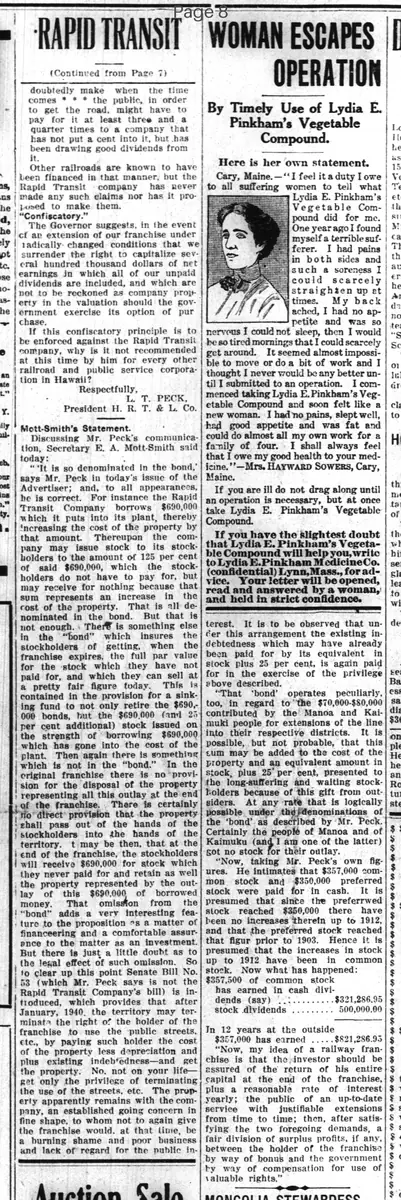
RAPID TRANSIT
(Continued from Page 7)
Undoubtedly make
when the time
comes * * * the public, in order
to get the road, might have to
pay for it at least three and a
quarter times to a company that
has not put a cent into it, but has
been drawing good dividends from
it.
Other railroads are known to have
been financed in that manner, but the
Rapid Transit company has never
made any such claims nor has it pro-
posed to make them.
"Confiscatory."
The Governor suggests, in the event
of an extension of our franchise under
radically changed conditions, that we
surrender the right to capitalize sev-
eral hundred thousand dollars of net
earnings in which all of our unpaid
dividends are included, and which are
not to be reckoned as company prop-
erty in the valuation should the gov-
ernment exercise its option of pur-
chase.
If this confiscatory principle is to
be enforced against the Rapid Transit
company, why is it not recommended
at this time by him for every other
railroad and public service corpora-
tion in Hawaii?
Respectfully,
L. T. PECK
President H. R. T. & L. Co.
Mott-Smith's Statement.
Discussing Mr. Peck's communica-
tion, Secretary E. A. Mott-Smith said
today:
'It is so denominated in the bond,'
says Mr. Peck in today's issue of the
Advertiser; and, to all appearances,
he is correct. For instance the Rapid
Transit Company borrows $690,000
which it puts into its plant, thereby
increasing the cost of the property by
that amount. Thereupon the com-
pany may issue stock to its stock-
holders to the amount of 125 per cent
of said $690,000, which the stock-
holders do not have to pay for, but
may receive for nothing because that
sum represents an increase in the
cost of the property. That is all de-
nominated in the bond. But that is
not enough. There is something else
in the "bond" which insures the
stockholders of getting, when the
franchise expires, the full par value
for the stock which they have not
paid for, and which they can sell at
a pretty fair figure today. This is
contained in the provision for a sink-
ing fund to not only retire the $690,-
000 bonds, but the $690,000 (and 25
per cent additional) stock issued on
the strength of borrowing $690,000
which has gone into the cost of the
plant. Then again there is something
which is not in the "bond." In the
original franchise there is no provi-
sion for the disposal of the property
representing all this outlay at the end
of the franchise. There is certainly
no direct provision that the property
shall pass out of the hands of the
stockholders into the hands of the
territory. It may be then, that at the
end of the franchise, the stockholders
will receive $690,000 for stock which
they never paid for and retain as well
the property represented by the out-
lay of this $690,000 of borrowed
money. That omission from the
"bond" adds a very interesting fea-
ture to the proposition as a matter of
financiering and a comfortable assur-
ace to the matter as an investment.
But there is just a little doubt as to
the legal effect of such omission. So
to clear up this point Senate Bill No.
53 (which Mr. Peck says is not the
Rapid Transit Company's bill) is in-
troduced, which provides that after
January, 1940, the territory may ter-
minate the right of the holder of the
franchise to use the public streets,
etc., by paying such holder the cost
of the property less depreciation and
plus existing indebtedness-and get
the property. No, not on your life
get only the privilege of terminating
the use of the streets, etc. The prop-
erty apparently remains with the com-
pany, an established going concern in
fine shape, to whom not to again give
the franchise would, at that time, be
a burning shame and poor business
and lack of regard for the public in-
terest. It is to be observed that un-
der this arrangement the existing in-
debtedness which may have already
been paid for by its equivalent in
stock plus 25 per cent, is again paid
for in the exercise of the privilege
above described.
"That 'bond' operates peculiarly,
too, in regard to the $70,000-$80,000
contributed by the Manoa and Kai-
muki people for extensions of the line
into their respective districts. It is
possible, but not probable, that this
sum may be added to the cost of the
property and an equivalent amount in
stock, plus 25 per cent, presented to
the long-suffering and waiting stock-
holders because of this gift from out-
siders. At any rate that is logically
possible, under the denominations of
the 'bond' as described by Mr. Peck.
Certainly the people of Manoa and of
Kaimuki (and I am one of the latter)
got no stock for their outlay.
"Now, taking Mr. Peck's own fig-
ures. He intimates that $357,000 com-
mon stock and $350,000 preferred
stock were paid for in cash. It is
presumed that since the preferred
stock reached $350,000 there have
been no increases therein up to 1912,
and that the preferred stock reached
that figure prior to 1903. Hence it is
presumed that the increases in stock
up to 1912 have been in common
stock. Now what has happened:
$357,500 of common stock
has earned in cash divi-
dends (say)
$321,286.95
stock dividends
500,000.00
In 12 years at the outside
$357,000 has earned ..$821,286.95
"Now, my idea of a railway fran-
chise is that the investor should be
assured of the return of his entire
capital at the end of the franchise,
plus a reasonable rate of interest
yearly; the public of an up-to-date
service with justifiable extensions
from time to time; then, after satis-
fying the two foregoing demands, a
fair division of surplus profits, if any,
between the holder of the franchise
by way of bonus and the government
by way of compensation for use of
valuable rights.'
(Continued from Page 7)
Undoubtedly make
when the time
comes * * * the public, in order
to get the road, might have to
pay for it at least three and a
quarter times to a company that
has not put a cent into it, but has
been drawing good dividends from
it.
Other railroads are known to have
been financed in that manner, but the
Rapid Transit company has never
made any such claims nor has it pro-
posed to make them.
"Confiscatory."
The Governor suggests, in the event
of an extension of our franchise under
radically changed conditions, that we
surrender the right to capitalize sev-
eral hundred thousand dollars of net
earnings in which all of our unpaid
dividends are included, and which are
not to be reckoned as company prop-
erty in the valuation should the gov-
ernment exercise its option of pur-
chase.
If this confiscatory principle is to
be enforced against the Rapid Transit
company, why is it not recommended
at this time by him for every other
railroad and public service corpora-
tion in Hawaii?
Respectfully,
L. T. PECK
President H. R. T. & L. Co.
Mott-Smith's Statement.
Discussing Mr. Peck's communica-
tion, Secretary E. A. Mott-Smith said
today:
'It is so denominated in the bond,'
says Mr. Peck in today's issue of the
Advertiser; and, to all appearances,
he is correct. For instance the Rapid
Transit Company borrows $690,000
which it puts into its plant, thereby
increasing the cost of the property by
that amount. Thereupon the com-
pany may issue stock to its stock-
holders to the amount of 125 per cent
of said $690,000, which the stock-
holders do not have to pay for, but
may receive for nothing because that
sum represents an increase in the
cost of the property. That is all de-
nominated in the bond. But that is
not enough. There is something else
in the "bond" which insures the
stockholders of getting, when the
franchise expires, the full par value
for the stock which they have not
paid for, and which they can sell at
a pretty fair figure today. This is
contained in the provision for a sink-
ing fund to not only retire the $690,-
000 bonds, but the $690,000 (and 25
per cent additional) stock issued on
the strength of borrowing $690,000
which has gone into the cost of the
plant. Then again there is something
which is not in the "bond." In the
original franchise there is no provi-
sion for the disposal of the property
representing all this outlay at the end
of the franchise. There is certainly
no direct provision that the property
shall pass out of the hands of the
stockholders into the hands of the
territory. It may be then, that at the
end of the franchise, the stockholders
will receive $690,000 for stock which
they never paid for and retain as well
the property represented by the out-
lay of this $690,000 of borrowed
money. That omission from the
"bond" adds a very interesting fea-
ture to the proposition as a matter of
financiering and a comfortable assur-
ace to the matter as an investment.
But there is just a little doubt as to
the legal effect of such omission. So
to clear up this point Senate Bill No.
53 (which Mr. Peck says is not the
Rapid Transit Company's bill) is in-
troduced, which provides that after
January, 1940, the territory may ter-
minate the right of the holder of the
franchise to use the public streets,
etc., by paying such holder the cost
of the property less depreciation and
plus existing indebtedness-and get
the property. No, not on your life
get only the privilege of terminating
the use of the streets, etc. The prop-
erty apparently remains with the com-
pany, an established going concern in
fine shape, to whom not to again give
the franchise would, at that time, be
a burning shame and poor business
and lack of regard for the public in-
terest. It is to be observed that un-
der this arrangement the existing in-
debtedness which may have already
been paid for by its equivalent in
stock plus 25 per cent, is again paid
for in the exercise of the privilege
above described.
"That 'bond' operates peculiarly,
too, in regard to the $70,000-$80,000
contributed by the Manoa and Kai-
muki people for extensions of the line
into their respective districts. It is
possible, but not probable, that this
sum may be added to the cost of the
property and an equivalent amount in
stock, plus 25 per cent, presented to
the long-suffering and waiting stock-
holders because of this gift from out-
siders. At any rate that is logically
possible, under the denominations of
the 'bond' as described by Mr. Peck.
Certainly the people of Manoa and of
Kaimuki (and I am one of the latter)
got no stock for their outlay.
"Now, taking Mr. Peck's own fig-
ures. He intimates that $357,000 com-
mon stock and $350,000 preferred
stock were paid for in cash. It is
presumed that since the preferred
stock reached $350,000 there have
been no increases therein up to 1912,
and that the preferred stock reached
that figure prior to 1903. Hence it is
presumed that the increases in stock
up to 1912 have been in common
stock. Now what has happened:
$357,500 of common stock
has earned in cash divi-
dends (say)
$321,286.95
stock dividends
500,000.00
In 12 years at the outside
$357,000 has earned ..$821,286.95
"Now, my idea of a railway fran-
chise is that the investor should be
assured of the return of his entire
capital at the end of the franchise,
plus a reasonable rate of interest
yearly; the public of an up-to-date
service with justifiable extensions
from time to time; then, after satis-
fying the two foregoing demands, a
fair division of surplus profits, if any,
between the holder of the franchise
by way of bonus and the government
by way of compensation for use of
valuable rights.'
What sub-type of article is it?
Historical Event
What themes does it cover?
Deception
Justice
What keywords are associated?
Rapid Transit
Franchise Extension
Capitalization
Stock Dividends
Hawaii Railroads
Sinking Fund
Senate Bill 53
What entities or persons were involved?
L. T. Peck
E. A. Mott Smith
Governor
Where did it happen?
Hawaii
Story Details
Key Persons
L. T. Peck
E. A. Mott Smith
Governor
Location
Hawaii
Event Date
1912
Story Details
L.T. Peck defends Rapid Transit company's financial practices against Governor's franchise extension proposals, calling them confiscatory. E.A. Mott-Smith critiques the 'bond' allowing unearned stock gains, sinking fund provisions, and potential double-dipping on indebtedness, using company figures to highlight profits from unpaid capital.