Thank you for visiting SNEWPapers!
Sign up free
The Enquirer
Richmond, Henrico County, Virginia
What is this article about?
Philo Nelson leads 23 adventurers from Natchez into New Mexico to capture wild mules and horses for sale, but they are attacked, captured by Spaniards and Indians, imprisoned for years in Mexico, face execution by lot, and some are freed during the Mexican revolution. Narrated by survivor Ellis P. Bean in New Orleans, 1814.
Clipping
OCR Quality
Full Text
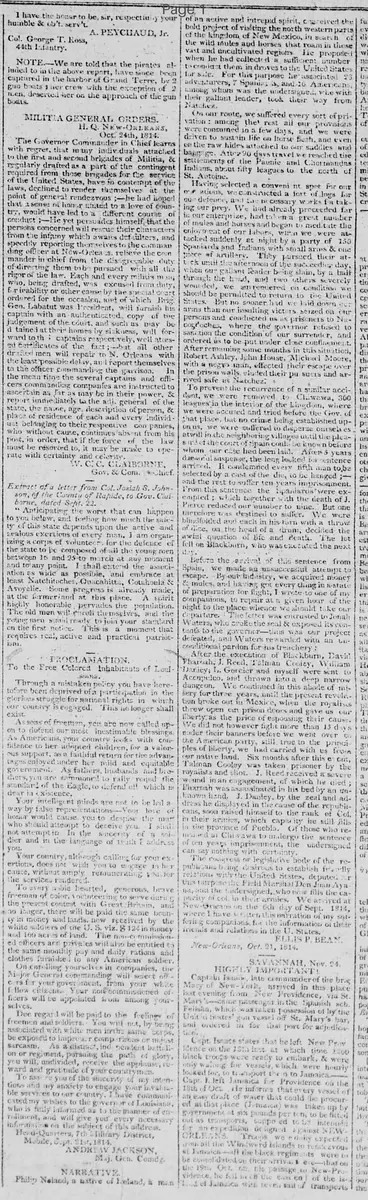
Philo Nelson, a native of Ireland, a man of an active and intrepid spirit, conceived the bold project of visiting the north western parts of the kingdom of New Mexico, in search of the wild mules and horses that roam in these vast and uncultivated regions. He proposed when he had collected a sufficient number to conduct them in droves to the United States for sale. For this purpose he associated 23 adventurers, 7 Spaniards, and 16 Americans, among whom was the undersigned, who with their gallant leader, took their way from Natchez.
On our route, we suffered every sort of privation: among the rest all our provisions were consumed in a few days, and we were driven to sustain life on horse flesh, and even on the raw hides attached to our saddles and baggage. After 90 days travel we reached the settlements of the Pawnee and Comanches Indians, about fifty leagues to the north of St. Antonio.
Having selected a convenient spot for our operations, we constructed a fort of logs for our defence, and the necessary works for taking our prey. We had already proceeded far in our enterprize, had taken a great number of mules and horses and began to meditate the enjoyment of our labors, when we were attacked suddenly at night by a party of 150 Spaniards and Indians with small arms & one piece of artillery. They pursued their attack until the afternoon of the succeeding day, when our gallant leader being slain, by a ball through the head, and two others severely wounded, we surrendered on condition we should be permitted to return to the United States. But no sooner had we laid down our arms than our insulting victors seized on our persons and conducted us as prisoners to Nacogdoches, where the governor refused to sanction the condition of our surrender, and ordered us to be put under close confinement.
After remaining some months in this situation, Robert Ashley, John House, Michael Moore, with a negro man, effected their escape over the prison walls eluded their pursuers and arrived safe at Natchez:
To prevent the recurrence of a similar accident, we were removed to Chihuahua, 300 leagues in the interior of the kingdom, where we were accused and tried before the Gov. of that place, but no crime being established upon us, we were suffered to disperse ourselves at will in the neighboring villages until the pleasure of the court of Spain could be known before whom our case had been laid. After 5 years dreadful suspense, the long looked for sentence arrived. It condemned every fifth man to be selected by a cast of the die, to be hanged; and the rest to suffer ten years imprisonment.
From this sentence the Spaniards were exempted; which together with the death of J. Pierce reduced our number to nine. But one therefore was destined to suffer. We were blindfolded and each in his turn with a throw of dice, on the head of a drum, decided the awful question of life and death. The lot fell on Blackburn, who was executed the next day.
Before the arrival of this sentence from Spain, we made an unsuccessful attempt to escape. By our industry, we acquired money & mules, and having got every thing in a state of preparation for flight, I wrote to one of my companions, to repair at a given hour of the night to the place whence we should take our departure. The letter was entrusted to Jonah Waters, who broke the seal & exposed its contents to the governor—thus was our project defeated, and Waters rewarded with an unconditional pardon for his treachery:
After the execution of Blackburn, David Pharoah, J. Reed, Talman Cooley, William Danley, J. Gorsier and myself were sent to Acapulco, and thrown into a deep narrow dungeon. We continued in this abode of misery for three years, until the present revolution broke out in Mexico, when the royalists threw open our prison doors and gave us our liberty as the price of espousing their cause.
We did not however fight more than 15 days under their banners before we went over to the American party, still true to the principles of liberty, we had carried with us from our native land. Six months after this event, Talman Cooley was taken prisoner by the royalists and shot. J. Reed received a severe wound in an engagement, of which he died; Pharoah was assassinated in his bed by an unknown hand. J. Danley, by the zeal and address he displayed in the cause of the republicans, soon raised himself to the rank of Col. in their armies, which capacity he still fills in the province of Puebla. Of those who remained at Chihuahua to undergo the sentence of ten years imprisonment, the undersigned can say nothing with certainty.
The congress or legislative body of the republicans being desirous to establish friendly relations with the United States, deputed for that purpose the Field Marshal Don Juan Ayala, and the undersigned, who now fills the capacity of col. in their armies. We arrived at New-Orleans on the 6th day of Sept. 1814, where I have written this narration of my suffering companions, for the information of their friends and relations in the U. States.
ELLIS P. BEAN.
New-Orleans, Oct. 21, 1814.
What sub-type of article is it?
What themes does it cover?
What keywords are associated?
What entities or persons were involved?
Where did it happen?
Story Details
Key Persons
Location
North Western Parts Of New Mexico, Settlements Of Pawnee And Comanches Indians North Of St. Antonio, Nacogdoches, Chihuahua, Acapulco, Mexico, New Orleans
Event Date
Prior To 1814, Spanning Several Years Until Sept. 6, 1814
Story Details
Expedition from Natchez to capture wild mules and horses in New Mexico; suffered privations; built fort; attacked and captured by Spaniards and Indians; imprisoned in Nacogdoches then Chihuahua; tried and sentenced to execution by lot and imprisonment; one executed; attempted escape betrayed; imprisoned in Acapulco; freed during Mexican revolution; joined republicans; some died; narrator deputized to U.S. in 1814.