Thank you for visiting SNEWPapers!
Sign up free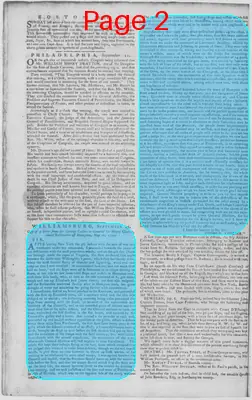
The Virginia Gazette
Richmond, Williamsburg, Richmond County, Virginia
What is this article about?
Sir George Collier's letter to General Sir Henry Clinton reports the British fleet's successful arrival in Virginia on May 8, 1779, after departing New York on May 5. Troops landed unopposed at Portsmouth, capturing the town, Norfolk, and a fort, while seizing and destroying numerous rebel vessels in the Chesapeake region with minimal losses.
Clipping
OCR Quality
Full Text
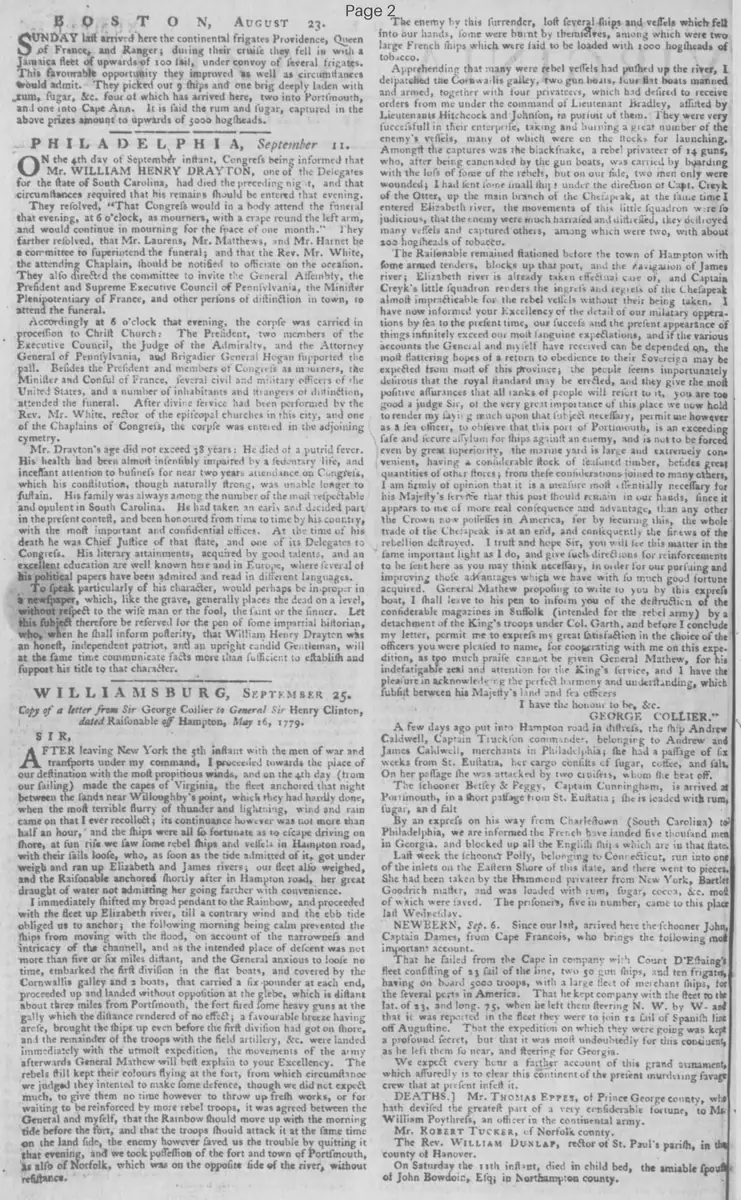
Copy of a letter from Sir George Collier to General Sir Henry Clinton, dated Raisonable off Hampton, May 16, 1779
SIR,
AFTER leaving New York the 5th instant with the men of war and transports under my command, I proceeded towards the place of our destination with the most propitious winds, and on the 4th day (from our sailing) made the capes of Virginia, the fleet anchored that night between the sands near Willoughby's point, which they had hardly done, when the most terrible flurry of thunder and lightning, wind and rain came on that I ever recollect; its continuance however was not more than half an hour, and the ships were all so fortunate as to escape driving on shore, at sunrise we saw some rebel ships and vessels in Hampton road, with their sails loose, who, as soon as the tide admitted of it, got under weigh and ran up Elizabeth and James rivers; our fleet also weighed, and the Raisonable anchored shortly after in Hampton road, her great draught of water not admitting her going farther with convenience.
I immediately shifted my broad pendant to the Rainbow, and proceeded with the fleet up Elizabeth river, till a contrary wind and the ebb tide obliged us to anchor; the following morning being calm prevented the ships from moving with the flood, on account of the narrowness and intricacy of this channel, and as the intended place of descent was not more than five or six miles distant, and the General anxious to loose no time, embarked the first division in the flat boats, and covered by the Cornwallis galley and 2 boats, that carried a six-pounder at each end, proceeded up and landed without opposition at the glebe, which is distant about three miles from Portsmouth, the fort fired some heavy guns at the galley which the distance rendered of no effect; a favourable breeze having arose, brought the ships up even before the first division had got on shore, and the remainder of the troops with the field artillery, &c. were landed immediately with the utmost expedition, the movements of the army afterwards General Mathew will best explain to your Excellency. The rebels still kept their colours flying at the fort, from which circumstance we judged they intended to make some defence, though we did not expect much, to give them no time however to throw up fresh works, or for waiting to be reinforced by more rebel troops, it was agreed between the General and myself, that the Rainbow should move up with the morning tide before the fort, and that the troops should attack it at the same time on the land side, the enemy however saved us the trouble by quitting it that evening, and we took possession of the fort and town of Portsmouth, as also of Norfolk, which was on the opposite side of the river, without resistance.
The enemy by this surrender, lost several ships and vessels which fell into our hands, some were burnt by themselves, among which were two large French ships which were said to be loaded with 1000 hogsheads of tobacco. Apprehending that many rebel vessels had pushed up the river, I despatched the Cornwallis galley, two gun boats, four flat boats manned and armed, together with four privateers, which had desired to receive orders from me under the command of Lieutenant Bradley, assisted by Lieutenants Hitchcock and Johnson, in pursuit of them. They were very successful in their enterprise, taking and burning a great number of the enemy's vessels, many of which were on the stocks for launching. Amongst the captures was the Black Snake, a rebel privateer of 14 guns, who, after being cannonaded by the gun boats, was carried by boarding with the loss of some of the rebels, but on our side, two men only were wounded; I had sent some small sloop under the direction of Capt. Creyk of the Otter, up the main branch of the Chesapeake, at the same time I entered Elizabeth river, the movements of this little squadron were so judicious, that the enemy were much harassed and distressed, they destroyed many vessels and captured others, among which were two, with about 200 hogsheads of tobacco.
The Raisonable remained stationed before the town of Hampton with some armed tenders, blocks up that part, and the navigation of James river; Elizabeth river is already taken effectual care of, and Captain Creyk's little squadron renders the ingress and egress of the Chesapeake almost impracticable for the rebel vessels without their being taken. I have now informed your Excellency of the detail of our military operations by sea to the present time, our success and the present appearance of things infinitely exceed our most sanguine expectations, and if the various accounts the General and myself have received can be depended on, the most flattering hopes of a return to obedience to their Sovereign may be expected from most of this province; the people seems inportunately desirous that the royal standard may be erected, and they give the most positive assurances that all ranks of people will resort to it, you are too good a judge Sir, of the very great importance of this place we now hold to render my saying much upon that subject necessary, permit me however as a sea officer, to observe that this port of Portsmouth, is an exceeding safe and secure asylum for ships against an enemy, and is not to be forced even by great superiority, the marine yard is large and extremely convenient, having a considerable stock of seasoned timber, besides great quantities of other stores; from these considerations joined to many others, I am firmly of opinion that it is a measure not essentially necessary for his Majesty's service that this post should remain in our hands, since it appears to me of more real consequence and advantage, than any other the Crown now possesses in America, for by securing this, the whole trade of the Chesapeake is at an end, and consequently the sinews of the rebellion destroyed. I trust and hope Sir, you will see this matter in the same important light as I do, and give such directions for reinforcements to be sent here as you may think necessary, in order for our pursuing and improving those advantages which we have with so much good fortune acquired. General Mathew proposing to write to you by this express boat, I shall leave to his pen to inform you of the destruction of the considerable magazines in Suffolk (intended for the rebel army) by a detachment of the King's troops under Col. Garth, and before I conclude my letter, permit me to express my great satisfaction in the choice of the officers you were pleased to name, for cooperating with me on this expedition, as too much praise cannot be given General Mathew, for his indefatigable zeal and attention for the King's service, and I have the pleasure in acknowledging the perfect harmony and understanding, which subsists between his Majesty's land and sea officers.
I have the honour to be, &c.
GEORGE COLLIER.
What sub-type of article is it?
What keywords are associated?
What entities or persons were involved?
Where did it happen?
Domestic News Details
Primary Location
Portsmouth, Virginia
Event Date
May 5 16, 1779
Key Persons
Outcome
troops landed without opposition; captured fort, portsmouth, and norfolk; enemy lost several ships and vessels, including two large french ships with 1000 hogsheads of tobacco; captured and burned many rebel vessels, including privateer black snake; british losses: two men wounded; destroyed rebel magazines in suffolk.
Event Details
British fleet under Sir George Collier departed New York on May 5, 1779, arrived Virginia capes on May 8 amid a storm, anchored in Hampton Road. Fleet proceeded up Elizabeth River; troops under General Mathew landed unopposed at the glebe near Portsmouth on May 9, captured fort and towns of Portsmouth and Norfolk that evening. Pursued and captured/burned rebel vessels in rivers and Chesapeake; Raisonable blockaded Hampton and James River.