Thank you for visiting SNEWPapers!
Sign up free
Alexandria Gazette & Daily Advertiser
Alexandria, Virginia
What is this article about?
In a conversation on the ludicrous in composition, participants debate if mock-heroic and burlesque succeed more in advanced societies or earlier eras. They cite superior examples from ancient and early modern authors like Homer, Shakespeare (Dogberry, Grumio, Falstaff), Cervantes (Don Quixote), Butler (Hudibras), and Swift, contrasting with modern inferiority, concluding excellence depends on individual genius rather than historical progress. Signed Z.
Merged-components note: These two components form a continuous literary essay on the ludicrous in composition, split across columns based on adjacent reading order and thematic continuity.
Clipping
OCR Quality
Full Text
SATURDAY, SEPTEMBER 12, 1818
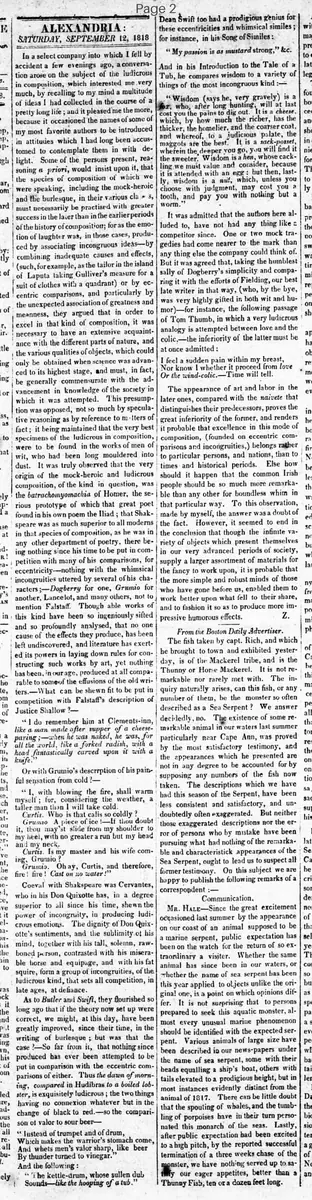
In a select company into which I fell by accident a few evenings ago, a conversation arose on the subject of the ludicrous in composition, which interested me very much, by recalling to my mind a multitude of ideas I had collected in the course of a pretty long life; and it pleased me the more, because it occasioned the names of some of my most favorite authors to be introduced in attitudes which I had long been accustomed to contemplate them in with delight. Some of the persons present, reasoning a priori, would insist upon it, that the species of composition of which we were speaking, including the mock-heroic and the burlesque, in their various classes, must necessarily be practised with greater success in the later than in the earlier periods of the history of composition; for as the emotion of laughter was, in those cases, produced by associating incongruous ideas--by combining inadequate causes and effects, (such, for example, as the tailor in the island of Laputa taking Gulliver's measure for a suit of clothes with a quadrant) or by eccentric comparisons, and particularly by the unexpected association of greatness and meanness, they argued that in order to excel in that kind of composition, it was necessary to have an extensive acquaintance with the different parts of nature, and the various qualities of objects, which could only be obtained when science was advanced to its highest stage, and must, in fact be generally commensurate with the advancement in knowledge of the society in which it was attempted. This presumption was opposed, not so much by speculative reasoning as by reference to matters of fact; it being maintained that the very best specimens of the ludicrous in composition, were to be found in the works of men of wit, who had been long mouldered into dust. It was truly observed that the very origin of the mock-heroic and ludicrous composition, of the kind in question, was the batrachomyomachia of Homer, the serious prototype of which that great poet found in his own poem the Iliad; that Shakespeare was as much superior to all moderns in that species of composition, as he was in any other department of poetry, there being nothing since his time to be put in competition with many of his comparisons, for eccentricity--nothing with the whimsical incongruities uttered by several of his characters;--Dogberry for one, Grumio for another, Lancelot, and many others, not to mention Falstaff. Though able works of this kind have been so ingeniously sifted and so profoundly analysed, that no one cause of the effects they produce, has been left undiscovered, and literature has exerted its powers in laying down rules for constructing such works by art, yet nothing has been, in our age, produced at all comparable to some of the effusions of the old writers.--What can be shewn fit to be put in competition with Falstaff's description of Justice Shallow?--
"I do remember him at Clements-inn, like a man made after supper of a cheese-paring; --when he was naked, he was, for all the world, like a forked radish, with a head fantastically carved upon it with a knife."
Or with Grumio's description of his painful sensation from cold?--
"I, with blowing the fire, shall warm myself; for, considering the weather, a taller man than I will take cold."
Curtis. Who is that calls so coldly?
Grumio. A piece of ice! If thou doubt it, thou may'st slide from my shoulder to my heel, with no greater a run but my head and my neck.
Curtis. Is my master and his wife coming, Grumio?
Grumio. Oh ay, Curtis, and therefore, fire! fire! Cast on no water!"
Coeval with Shakespeare was Cervantes, who in his Don Quixotte has, in a degree superior to all since his time, shewn the power of incongruity, in producing ludicrous emotions. The dignity of Don Quixotte's sentiments, and the sublimity of his mind, together with his tall, solemn, raw-boned person, contrasted with his miserable horse and equipage, and with his fat squire, form a group of incongruities, of the ludicrous kind, that sets all competition, in late ages, at defiance.
As to Butler and Swift, they flourished so long ago that if the theory now set up were correct, we might, at this day, have been greatly improved, since their time, in the writing of burlesque; but was that the case? So far from it, that nothing since produced has ever been attempted to be put in comparison with the eccentric comparisons of either. Thus the dawn of morning, compared in Hudibras to a boiled lobster, is exquisitely ludicrous; the two things having no connexion whatever but in the change of black to red.--so the comparison of valor to sour beer
"Instead of trumpet and of drum,
Which makes the warrior's stomach come,
And whets men's valor sharp, like beer
By thunder turned to vinegar."
And the following:
"The kettle-drum, whose sullen dub
Sounds like the hooping of a tub."
Dean Swift too had a prodigious genius for these eccentricities and whimsical similes; for instance, in his Song of Similes:
"My passion is as mustard strong," &c.
And in his Introduction to the Tale of a Tub, he compares wisdom to a variety of things of the most incongruous kind:--
"Wisdom (says he, very gravely) is a ox, who, after long hunting, will at last cost you the pains to dig out. It is a cheese, which, by how much the richer, has the thicker, the homelier, and the coarser coat. And whereof, to a judicious palate, the maggots are the best. It is a sack-posset, wherein the deeper you go, you will find it the sweeter. Wisdom is a hen, whose cackling we must value and consider, because it is attended with an egg: but then, lastly; wisdom is a nut, which, unless you choose with judgment, may cost you a tooth, and pay you with nothing but a worm."
It was admitted that the authors here alluded to, have not had any thing like a competitor since. One or two mock tragedies had come nearer to the mark than any thing else the company could think of. But it was agreed that, taking the humblest sally of Dogberry's simplicity and comparing it with the efforts of Fielding, our best late writer in that way, (who, by the bye, was very highly gifted in both wit and humor)--for instance, the following passage of Tom Thumb, in which a very ludicrous analogy is attempted between love and the colic.--the inferiority of the latter must be at once admitted:
I feel a sudden pain within my breast,
Nor know I whether it proceed from love
Or the wind-colic. Time will tell.
The appearance of art and labor in the later ones, compared with the naivete that distinguishes their predecessors, proves the great inferiority of the former, and renders it probable that excellence in this mode of composition, (founded on eccentric comparisons and incongruities,) belongs rather to particular persons, and nations, than to times and historical periods. Else how should it happen that the common Irish people should be so much more remarkable than any other for boundless whim in that particular way. To this observation, made by myself, the answer was a doubt of the fact. However, it seemed to end in the conclusion that though the infinite variety of objects which present themselves in our very advanced periods of society, supply a larger assortment of materials for the fancy to work upon, it is probable that the more simple and robust minds of those who have gone before us, enabled them to work better upon what fell to their share, and to fashion it so as to produce more impressive humorous effects.
Z.
What sub-type of article is it?
What keywords are associated?
What entities or persons were involved?
Literary Details
Author
Z.
Subject
Conversation On The Ludicrous In Composition
Form / Style
Prose Reflection On Burlesque And Mock Heroic Literature
Key Lines