Thank you for visiting SNEWPapers!
Sign up free
Letter to Editor
February 20, 1867
The Central Presbyterian
Richmond, Virginia
What is this article about?
The letter discusses verbal variations in the Lord's Prayer between the Book of Common Prayer (Edward VI era, Cranmer's Bible) and the Common Version of the Scriptures (James I era), highlighting differences like 'which' vs. 'who', 'debts' vs. 'trespasses', and 'for ever' vs. 'for ever and ever', with references to original Greek and Latin.
Clipping
OCR Quality
98%
Excellent
Full Text
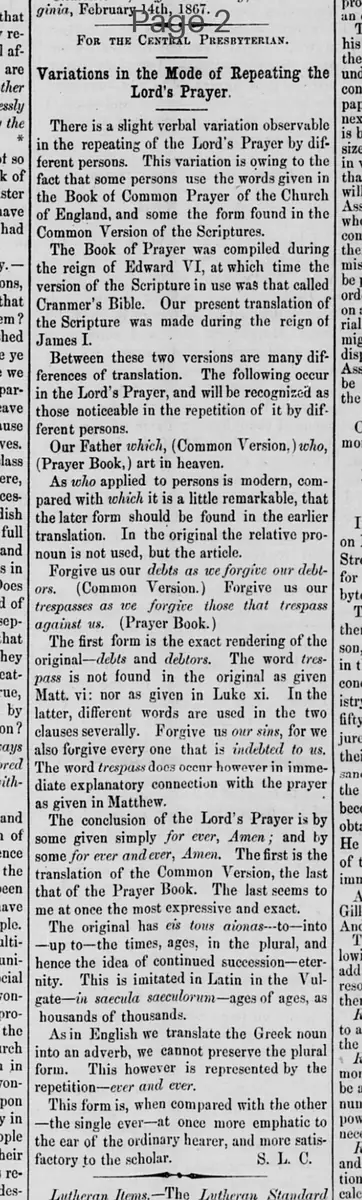
Variations in the Mode of Repeating the Lord's Prayer.
There is a slight verbal variation observable in the repeating of the Lord's Prayer by different persons. This variation is owing to the fact that some persons use the words given in the Book of Common Prayer of the Church of England, and some the form found in the Common Version of the Scriptures.
The Book of Prayer was compiled during the reign of Edward VI, at which time the version of the Scripture in use was that called Cranmer's Bible. Our present translation of the Scripture was made during the reign of James I.
Between these two versions are many differences of translation. The following occur in the Lord's Prayer, and will be recognized as those noticeable in the repetition of it by different persons.
Our Father which, (Common Version,) who, (Prayer Book,) art in heaven.
As who applied to persons is modern, compared with which it is a little remarkable, that the later form should be found in the earlier translation. In the original the relative pronoun is not used, but the article.
Forgive us our debts as we forgive our debtors. (Common Version.) Forgive us our trespasses as we forgive those that trespass against us. (Prayer Book.)
The first form is the exact rendering of the original—debts and debtors. The word trespass is not found in the original as given Matt. vi: nor as given in Luke xi. In the latter, different words are used in the two clauses severally. Forgive us our sins, for we also forgive every one that is indebted to us.
The word trespass does occur however in immediate explanatory connection with the prayer as given in Matthew.
The conclusion of the Lord's Prayer is by some given simply for ever, Amen; and by some for ever and ever, Amen. The first is the translation of the Common Version, the last that of the Prayer Book. The last seems to me at once the most expressive and exact.
The original has eis tous aionas—to—into—up to—the times, ages, in the plural, and hence the idea of continued succession—eternity. This is imitated in Latin in the Vulgate—in saecula saeculorum—ages of ages, as thousands of thousands.
As in English we translate the Greek noun into an adverb, we cannot preserve the plural form. This however is represented by the repetition—ever and ever.
This form is, when compared with the other—the single ever—at once more emphatic to the ear of the ordinary hearer, and more satisfactory to the scholar.
S. L. C.
There is a slight verbal variation observable in the repeating of the Lord's Prayer by different persons. This variation is owing to the fact that some persons use the words given in the Book of Common Prayer of the Church of England, and some the form found in the Common Version of the Scriptures.
The Book of Prayer was compiled during the reign of Edward VI, at which time the version of the Scripture in use was that called Cranmer's Bible. Our present translation of the Scripture was made during the reign of James I.
Between these two versions are many differences of translation. The following occur in the Lord's Prayer, and will be recognized as those noticeable in the repetition of it by different persons.
Our Father which, (Common Version,) who, (Prayer Book,) art in heaven.
As who applied to persons is modern, compared with which it is a little remarkable, that the later form should be found in the earlier translation. In the original the relative pronoun is not used, but the article.
Forgive us our debts as we forgive our debtors. (Common Version.) Forgive us our trespasses as we forgive those that trespass against us. (Prayer Book.)
The first form is the exact rendering of the original—debts and debtors. The word trespass is not found in the original as given Matt. vi: nor as given in Luke xi. In the latter, different words are used in the two clauses severally. Forgive us our sins, for we also forgive every one that is indebted to us.
The word trespass does occur however in immediate explanatory connection with the prayer as given in Matthew.
The conclusion of the Lord's Prayer is by some given simply for ever, Amen; and by some for ever and ever, Amen. The first is the translation of the Common Version, the last that of the Prayer Book. The last seems to me at once the most expressive and exact.
The original has eis tous aionas—to—into—up to—the times, ages, in the plural, and hence the idea of continued succession—eternity. This is imitated in Latin in the Vulgate—in saecula saeculorum—ages of ages, as thousands of thousands.
As in English we translate the Greek noun into an adverb, we cannot preserve the plural form. This however is represented by the repetition—ever and ever.
This form is, when compared with the other—the single ever—at once more emphatic to the ear of the ordinary hearer, and more satisfactory to the scholar.
S. L. C.
What sub-type of article is it?
Informative
Religious
Historical
What themes does it cover?
Religion
What keywords are associated?
Lord's Prayer
Book Of Common Prayer
Bible Translation
Cranmer's Bible
King James Version
Greek Original
Trespasses
Debts
Eternity
What entities or persons were involved?
S. L. C.
Letter to Editor Details
Author
S. L. C.
Main Argument
the letter explains variations in the lord's prayer due to differences between the book of common prayer and the common version of the scriptures, attributing them to historical bible translations, and prefers the prayer book's phrasing for accuracy and expressiveness.
Notable Details
References Cranmer's Bible (Edward Vi) And King James Version (James I)
Cites Original Greek 'Eis Tous Aionas' And Latin Vulgate 'In Saecula Saeculorum'
Discusses 'Debts' Vs. 'Trespasses' And Absence Of 'Trespass' In Original Greek Of Matthew Vi And Luke Xi