Thank you for visiting SNEWPapers!
Sign up free
Dallas Herald
Dallas, Dallas County, Texas
What is this article about?
Article on Hungarian Grass, actually German Millet, covers its history from seed obtained by a farmer from a Hungarian refugee, cultivation methods yielding 2-4 tons of grass and 20-40 bushels of seed per acre in Iowa and Indiana, and varying popularity across U.S. states, especially positive in Iowa but less so in Kentucky.
Clipping
OCR Quality
Full Text
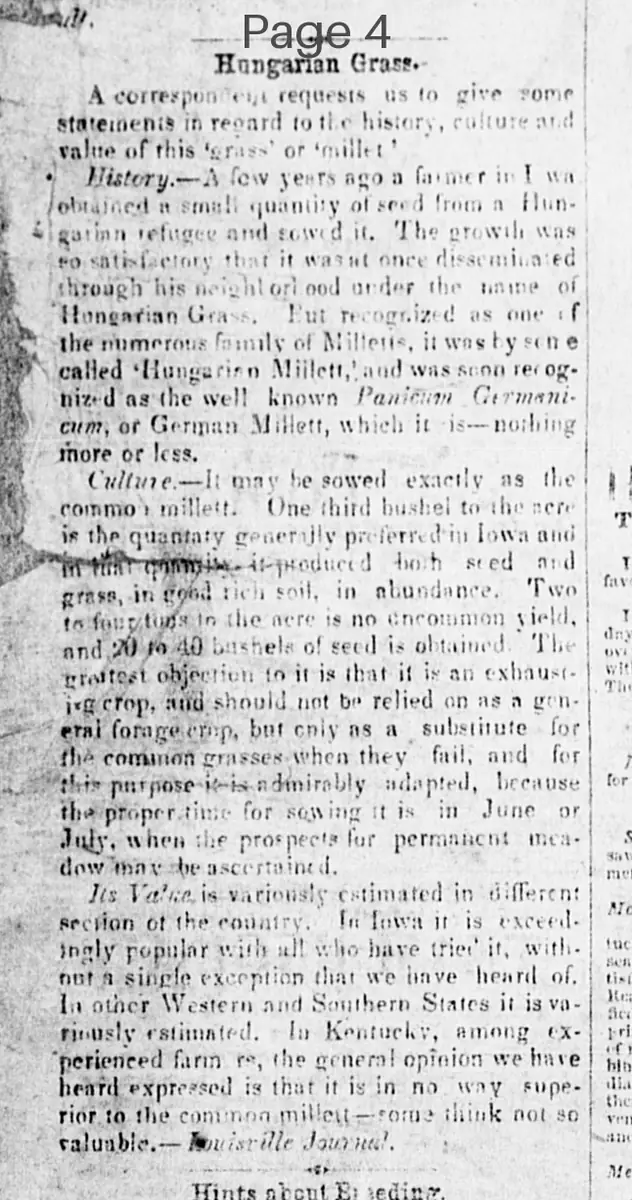
A correspondent requests us to give some statements in regard to the history, culture and value of this 'grass' or 'millet'
History.--A few years ago a farmer who had obtained a small quantity of seed from a Hungarian refugee and sowed it. The growth was so satisfactory that it was at once disseminated through his neighborhood under the name of Hungarian Grass. But, recognized as one of the numerous family of millets, it was by some called Hungarian Millet, and was soon recognized as the well known Panicum Germanicum, or German Millet, which it is--nothing more or less.
Culture--It may be sowed exactly as the common millet. One-third bushel to the acre is the quantity generally preferred in Iowa and Indiana--it produces both seed and grass, in good rich soil, in abundance. Two to four tons to the acre is no uncommon yield, and 20 to 40 bushels of seed is obtained. The greatest objection to it is that it is an exhausting crop, and should not be relied on as a general forage crop, but only as a substitute for the common grasses when they fail, and for this purpose it is admirably adapted, because the proper time for sowing it is in June or July, when the prospects for permanent meadow may be ascertained.
Its Value is variously estimated in different sections of the country. In Iowa it is exceedingly popular with all who have tried it, without a single exception that we have heard of. In other Western and Southern States it is variously estimated. In Kentucky, among experienced farmers, the general opinion we have heard expressed is that it is in no way superior to the common millet--some think not so valuable.--Louisville Journal.
What sub-type of article is it?
What themes does it cover?
What keywords are associated?
Where did it happen?
Story Details
Location
Iowa, Indiana, Kentucky, Western And Southern States
Event Date
A Few Years Ago
Story Details
Farmer obtains seed from Hungarian refugee, sows it, leading to dissemination as Hungarian Grass, identified as German Millet; cultivation yields abundant seed and grass but exhausts soil; valued as substitute forage, popular in Iowa but not superior to common millet in Kentucky.