Thank you for visiting SNEWPapers!
Sign up free
Letter to Editor
August 14, 1839
The Daily Herald
New Haven, New Haven County, Connecticut
What is this article about?
A letter praises Prof. Olmsted's lecture on the recent storm, explaining its phenomena and principles. The writer defends Mr. Espy's tornado theory, arguing that observed debris patterns are consistent when accounting for the storm's progressive motion.
Clipping
OCR Quality
95%
Excellent
Full Text
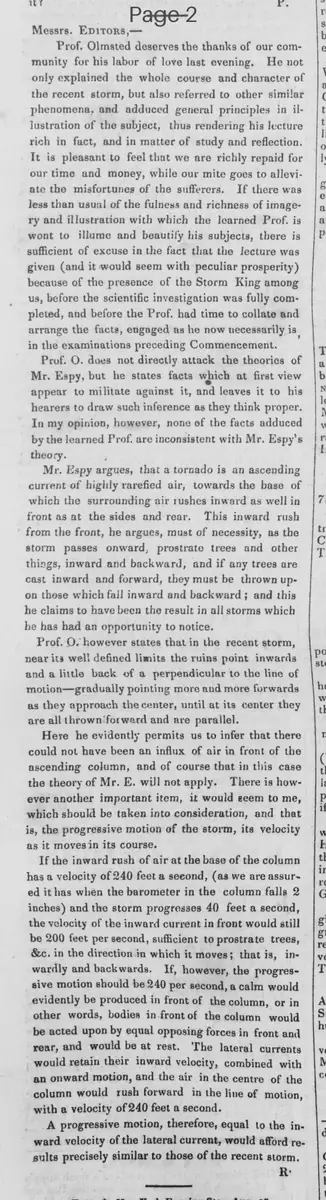
Messrs. Editors,
Prof. Olmsted deserves the thanks of our community for his labor of love last evening. He not only explained the whole course and character of the recent storm, but also referred to other similar phenomena, and adduced general principles in illustration of the subject, thus rendering his lecture rich in fact, and in matter of study and reflection.
It is pleasant to feel that we are richly repaid for our time and money, while our mite goes to alleviate the misfortunes of the sufferers. If there was less than usual of the fulness and richness of imagery and illustration with which the learned Prof. is wont to illume and beautify his subjects, there is sufficient of excuse in the fact that the lecture was given (and it would seem with peculiar prosperity) because of the presence of the Storm King among us, before the scientific investigation was fully completed, and before the Prof. had time to collate and arrange the facts, engaged as he now necessarily is in the examinations preceding Commencement.
Prof. O. does not directly attack the theories of Mr. Espy, but he states facts which at first view appear to militate against it, and leaves it to his hearers to draw such inference as they think proper. In my opinion, however, none of the facts adduced by the learned Prof. are inconsistent with Mr. Espy's theory.
Mr. Espy argues, that a tornado is an ascending current of highly rarefied air, towards the base of which the surrounding air rushes inward as well in front as at the sides and rear. This inward rush from the front, he argues, must of necessity, as the storm passes onward, prostrate trees and other things, inward and backward, and if any trees are cast inward and forward, they must be thrown upon those which fall inward and backward; and this he claims to have been the result in all storms which he has had an opportunity to notice.
Prof. O. however states that in the recent storm, near its well defined limits the ruins point inwards and a little back of a perpendicular to the line of motion—gradually pointing more and more forwards as they approach the center, until at its center they are all thrown forward and are parallel.
Here he evidently permits us to infer that there could not have been an influx of air in front of the ascending column, and of course that in this case the theory of Mr. E. will not apply. There is however another important item, it would seem to me, which should be taken into consideration, and that is, the progressive motion of the storm, its velocity as it moves in its course.
If the inward rush of air at the base of the column has a velocity of 240 feet a second, (as we are assured it has when the barometer in the column falls 2 inches) and the storm progresses 40 feet a second, the velocity of the inward current in front would still be 200 feet per second, sufficient to prostrate trees, &c. in the direction in which it moves; that is, inwardly and backwards. If, however, the progressive motion should be 240 per second, a calm would evidently be produced in front of the column, or in other words, bodies in front of the column would be acted upon by equal opposing forces in front and rear, and would be at rest. The lateral currents would retain their inward velocity, combined with an onward motion, and the air in the centre of the column would rush forward in the line of motion, with a velocity of 240 feet a second.
A progressive motion, therefore, equal to the inward velocity of the lateral current, would afford results precisely similar to those of the recent storm.
R.
Prof. Olmsted deserves the thanks of our community for his labor of love last evening. He not only explained the whole course and character of the recent storm, but also referred to other similar phenomena, and adduced general principles in illustration of the subject, thus rendering his lecture rich in fact, and in matter of study and reflection.
It is pleasant to feel that we are richly repaid for our time and money, while our mite goes to alleviate the misfortunes of the sufferers. If there was less than usual of the fulness and richness of imagery and illustration with which the learned Prof. is wont to illume and beautify his subjects, there is sufficient of excuse in the fact that the lecture was given (and it would seem with peculiar prosperity) because of the presence of the Storm King among us, before the scientific investigation was fully completed, and before the Prof. had time to collate and arrange the facts, engaged as he now necessarily is in the examinations preceding Commencement.
Prof. O. does not directly attack the theories of Mr. Espy, but he states facts which at first view appear to militate against it, and leaves it to his hearers to draw such inference as they think proper. In my opinion, however, none of the facts adduced by the learned Prof. are inconsistent with Mr. Espy's theory.
Mr. Espy argues, that a tornado is an ascending current of highly rarefied air, towards the base of which the surrounding air rushes inward as well in front as at the sides and rear. This inward rush from the front, he argues, must of necessity, as the storm passes onward, prostrate trees and other things, inward and backward, and if any trees are cast inward and forward, they must be thrown upon those which fall inward and backward; and this he claims to have been the result in all storms which he has had an opportunity to notice.
Prof. O. however states that in the recent storm, near its well defined limits the ruins point inwards and a little back of a perpendicular to the line of motion—gradually pointing more and more forwards as they approach the center, until at its center they are all thrown forward and are parallel.
Here he evidently permits us to infer that there could not have been an influx of air in front of the ascending column, and of course that in this case the theory of Mr. E. will not apply. There is however another important item, it would seem to me, which should be taken into consideration, and that is, the progressive motion of the storm, its velocity as it moves in its course.
If the inward rush of air at the base of the column has a velocity of 240 feet a second, (as we are assured it has when the barometer in the column falls 2 inches) and the storm progresses 40 feet a second, the velocity of the inward current in front would still be 200 feet per second, sufficient to prostrate trees, &c. in the direction in which it moves; that is, inwardly and backwards. If, however, the progressive motion should be 240 per second, a calm would evidently be produced in front of the column, or in other words, bodies in front of the column would be acted upon by equal opposing forces in front and rear, and would be at rest. The lateral currents would retain their inward velocity, combined with an onward motion, and the air in the centre of the column would rush forward in the line of motion, with a velocity of 240 feet a second.
A progressive motion, therefore, equal to the inward velocity of the lateral current, would afford results precisely similar to those of the recent storm.
R.
What sub-type of article is it?
Informative
Persuasive
What themes does it cover?
Science Nature
What keywords are associated?
Tornado Theory
Espys Theory
Prof Olmsted
Recent Storm
Ascending Current
Progressive Motion
Debris Patterns
Air Velocity
What entities or persons were involved?
R.
Messrs. Editors,
Letter to Editor Details
Author
R.
Recipient
Messrs. Editors,
Main Argument
the facts presented by prof. olmsted about the recent storm's debris patterns are consistent with mr. espy's tornado theory when considering the storm's progressive motion and velocity.
Notable Details
Prof. Olmsted's Lecture On Recent Storm
Reference To Mr. Espy's Ascending Current Theory
Debris Pointing Inwards And Forwards Near Storm Center
Velocities: 240 Feet Per Second Inward Rush, Progressive Motion Effects