Thank you for visiting SNEWPapers!
Sign up free
The National Intelligencer And Washington Advertiser
Washington, District Of Columbia
What is this article about?
Napoleon Bonaparte, First Consul of France, delivers a speech to the Council of State in Paris on June 20, critiquing internal administration, public opinion, military conscription, finances, and judicial independence, while outlining plans for reforms and a major journey.
Merged-components note: Introduction from Charleston Courier and full text of Bonaparte's speech to the Council of State, continued across multiple components on page 3 with sequential reading order and clear textual continuation.
Clipping
OCR Quality
Full Text
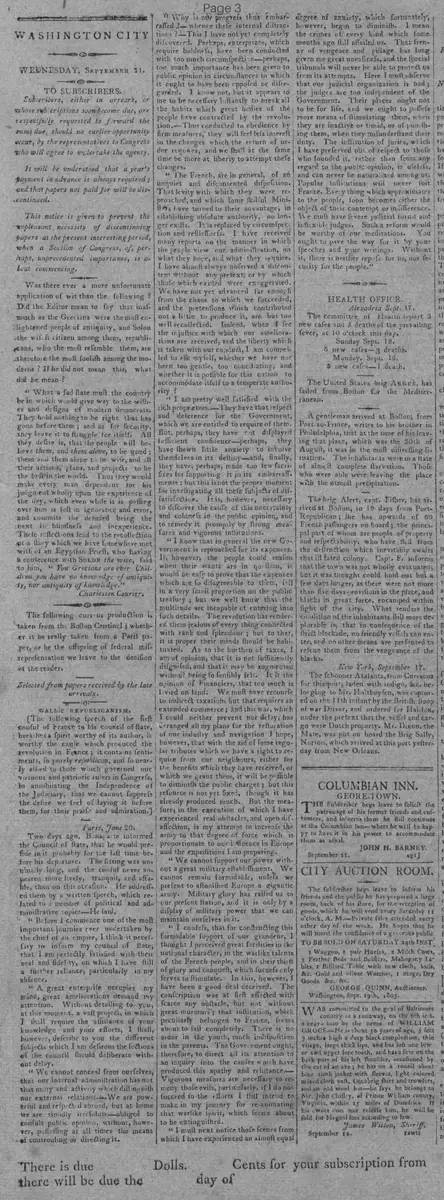
The following curious production is taken from the Boston Centinel; whether it be really taken from a Paris paper, or be the offspring of federal misrepresentation we leave to the decision of the reader.
Selected from papers received by the late arrivals.
GALLIC REPUBLICANISM
The following speech of the First Consul of France to his council of state, breathes a spirit worthy of its author, & worthy the cause which produced the revolution in France; it contains sentiments, so purely republican, and so nearly allied to those which governed our virtuous and patriotic rulers in Congress, in annihilating the Independence of the Judiciary, that we cannot suppress the desire we feel of laying it before them, for their praise and admiration.
Paris, June 20.
Two days ago, Bonaparte informed the Council of state, that he would preside in it probably for the last time before his departure. The sitting was unusually long, and the consul never appeared more lively, tranquil, and affable, than on this occasion. He addressed them by a written speech, which related to a number of political and administrative topics--He said,
"Before I commence one of the most important journeys ever undertaken by the chief of an empire, I think it necessary to inform my council of state that I am perfectly satisfied with their zeal and fidelity, on which I have still a further reliance, particularly in my absence.
"A great enterprise occupies my mind, great ameliorations demand my attention. Without detailing to you, at this moment, a vast project, in which I shall require the assistance of your knowledge and your efforts, I shall, however, describe to you the different subjects which I am desirous the sections of the council should deliberate without delay.
"We cannot conceal from ourselves that our internal administration has not that unity and activity which distinguish our external relations. We are powerful and respected abroad, but at home we are timid irresolute—obliged to consult public opinion, without, however, possessing at all times the means of controuling or directing it.
There is due to the nation why is our progress thus embarrassed—whence these internal distractions? This I have not yet completely discovered. Perhaps, enterprizes, which require boldness, have been conducted with too much circumspection—perhaps too much importance has been given to public opinion in circumstances in which it ought to have been opposed or disregarded. I know not, but it appears to me to be necessary instantly to break all the habits which great bodies of the people have contracted by the revolution. Thus conducted to obedience by firm measures, they will feel less interest in the changes which the return of order requires, and we shall at the same time be more at liberty to attempt these changes.
"The French are in general, of an unquiet and discontented disposition. That levity with which they were reproached, and which some skilful Ministers have turned to their advantage, in establishing absolute authority, no longer exists. It is replaced by circumspection and restlessness. I have received many reports on the manner in which the people view our administration, on what they hope, and what they require. I have almost always observed a discontent without any pretext, or by which those which existed were exaggerated. We have not yet advanced far enough from the chaos to which we succeeded, and the pretensions which contributed not a little to produce it, are but too well recollected. Indeed, when I see the injustice with which our ameliorations are received, and the liberty which is taken with our conduct, I am compelled to ask myself, whether we have not been too gentle, too conciliating, and whether it is possible for this nation to accommodate itself to a temperate authority?
I am pretty well satisfied with the rich proprietors.— They have that respect and deference for the Government, which we are entitled to require of them. But, perhaps, they have not displayed sufficient confidence perhaps, they have shewn little anxiety to involve themselves in its destiny and, finally, they have, perhaps, made too few sacrifices for supporting it in its embarrassments : but this is not the proper moment for investigating all these subjects of dissatisfaction. It is, however, necessary to discover the cause of this uncertainty and coldness in the public opinion, and to remedy it promptly by strong measures and vigorous institutions.
"I know that in general the new Government is reproached for its expences. If, however, the people could reason when their wants are in question, it would be easy to prove that the expences which are so disagreeable to them, fall in a very small proportion on the public treasury ; but we well know that the multitude are incapable of entering into such details. The revolution has rendered them jealous of every thing connected with rank and splendour ; but to that, it is proper their minds should be habituated. As to the burthen of taxes, I am of opinion, that it is not sufficiently disguised, and that it may be augmented without being so sensibly felt. It is the opinion of Financiers, that too much is levied on land: We must have recourse to indirect taxation, but that requires an extended commerce; and this war, which I could neither prevent nor delay, has deranged all my plans for the restoration of our industry and navigation I hope, however, that with the aid of some regular tributes which we have a right to require from our neighbours, either for the benefits which they have received, or which we grant them, it will be possible to diminish the public charges ; but this resource is not yet fixed, though it has already produced much. But the measure, in the execution of which I have experienced real obstacles, and open disaffection, is my attempt to increase the army to that degree of force which is proportionate to our influence in Europe and the expeditions I am preparing.
"We cannot support our power without a great military establishment. We cannot remain formidable, unless we present to astonished Europe a gigantic army. Military glory has raised us to our present station, and it is only by a display of military power that we can maintain ourselves in it.
"I confess, that for constructing this formidable support of our grandeur, I thought I perceived great facilities in the national character, in the warlike talents of the French people, and in their thirst of glory and conquest, which success only serves to stimulate. In this, however, I have been a good deal deceived. The conscription was at first effected with scarce any obstacle, but not without great murmurs; that institution, which peculiarly belonged to France, seems about to fail completely. There is no ardor in the youth, much indisposition in the parents. The Government ought, therefore, to direct all its attention to an inquiry into the causes which have produced this apathy and resistance.— Vigorous measures are necessary to remedy those evils, particularly, if I do not succeed in the efforts I still intend to make in my journey for re-animating that warlike spirit, which seems about to be extinguished.
"I must next notice those scenes from degree of anxiety, which fortunately, however, begin to diminish. I mean the crimes of every kind which some months ago still assailed us. That frenzy of vengeance and pillage has long given me great uneasiness, and the special tribunals will never be able to protect us from its attempts. Here I must observe that our judicial organization is bad ; the judges are too independent of the Government. Their places ought not to be for life, and we ought to possess more means of stimulating them, when they are inactive or timid, or of punishing them, when they misunderstand their duty. The institution of juries, which I have preserved out of respect to those who founded it, rather than from any regard to the public opinion, is useless, and can never be naturalized among us: Popular institutions will never suit France. Every thing which approximates to the people, soon becomes either the object of their contempt or indifference. We must have severe judicial forms and inflexible judges. Such a reform would be worthy of our meditations. You ought to pave the way for it by your speeches and your writings. Without it, there is neither repose for us, nor security for the people."
What sub-type of article is it?
What keywords are associated?
What entities or persons were involved?
Where did it happen?
Foreign News Details
Primary Location
Paris
Event Date
June 20
Key Persons
Event Details
Bonaparte addresses the Council of State, expressing satisfaction with their zeal, outlining a major journey and project, critiquing internal administration's timidity and over-reliance on public opinion, calling for firm measures to break revolutionary habits, noting French discontent and need for stronger control, praising rich proprietors but urging more support, addressing government expenses and taxes, emphasizing need for a large army despite conscription resistance, and advocating judicial reforms to reduce independence of judges and juries.