Thank you for visiting SNEWPapers!
Sign up free
Morning Herald
New York, New York County, New York
What is this article about?
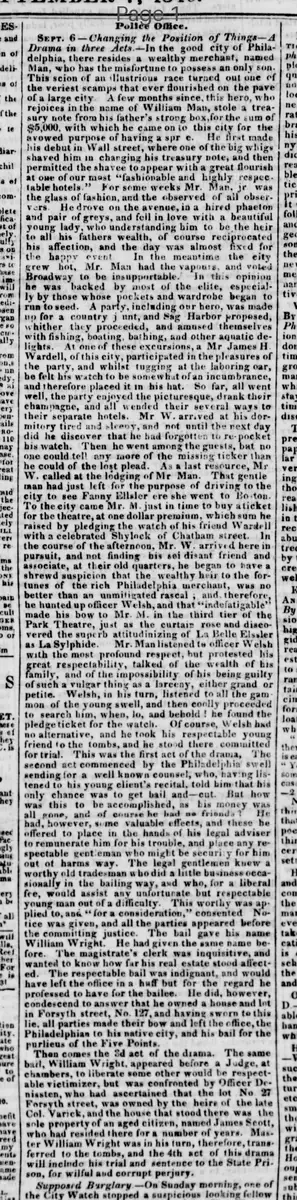
A dramatic account of Philadelphia youth William Mann's theft of $5,000 from his father, his spree in New York, theft and pawning of James H. Wardell's watch, arrest by officer Welsh, and the subsequent arrest of bail William Wright for perjury, reported from the Police Office on Sept. 6.
Clipping
OCR Quality
Full Text
Sept. 6—Changing the Position of Things—A
Drama in three Acts.—In the good city of Phila-
delphia, there resides a wealthy merchant, named
Mann, who has the misfortune to possess an only son.
This scion of an illustrious race turned out one of
the veriest scamps that ever flourished on the pave-
ment of a large city. A few months since, this hero, who
rejoices in the name of William Mann, stole a trea-
sury note from his father's strong box, for the sum of
$5,000, with which he came on to this city for the
avowed purpose of having a spree. He first made
his debut in Wall street, where one of the big whigs
shaved him in charging his treasury note, and then
permitted the shavee to appear with a great flourish
at one of our most "fashionable and highly respec-
table hotels." For some weeks Mr. Mann, jr. was
the glass of fashion, and the observed of all obser-
vers. He drove on the avenue, in a hired phaeton
and pair of greys, and fell in love with a beautiful
young lady, who understanding him to be the heir
to all his father's wealth, of course reciprocated
his affection, and the day was almost fixed for
the happy event
In the meantime the city
grew hot, Mr. Mann had the vapours, and voted
Broadway to be insupportable. In this opinion
he was backed by most of the elite, especial-
ly by those whose pockets and wardrobe began to
run to seed. A party, including our hero, was made
up for a country jaunt, and Sag Harbor proposed,
whither they proceeded, and amused themselves
with fishing, boating, bathing, and other aquatic de-
lights. At one of these excursions, a Mr. James H.
Wardell, of this city, participated in the pleasures of
the party, and whilst tugging at the laboring oar,
he felt his watch to be somewhat of an incumbrance,
and therefore placed it in his hat. So far, all went
well, the party enjoyed the picturesque, drank their
champagne, and all wended their several ways to
their separate hotels. Mr. W. arrived at his dor-
mitory tired and sleepy, and not until the next day
did he discover that he had forgotten to re-pocket
his watch. Then he went among the guests, but no
one could tell any more of the missing ticker than
he could of the lost plead. As a last resource, Mr.
W. called at the lodging of Mr. Mann. That gentle-
man had just left for the purpose of driving to the
city to see Fanny Elssler ere she went to Boston.
To the city came Mr. M. just in time to buy a ticket
for the theatre, at one dollar premium, which sum he
raised by pledging the watch of his friend Wardell
with a celebrated Shylock of Chatham street. In
the course of the afternoon, Mr. W. arrived here in
pursuit, and not finding his soi disant friend and
associate, at their old quarters, he began to have a
shrewd suspicion that the wealthy heir to the for-
tunes of the rich Philadelphia merchant, was no
better than an unmitigated rascal; and, therefore,
he hunted up officer Welsh, and that "indefatigable"
made his bow to Mr. M. in the third tier of the
Park Theatre, just as the curtain rose and disco-
vered the superb attitudinizing of La Belle Elssler
as La Sylphide. Mr. Mann listened to officer Welsh
with the most profound respect, but protested his
great respectability, talked of the wealth of his
family, and of the impossibility of his being guilty
of such a vulgar thing as a larceny, either grand or
petite. Welsh, in his turn, listened to all the gam-
mon of the young swell, and then coolly proceeded
to search him, when, lo, and behold! he found the
pledge ticket for the watch. Of course, Welsh had
no alternative, and he took his respectable young
friend to the tombs, and he stood there committed
for trial. This was the first act of the drama, The
second act commenced by the Philadelphia swell
sending for a well known counsel, who, having lis-
tened to his young client's recital, told him that his
only chance was to get bail and—cut. But how
was this to be accomplished, as his money was
all gone, and of course he had no friends? He
had, however, some valuable effects, and these he
offered to place in the hands of his legal adviser
to remunerate him for his trouble, and place any re-
spectable gentleman who might be security for him
out of harm's way. The legal gentleman knew a
worthy old tradesman who did a little business occa-
sionally in the bailing way, and who, for a liberal
fee, would assist any unfortunate but respectable
young man out of a difficulty. This worthy was ap-
plied to, and "for a consideration," consented. No-
tice was given, and all the parties appeared before
the committing justice. The bail gave his name
William Wright. He had given the same name be-
fore. The magistrate's clerk was inquisitive, and
wanted to know how far his real estate stood afect-
ed. The respectable bail was indignant, and would
have left the office in a huff but for the regard he
professed to have for the bailee. He did, however,
condescend to answer that he owned a house and lot
in Forsyth street, No. 127, and having sworn to this
lie, all parties made their bow and left the office, the
Philadelphian to his native city, and his bail for the
purlieus of the Five Points.
Then comes the 3d act of the drama. The same
bail, William Wright, appeared before a Judge, at
chambers, to liberate some other would be respect-
able victimizer, but was confronted by Officer De-
nissten, who had ascertained that the lot No. 127
Forsyth street, was owned by the heirs of the late
Col. Varick, and the house that stood there was the
sole property of an aged citizen, named James Scott,
who had resided there for a number of years. Mas-
ter William Wright was in his turn, therefore, trans-
ferred to the tombs, and the 4th act of this drama
will include his trial and sentence to the State Pri-
son, for wilful and corrupt perjury.
What sub-type of article is it?
What keywords are associated?
What entities or persons were involved?
Where did it happen?
Domestic News Details
Primary Location
New York
Event Date
Sept. 6
Key Persons
Outcome
william mann committed for trial on larceny charge; william wright arrested and to be tried for perjury.
Event Details
William Mann, son of a Philadelphia merchant, stole $5,000 and spent it on a spree in New York, including socializing and a trip to Sag Harbor. There, he stole James H. Wardell's watch while boating, pawned it to buy theater tickets, and was arrested by officer Welsh at the Park Theatre. Mann secured bail from William Wright, who falsely claimed property ownership under oath. Wright was later exposed by officer Dennissten and arrested for perjury.