Thank you for visiting SNEWPapers!
Sign up free
National Gazette
Philadelphia, Philadelphia County, Pennsylvania
What is this article about?
An editorial in the National Gazette urges state legislatures to appoint official shorthand writers to accurately record and publish U.S. congressional debates, criticizing current unreliable reporting methods and warning of potential corruption, while emphasizing benefits for public information, historical preservation, and federal unity. Dated Philadelphia, March 24, 1792.
Merged-components note: Continuation of the editorial 'MODE HINT TO THE STATE LEGISLATURES' across pages 2 and 3, maintaining coherent topic on publishing debates.
Clippings
1 of 2
OCR Quality
Full Text
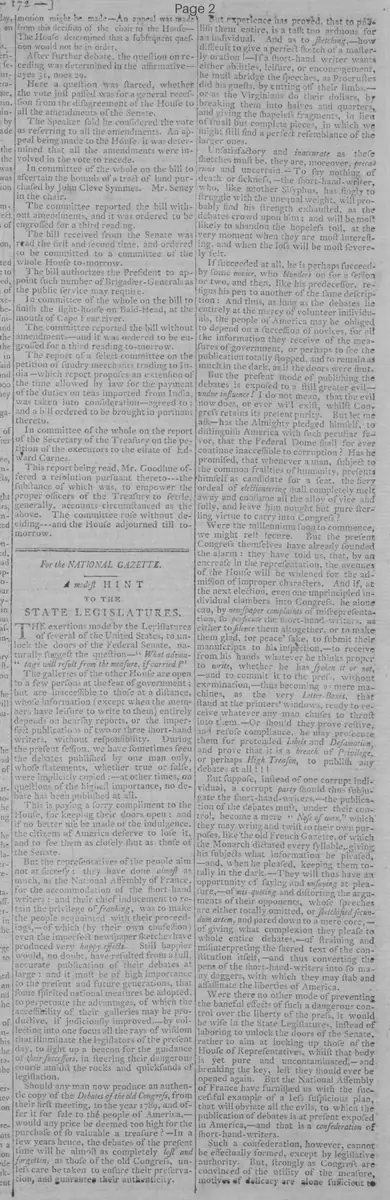
MODE HINT
TO THE
STATE LEGISLATURES.
THE exertions made by the Legislatures of several of the United States, to unlock the doors of the Federal Senate, naturally suggest the question—"What advantage will result from the measure, if carried?"
The galleries of the other House are open to a few persons at the seat of government; but are inaccessible to those at a distance, whose information (except when the members have leisure to write to them) entirely depends on hearsay reports, or the imperfect publications of two or three short-hand writers, without responsibility. During the present session, we have sometimes seen the debates published by one man only, whose statements, whether true or false, were implicitly copied:—at other times, on questions of the highest importance, no debate has been published at all.
This is paying a sorry compliment to the House, for keeping their doors open: and if no better use be made of the indulgence, the citizens of America deserve to lose it, and to see them as closely shut as those of the Senate.
But the representatives of the people aim not at secrecy: they have done almost as much, as the National Assembly of France, for the accommodation of the short hand writers: and their chief inducement to retain the privilege of franking, was to make the people acquainted with their proceedings,—of which (by their own confession) even the imperfect newspaper sketches have produced very happy effects. Still happier would, no doubt, have resulted from a full, accurate publication of their debates at large: and it must be of high importance to the present and future generations, that some spirited national measures be adopted, to perpetuate the advantages, of which the accessibility of their galleries may be productive, if judiciously improved,—by collecting into one focus all the rays of wisdom that illuminate the legislators of the present day, to light up a beacon for the guidance of their successors, in steering their dangerous course amidst the rocks and quicksands of legislation.
Should any man now produce an authentic copy of the Debates of the old Congress, from their first meeting, to the year 1789, and offer it for sale to the people of America,—would any price be deemed too high for the purchase of so valuable a treasure?—In a few years hence, the debates of the present time will be almost as completely lost and forgotten, as those of the old Congress, unless care be taken to ensure their preservation, and guarantee their authenticity.
But experience has proved, that to publish them entire, is a task too arduous for an individual. And as to sketching,—how difficult to give a perfect sketch of a masterly oration!—If a short-hand writer wants either abilities, leisure, or encouragement, he must abridge the speeches, as Procrustes did his guests, by cutting off their limbs;—or as the Virginians do their dollars, by breaking them into halves and quarters, and giving the shapeless fragments, in lieu of small but complete pieces, in which we might still find a perfect resemblance of the larger ones.
Unsatisfactory and inaccurate as these sketches must be, they are, moreover, precarious and uncertain.—To say nothing of death or sickness,—the short-hand-writer, who, like another Sisyphus, has singly to struggle with the unequal weight, will probably find his strength exhausted, as the debates crowd upon him: and will be most likely to abandon the hopeless toil, at the very moment when they are most interesting, and when the loss will be most severely felt.
If succeeded at all, he is perhaps succeeded by some novice, who blunders on for a session or two, and then, like his predecessor, resigns his pen to another of the same description: And thus, as long as the debates lie entirely at the mercy of volunteer individuals, the people of America may be obliged to depend on a succession of novices, for all the information they receive of the measures of government, or perhaps to see the publication totally stopped, and to remain as much in the dark, as if the doors were shut.
But the present mode of publishing the debates is exposed to a still greater evil—undue influence! I do not mean, that the evil now does, or ever will exist, whilst Congress retains its present purity. But let me ask—has the Almighty pledged himself, to distinguish America with such peculiar favor, that the Federal Dome shall for ever continue inaccessible to corruption? Has he promised, that whenever a man, subject to the common frailties of humanity, presents himself as candidate for a seat, the fiery ordeal of electioneering shall completely melt away and consume all the alloy of vice and folly, and leave him nought but pure sterling virtue to carry into Congress?
Were the millennium soon to commence, we might rest secure. But the present Congress themselves have already sounded the alarm: they have told us, that, by an increase in the representation, the avenues of the House will be widened for the admission of improper characters. And if, at the next election, even one unprincipled individual clambers into Congress, he alone can, by newspaper complaints of misrepresentation, so persecute the short-hand-writers, as either to silence them altogether, or to make them glad, for peace's sake, to submit their manuscripts to his inspection,—to receive from his hands whatever he thinks proper to write, whether he has spoken it or not,—and to commit it to the press, without examination,—thus becoming as mere machines, as the very Letter-Boxes, that stand at the printers' windows, ready to receive whatever any man chooses to thrust into them.—Or should they prove restive, and refuse compliance, he may prosecute them for pretended Libels and Defamation, and prove that it is a breach of Privilege, or perhaps High Treason, to publish any debates at all!!!
But suppose, instead of one corrupt individual, a corrupt party should thus subjugate the short-hand-writers,—the publication of the debates must, under their control, become a mere "nose of wax," which they may wring and twist to their own purposes, like the old French Gazette, of which the Monarch dictated every syllable, giving his subjects what information he pleased,—and, when he pleased, keeping them totally in the dark.—They will thus have an opportunity of saying and unsaying at pleasure, of mis-quoting and distorting the arguments of their opponents, whose speeches are either totally omitted, or sketchified secundum artem, and pared down to a mere core,—of giving what complexion they please to whole entire debates,—of straining and misinterpreting the sacred text of the constitution itself,—and thus converting the pens of the short-hand-writers into so many daggers, with which they may stab and assassinate the liberties of America.
Were there no other mode of preventing the baneful effects of such a dangerous control over the liberty of the press, it would be wise in the State Legislatures, instead of laboring to unlock the doors of the Senate, rather to aim at locking up those of the House of Representatives, whilst that body is yet pure and uncontaminated,—and breaking the key, lest they should ever be opened again. But the National Assembly of France have furnished us with the successful example of a less suspicious plan, that will obviate all the evils, to which the publication of debates is at present exposed in America,—and that is a confederation of short-hand-writers.
Such a confederation, however, cannot be effectually formed, except by legislative authority. But, strongly as Congress are convinced of the utility of the measure, motives of delicacy are alone sufficient to
prevent any alive interference on their part. In permitting the short-hand-writers to choose the most convenient stations on the floor of the House, they have perhaps done as much, as could with propriety be expected of them. It remains with the State Legislatures to do the rest, and to step forward to the relief of America, who stands eyeing the fair and not forbidden fruit of the tree of knowledge,—but, like Tantalus, unable to taste, unless some intermediate hand be stretched forth, to pluck it, before it vanish from her sight.
How easy for the legislature of each state to appoint a person for the purpose!—The joint labors of fifteen short-hand-writers cannot fail to do ample justice to the most interesting debate:—there will then be no complaints of misrepresentation,—no danger of interruption:—un-influenced by smiles or frowns, these men will boldly publish the truth—attest it under their hand,—and, thus authenticated, stamp it with the seal of immortality.
Nor will any difficulty arise from the present scarcity of short-hand-writers.—Men of talents and integrity abound in every state of the Union: and if, within any reasonable time, even three or four States appoint men of this description,—though now unacquainted with short-hand, they may, before the next meeting of Congress, acquire sufficient skill in the art, to publish the debate of the ensuing session, if not with unerring accuracy, at least with a degree of correctness hitherto un-attained in America,—especially if they be careful to adopt the same system of writing.—an uniformity in that particular, being essentially necessary for men, who are to act in concert, and must frequently consult each other's notes.
Their publications may be forwarded by every post, to every member of every state Legislature in the Union, and by them soon communicated to their constituents:—and thus the wisdom of our Representatives, no longer eclipsed by short-hand misrepresentation, will dart its rays to the remotest bounds of America, dispelling every where the clouds of discontent and jealousy, enlightening the great body of the people with political knowledge, and warming every bosom with federal affection, and confidence in the general government.
"These things ought ye to have done, and not to leave the other undone."
ABOVE-BOARD.
Philadelphia, March 24, 1792.
What sub-type of article is it?
What keywords are associated?
What entities or persons were involved?
Editorial Details
Primary Topic
Proposal For State Appointed Shorthand Writers To Record Congressional Debates
Stance / Tone
Strong Advocacy For Government Transparency And Accurate Debate Publication
Key Figures
Key Arguments