Thank you for visiting SNEWPapers!
Sign up free
American Republican And Baltimore Daily Clipper
Baltimore, Maryland
What is this article about?
Steamship Caledonia arrived in Boston with European news to November 19, 1845, detailing declines in cotton and grain markets, fighting in Portugal where Queen's adherents routed insurgents with 1000 casualties, Ireland's deplorable state, diplomatic activities, and ship news.
Merged-components note: Duplicate/continued foreign news article across pages; merge into single component.
Clippings
1 of 2
OCR Quality
Full Text
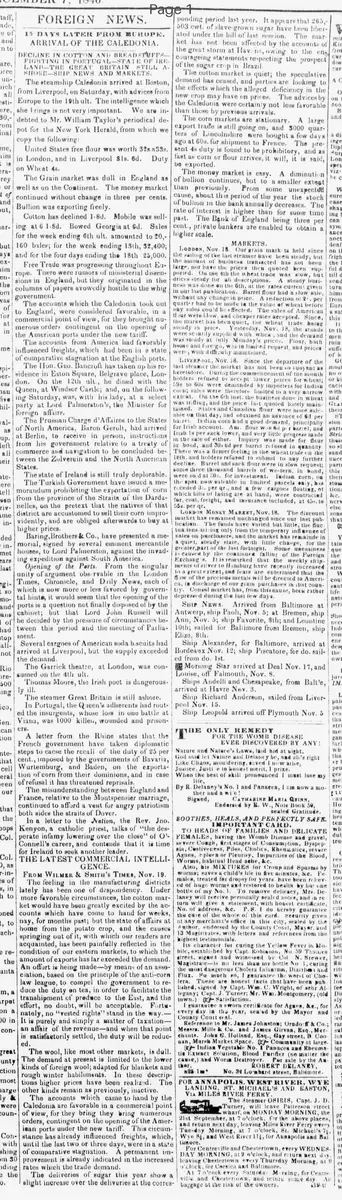
15 DAYS LATER FROM EUROPE.
ARRIVAL OF THE CALEDONIA.
DECLINE IN COTTON AND BREADSTUFFS—FIGHTING IN PORTUGAL—STATE OF IRELAND—THE GREAT BRITAIN STILL ASHORE—SHIP NEWS AND MARKETS.
The steamship Caledonia arrived at Boston, from Liverpool, on Saturday, with advices from Europe to the 19th ult. The intelligence which she brings is not very important. We are indebted to Mr. William Taylor's periodical depot for the New York Herald, from which we copy the following:
United States free flour was worth 32s. to 33s. in London, and in Liverpool 31s. 6d. Duty on Wheat 4s.
The Grain market was dull in England as well as on the Continent. The money market continued without change in three per cents. Bullion was exporting freely.
Cotton has declined 1-8d. Mobile was selling at 6 1-8d. Bowed Georgia at 6d. Sales for the week ending 6th ult. amounted to 20,160 bales; for the week ending 13th, 32,400; and for the four days ending the 18th 25,000.
Free Trade was progressing throughout Europe. There were rumors of ministerial dissensions in England, but they originated in the columns of papers avowedly hostile to the whig government.
The accounts which the Caledonia took out to England, were considered favorable, in a commercial point of view, for they brought numerous orders contingent on the opening of the American ports under the new tariff.
The accounts from America had favorably influenced freights, which had been in a state of comparative stagnation at the English ports.
The Hon. Geo. Bancroft has taken up his residence in Eaton Square, Belgrave place, London. On the 12th ult., he dined with the Queen, at Windsor Castle; and, on the following Saturday, was, with his lady, at a select party at Lord Palmerston's, the Minister for foreign affairs.
The Prussian Charge d'Affaires to the States of North America, Baron Gerolt, had arrived at Berlin, to receive in person, instructions from his government relative to a treaty of commerce and navigation to be concluded between the Zollverein and the North American States.
The state of Ireland is still truly deplorable.
The Turkish Government have issued a memorandum prohibiting the exportation of corn from the province of the Straits of the Dardanelles, on the pretext that the natives of that district are accustomed to sell their corn improvidently, and are obliged afterwards to buy at higher prices.
Baring, Brothers & Co., have presented a memorial, signed by several eminent mercantile houses, to Lord Palmerston, against the invading expedition against South America.
Opening of the Ports. From the singular unity of argument observable in the London Times, Chronicle, and Daily News, each of which is now more or less favored by governmental hint, it would seem that the opening of the ports is a question not finally disposed of by the cabinet; but that Lord John Russell will be decided by the pressure of circumstances between this period and the meeting of Parliament.
Several cargoes of American soda biscuits had arrived at Liverpool, but the supply exceeded the demand.
The Garrick theatre, at London, was consumed on the 4th ult.
Thomas Moore, the Irish poet is dangerously ill.
The steamer Great Britain is still ashore.
In Portugal, the Queen's adherents had routed the insurgents, whose loss in one battle at Viana, was 1000 killed, wounded and prisoners.
A letter from the Rhine states that the French government have taken diplomatic steps to cause the recall of the duty of 25 per cent., imposed by the governments of Bavaria, Wurtemburg, and Baden, on the exportation of corn from their dominions, and in case of refusal it has threatened reprisals.
The misunderstanding between England and France, relative to the Montpensier marriage, continued to afford a vent for angry patriotism both sides the straits of Dover.
In a letter to the Nation, the Rev. Jno. Kenyon, a catholic priest, talks of "the desperate infamy lowering over the close" of O'Connell's career, and contends that it is time for Ireland to seek another leader.
THE LATEST COMMERCIAL INTELLIGENCE.
From Wilmer & Smith's Times, Nov. 19,
The feeling in the manufacturing districts lately has been one of despondency. Under more favorable circumstances, the cotton market would have been greatly excited by the accounts which have come to hand for weeks—nay, for months past; but the state of affairs at home from the potato crop, and the causes springing out of it, with which our readers are acquainted, has been painfully reflected in the condition of our eastern markets, to which the amount of exports has far exceeded the demand.
An effort is being made—by means of an association, based on the principle of the anti-corn law league, to compel the government to reduce the duty on tea, in order to facilitate the transhipment of produce to the East, and the effort, no doubt, will be acceptable. Fortunately, no "vested rights" stand in the way.— It is purely and simply a matter of taxation— an affair of the revenue—and when that point is satisfactorily settled, the duty will be reduced.
The wool, like most other markets, is dull. The demand at present is limited to the lower kinds of foreign wool; adapted for blankets and rough winter habiliments. In these descriptions higher prices have been realized. The other kinds remain as previously, inactive.
The accounts which came to hand by the Caledonia are favorable in a commercial point of view, for they bring numerous orders, contingent on the opening of the American ports under the new tariff. This circumstance has already influenced freights, which, until the last two or three days, were in a state of comparative stagnation. A permanent improvement is already indicated in the increased rates which the trade demand.
The deliveries of sugar this year show a slight increase over the deliveries at the corresponding period last year. It appears that 265,503 cwt. of slave-grown sugar have been liberated under the bill of last session. The market has not been affected by the accounts of the great storm at Havana, owing to the encouraging statements respecting the prospect of the sugar crop in Brazil.
The cotton market is quiet; the speculative demand has ceased, and parties are looking to the effects which the alleged deficiency in the new crop may have on prices. The advices by the Caledonia were certainly not less favorable than those by previous arrivals.
The corn markets are stationary. A large export trade is still going on, and 5000 quarters of Lincolnshire were bought a few days ago at 60s. for shipment to France. The present 4s duty is found to be prohibitory, and as fast as corn or flour arrives, it will, it is said, be exported.
The money market is easy. A diminution of bullion continues, but to a smaller extent than previously.
From some unexpected cause, about this period of the year the stock of bullion in the bank annually decreases. The rate of interest is higher than for some time past. The Bank of England being three per cent., private bankers are enabled to obtain a higher scale.
MARKETS.
London, Nov. 18. Our grain markets held since the sailing of the last steamer have been steady, but the amount of business transacted has not been large, nor have the prices then quoted been supported. On the 4th the wheat trade was slow, but prices steady for all descriptions. A steady business was done on the 6th, at the rates current given in our last publication. Barrel flour had a slow sale without any change in price. A reduction of 2d. per quarter had to be made in the value of wheat before any sales could be effected. The sales of American flour were low, and cheaper rates accepted. Since, the market has been quiet, the wheat trade being steady in price. Yesterday, Nov. 18, the stands were scantily supplied with wheat, and the demand was steady at fully Monday's prices. Flour, both home and foreign, was in limited request and prices were, with difficulty maintained.
Liverpool, Nov. 18. Since the departure of the last steamer the market has not been so buoyant as heretofore. During the commencement of the month holders refused to accept lower prices for wheat; 59s to 60s were demanded by importers for Indian corn; sales were therefore limited to a very narrow extent. On the 6th inst. the business done in wheat was trifling, and the price last quoted barely maintained. States and Canadian flour were more saleable on that day, and obtained an advance of 6d per barrel. Indian corn had a good demand, principally for Irish account. Am. flour was 6d per barrel, and Irish 1s per sack lower, and very little progress made in the sale of either. Inquiry was made for flour in bond, and 30s 6d per barrel refused in quantity. There was a firmer feeling in the wheat trade on the 18th, and holders refused to submit to any further decline. Barrel and sack flour were in slow request; some three thousand barrels of western, in bond, were sold at 30s. for investment. Indian corn, on the spot, new saleable in limited parcels only, has receded 3d. per qr., and a few cargoes floating, of which bills of lading are at hand, were contracted for, cost, freight, and insurance included, at 45s. to 55s. per qr.
LONDON Money MARKET, Nov. 18. The discount market has remained unchanged since our last publication. The funds have varied but little, the fluctuations arising only from the temporary influence of sales on purchasers, and the market has remained in a quiet, steady state, with little change, for the greater part of the last fortnight. Some uneasiness is caused by the continued falling of the Foreign Exchanges. It is remarked that the weekly shipments of silver to Hamburg have recently increased to a greater extent, and fears are entertained that the flow of the precious metals will be directed to America, in discharge of our grain purchases in that country. Consol market has, from this cause, been rather depressed during the last few days.
SHIP NEWS. Arrived from Baltimore at Antwerp, ship Paoli, Nov. 5; at Bremen, ship Ann, Nov. 5; ship Favorite, 5th; and Leontine 10th; sailed for Baltimore from Bremen, ship Elize, 5th.
Ship Alexander, for Baltimore, arrived at Bordeaux Nov. 12; ship Piscatore, for do. sailed from do. 1st.
Morning Star arrived at Deal Nov. 17, and Louise, off Falmouth, Nov. 8.
Ships Andelli and Chesapeake, from Balt'e, arrived at Havre Nov. 3.
Ship Richard Anderson, sailed from Liverpool Nov. 15.
Ship Leopold arrived off Plymouth Nov. 5.
What sub-type of article is it?
What keywords are associated?
What entities or persons were involved?
Where did it happen?
Foreign News Details
Primary Location
Europe
Event Date
To The 19th Ult.
Key Persons
Outcome
in portugal, the queen's adherents routed the insurgents, whose loss in one battle at viana was 1000 killed, wounded and prisoners.
Event Details
The steamship Caledonia brought advices from Europe to November 19, reporting dull grain and declining cotton markets, progressing free trade, diplomatic activities including Bancroft dining with the Queen and Gerolt seeking treaty instructions, deplorable state in Ireland, Turkish prohibition on corn export, memorial against South American expedition, debates on port openings, theater fire in London, Moore's illness, Great Britain still ashore, Portuguese royalist victory, French diplomatic steps on German corn duties, Anglo-French tensions over Montpensier marriage, and criticism of O'Connell. Commercial intelligence detailed despondency in manufacturing, efforts to reduce tea duty, dull wool market, favorable American orders influencing freights, sugar deliveries, quiet cotton, stationary corn with exports, easy money market. Markets in London and Liverpool showed steady but slow grain and flour trades with minor price adjustments. Ship news included arrivals and sailings to/from various ports.