Thank you for visiting SNEWPapers!
Sign up free
Literary
March 20, 1913
Semi Weekly Herald
Durango, La Plata County, Colorado
What is this article about?
An essay reviewing historical events in years ending with 13 from 413 BC to 1813 AD, questioning if such years are unlucky, amid wars, conquests, and political changes, with a brief reflection on Turkey's troubles and appended railroad construction news.
Merged-components note: Continuation of the historical article on years ending in thirteen.
Clipping
OCR Quality
78%
Good
Full Text
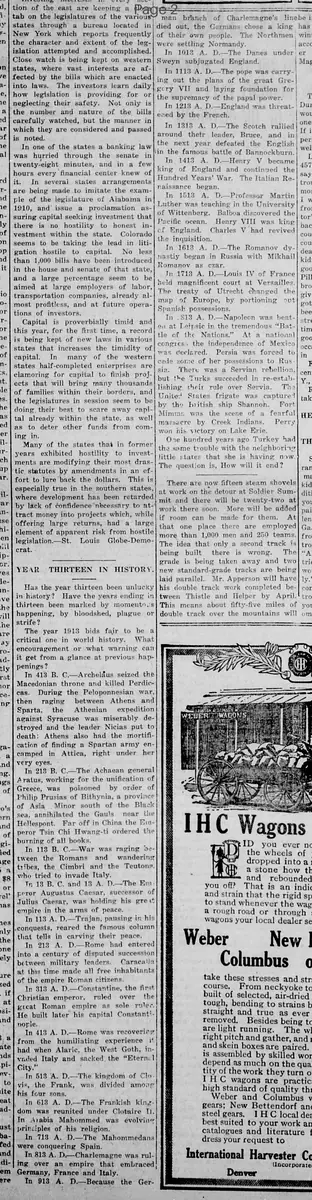
YEAR THIRTEEN IN HISTORY
Has the year thirteen been unlucky
in history? Have the years ending in
thirteen been marked by moments
happening, by bloodshed, plague or
strife?
The year 1913 bids fair to be a
critical one in world history. What
encouragement or what warning can
it get from a glance at previous hap-
penings?
In 413 B. C.-Archelaus seized the
Macedonian throne and killed Perdic-
cas. During the Peloponnesian war.
then raging between Athens and
Sparta, the Athenian expedition
against Syracuse was miserably de-
stroved and the leader Nicias put to
death: Athens also had the mortifi-
cation of finding a Spartan army en-
camped in Attica. right under her
very eyes.
In 213 B. C.—The Achaean general
Aratus, working for the unification of
Greece, was poisoned by order of
Philip Prusias of Bithynia. a province
of Asia Minor south of the Black
sea. annihilated the Gauls near the
Hellespont. Far off in China the Em-
peror Tsin Chi Hwang-ti ordered the
burning of all books.
In 113 B. C.--War was raging be-
tween the Romans and wandering
tribes. the Cimbri and the Teutons
who tried to invade Italy.
In 13 B. C. and 13 A. D.--The Em-
peror Augustus Caesar. successor of
Julius Caesar, was holding his great
empire in the arms of peace.
In 113 A. D.—Trajan, pausing in his
conquests, reared the famous column
that tells in carving their peace.
In 213 A. D.-Rome had entered
into a century of disputed succession
between military leaders. Caracalla
at this time made all free inhabitants
of the empire Roman citizens.
In 313 A. D. Constantine. the first
Christian emperor. ruled over the
great Roman empire as sole ruler.
He built later his capital Constanti-
nople.
In 413 A. D.-Rome was recovering
from the humiliating experience it
had when Alaric, the West Goth. in-
vaded Italy and sacked the "Eternal
City."
In 513 A. D.-The kingdom of Clo-
vis, the Frank, was divided among
his four sons.
In 613 A. D.--The Frankish king-
dom was reunited under Clotaire II.
In Arabia Mahommed was evolving
principles of his religion.
In 713 A. D.-The Mahommedans
were conquering Spain.
In 813 A. D.—Charlemagne was rul-
ing over an empire that embraced
Germany, France and Italy.
In 913 A. D.-Because the Ger-
man branch of Charlemagne's line
died out, the Germans chose a king
of their own people. The Northmen
were settling Normandy.
In 1013 A. D.-The Danes under
Sweyn subjugated England.
In 1113 A. D.--The pope was carry-
ing out the plans of the great Gre-
gory VII and laying foundation for
the supremacy of the papal power.
In 1213 A. D. England was threat-
ened by the French.
In 1313 A. D.-The Scotch rallied
around their leader, Bruce, and in
the next year defeated the English
in the famous battle of Bannockburn.
In 1413 A. D.-Henry V became
king of England and continued the
Hundred Years' War. The Italian Re-
naissance began.
In 1513 A. D.-Professor Martin
Luther was teaching in the University
of Wittenberg. Balboa discovered the
Pacific ocean. Henry VIII was king
of England. Charles V had revived
the inquisition.
In 1613 A. D.-The Romanov
dynasty began in Russia with Mikhail
Romanov as czar.
In 1713 A. D. Louis XIV of France
held magnificent court at Versailles.
The treaty of Utrecht changed the
map of Europe, by portioning out
Spanish possessions.
In 1813 A. D.-Napoleon was beat-
en at Leipzig in the tremendous "Bat-
tle of the Nations." At a national
congress the independence of Mexico
was declared. Persia was forced to
cede some of her possessions to Rus-
sia. There was a Servian rebellion.
but the Turks succeeded in re-estab-
lishing their rule over Servia. The
United States frigate was captured
by the British ship Shannon. Fort
Mimms was the scene of a fearful
massacre by Creek Indians. Perry
won his victory on Lake Erie.
One hundred years ago Turkey had
the same trouble with the neighboring
little states that she is having now.
The question is, How will it end?
There are now fifteen steam shovels
at work on the detour at Soldier Sum-
mit and there will be twenty-two at
work there soon. More will be added
if room can be made for them. At
that one place there are employed
more than 1,000 men and 250 teams.
The idea that only a second track is
being built there is wrong. The
grade is being taken away and two
new standard-grade tracks are being
laid parallel. Mr. Apperson will have
his double track work completed be-
tween Thistle and Helper by April.
This means about fifty-five miles of
double track over the mountains will
Has the year thirteen been unlucky
in history? Have the years ending in
thirteen been marked by moments
happening, by bloodshed, plague or
strife?
The year 1913 bids fair to be a
critical one in world history. What
encouragement or what warning can
it get from a glance at previous hap-
penings?
In 413 B. C.-Archelaus seized the
Macedonian throne and killed Perdic-
cas. During the Peloponnesian war.
then raging between Athens and
Sparta, the Athenian expedition
against Syracuse was miserably de-
stroved and the leader Nicias put to
death: Athens also had the mortifi-
cation of finding a Spartan army en-
camped in Attica. right under her
very eyes.
In 213 B. C.—The Achaean general
Aratus, working for the unification of
Greece, was poisoned by order of
Philip Prusias of Bithynia. a province
of Asia Minor south of the Black
sea. annihilated the Gauls near the
Hellespont. Far off in China the Em-
peror Tsin Chi Hwang-ti ordered the
burning of all books.
In 113 B. C.--War was raging be-
tween the Romans and wandering
tribes. the Cimbri and the Teutons
who tried to invade Italy.
In 13 B. C. and 13 A. D.--The Em-
peror Augustus Caesar. successor of
Julius Caesar, was holding his great
empire in the arms of peace.
In 113 A. D.—Trajan, pausing in his
conquests, reared the famous column
that tells in carving their peace.
In 213 A. D.-Rome had entered
into a century of disputed succession
between military leaders. Caracalla
at this time made all free inhabitants
of the empire Roman citizens.
In 313 A. D. Constantine. the first
Christian emperor. ruled over the
great Roman empire as sole ruler.
He built later his capital Constanti-
nople.
In 413 A. D.-Rome was recovering
from the humiliating experience it
had when Alaric, the West Goth. in-
vaded Italy and sacked the "Eternal
City."
In 513 A. D.-The kingdom of Clo-
vis, the Frank, was divided among
his four sons.
In 613 A. D.--The Frankish king-
dom was reunited under Clotaire II.
In Arabia Mahommed was evolving
principles of his religion.
In 713 A. D.-The Mahommedans
were conquering Spain.
In 813 A. D.—Charlemagne was rul-
ing over an empire that embraced
Germany, France and Italy.
In 913 A. D.-Because the Ger-
man branch of Charlemagne's line
died out, the Germans chose a king
of their own people. The Northmen
were settling Normandy.
In 1013 A. D.-The Danes under
Sweyn subjugated England.
In 1113 A. D.--The pope was carry-
ing out the plans of the great Gre-
gory VII and laying foundation for
the supremacy of the papal power.
In 1213 A. D. England was threat-
ened by the French.
In 1313 A. D.-The Scotch rallied
around their leader, Bruce, and in
the next year defeated the English
in the famous battle of Bannockburn.
In 1413 A. D.-Henry V became
king of England and continued the
Hundred Years' War. The Italian Re-
naissance began.
In 1513 A. D.-Professor Martin
Luther was teaching in the University
of Wittenberg. Balboa discovered the
Pacific ocean. Henry VIII was king
of England. Charles V had revived
the inquisition.
In 1613 A. D.-The Romanov
dynasty began in Russia with Mikhail
Romanov as czar.
In 1713 A. D. Louis XIV of France
held magnificent court at Versailles.
The treaty of Utrecht changed the
map of Europe, by portioning out
Spanish possessions.
In 1813 A. D.-Napoleon was beat-
en at Leipzig in the tremendous "Bat-
tle of the Nations." At a national
congress the independence of Mexico
was declared. Persia was forced to
cede some of her possessions to Rus-
sia. There was a Servian rebellion.
but the Turks succeeded in re-estab-
lishing their rule over Servia. The
United States frigate was captured
by the British ship Shannon. Fort
Mimms was the scene of a fearful
massacre by Creek Indians. Perry
won his victory on Lake Erie.
One hundred years ago Turkey had
the same trouble with the neighboring
little states that she is having now.
The question is, How will it end?
There are now fifteen steam shovels
at work on the detour at Soldier Sum-
mit and there will be twenty-two at
work there soon. More will be added
if room can be made for them. At
that one place there are employed
more than 1,000 men and 250 teams.
The idea that only a second track is
being built there is wrong. The
grade is being taken away and two
new standard-grade tracks are being
laid parallel. Mr. Apperson will have
his double track work completed be-
tween Thistle and Helper by April.
This means about fifty-five miles of
double track over the mountains will
What sub-type of article is it?
Essay
What themes does it cover?
Political
War Peace
What keywords are associated?
Historical Events
Years Ending In Thirteen
World History
Unlucky Years
Political Changes
Wars And Conquests
Literary Details
Title
Year Thirteen In History
Subject
Has The Year Thirteen Been Unlucky In History?
Key Lines
Has The Year Thirteen Been Unlucky In History? Have The Years Ending In Thirteen Been Marked By Moments Happening, By Bloodshed, Plague Or Strife?
The Year 1913 Bids Fair To Be A Critical One In World History. What Encouragement Or What Warning Can It Get From A Glance At Previous Happenings?