Thank you for visiting SNEWPapers!
Sign up free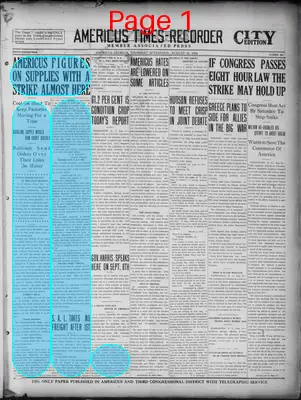
Americus Times Recorder
Americus, Sumter County, Georgia
What is this article about?
Americus, Georgia, braces for a railroad strike starting September 4, 1916, with local utilities reporting sufficient coal for weeks, limited gasoline, and railroads issuing embargoes on freight. Cotton buyers withdraw amid bullish market reports, and heavy freight arrives preemptively.
Clipping
OCR Quality
Full Text
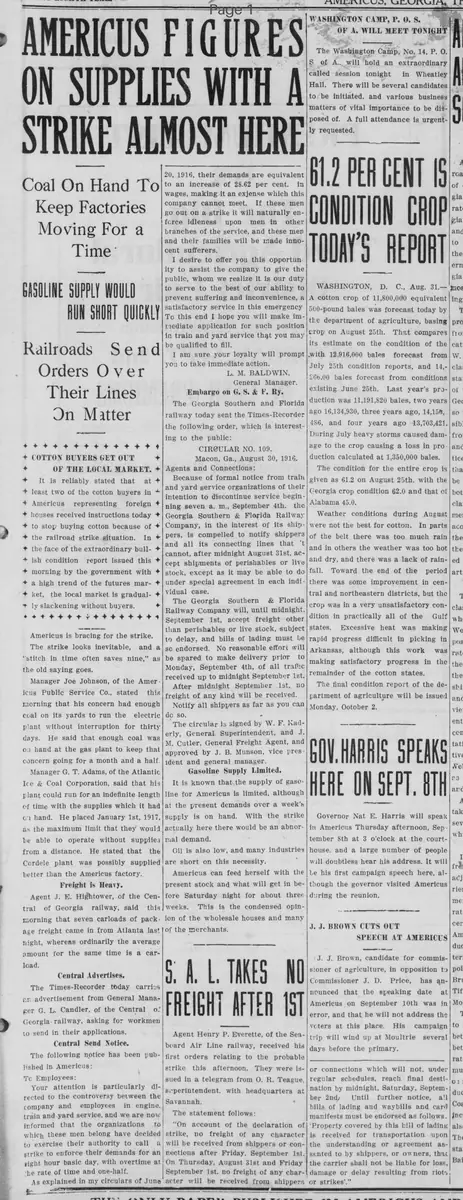
Coal On Hand To Keep Factories Moving For a Time
GASOLINE SUPPLY WOULD RUN SHORT QUICKLY
Railroads Send Orders Over Their Lines On Matter
COTTON BUYERS GET OUT OF THE LOCAL MARKET.
It is reliably stated that at least two of the cotton buyers in Americus representing foreign houses received instructions today to stop buying cotton because of the railroad strike situation. In the face of the extraordinary bullish condition report issued this morning by the government with a high trend of the futures market, the local market is gradually slackening without buyers.
Americus is bracing for the strike. The strike looks inevitable, and a "stitch in time often saves nine," as the old saying goes.
Manager Joe Johnson, of the Americus Public Service Co., stated this morning that his concern had enough coal on its yards to run the electric plant without interruption for thirty days. He said that enough coal was on hand at the gas plant to keep that concern going for a month and a half.
Manager G. T. Adams, of the Atlantic Ice & Coal Corporation, said that his plant could run for an indefinite length of time with the supplies which it had on hand. He placed January 1st, 1917, as the maximum limit that they would be able to operate without supplies from a distance. He stated that the Cordele plant was possibly supplied better than the Americus factory.
Freight is Heavy.
Agent J. E. Hightower, of the Central of Georgia railway, said this morning that seven carloads of package freight came in from Atlanta last night, whereas ordinarily the average amount for the same time is a carload.
Central Advertises.
The Times-Recorder today carries an advertisement from General Manager G. L. Candler, of the Central of Georgia railway, asking for workmen to send in their applications.
Central Send Notice.
The following notice has been published in Americus:
To Employees:
Your attention is particularly directed to the controversy between the company and employees in engine, train and yard service, and we are now informed that the organizations to which these men belong have decided to exercise their authority to call a strike to enforce their demands for an eight hour basic day, with overtime at the rate of time and one-half.
As explained in my circulars of June 20, 1916, their demands are equivalent to an increase of 28.62 per cent. in wages, making it an expense which this company cannot meet. If these men go out on a strike it will naturally enforce idleness upon men in other branches of the service, and these men and their families will be made innocent sufferers.
I desire to offer you this opportunity to assist the company to give the public, whom we realize it is our duty to serve to the best of our ability to prevent suffering and inconvenience, a satisfactory service in this emergency. To this end I hope you will make immediate application for such position in train and yard service that you may be qualified to fill.
I am sure your loyalty will prompt you to take immediate action.
L. M. BALDWIN,
General Manager.
Embargo on G. S. & F. Ry.
The Georgia Southern and Florida railway today sent the Times-Recorder the following order, which is interesting to the public:
CIRCULAR NO. 109,
Macon, Ga., August 30, 1916.
Agents and Connections:
Because of formal notice from train and yard service organizations of their intention to discontinue service beginning seven a. m., September 4th, the Georgia Southern & Florida Railway Company, in the interest of its shippers, is compelled to notify shippers and all its connecting lines that it cannot, after midnight August 31st, accept shipments of perishables or live stock, except as it may be able to do under special agreement in each individual case.
The Georgia Southern & Florida Railway Company will, until midnight, September 1st, accept freight other than perishables or live stock, subject to delay, and bills of lading must be so endorsed. No reasonable effort will be spared to make delivery prior to Monday, September 4th, of all traffic received up to midnight September 1st.
After midnight September 1st, no freight of any kind will be received. Notify all shippers as far as you can do so.
The circular is signed by W. F. Kaderly, General Superintendent, and J. M. Cutler, General Freight Agent, and approved by J. B. Munson, vice president and general manager.
Gasoline Supply Limited.
It is known that the supply of gasoline for Americus is limited, although at the present demands over a week's supply is on hand. With the strike actually here there would be an abnormal demand.
Oil is also low, and many industries are short on this necessity.
Americus can feed herself with the present stock and what will get in before Saturday night for about three weeks. This is the condensed opinion of the wholesale houses and many of the merchants.
S. A. L. TAKES NO FREIGHT AFTER 1ST
Agent Henry P. Everette, of the Seaboard Air Line railway, received his first orders relating to the probable strike this afternoon. They were issued in a telegram from O. R. Teague, superintendent, with headquarters at Savannah.
The statement follows:
"On account of the declaration of strike, no freight of any character will be received from shippers or connections after Friday, September 1st. On Thursday, August 31st and Friday September 1st, no freight of any character will be received from shippers or connections which will not, under regular schedules, reach final destination by midnight, Saturday, September 2nd. Until further notice, all bills of lading and waybills and car manifests must be endorsed as follows,
'Property covered by this bill of lading is received for transportation upon the understanding or agreement assented to by shippers, or owners, that the carrier shall not be liable for loss, damage or delay resulting from riots or strikes'."
What sub-type of article is it?
What keywords are associated?
What entities or persons were involved?
Where did it happen?
Story Details
Key Persons
Location
Americus, Georgia
Event Date
August 30, 1916 To September 4, 1916
Story Details
Local businesses and railroads in Americus prepare for an imminent railroad strike by train and yard workers demanding an eight-hour day and overtime pay. Utilities report coal supplies lasting weeks, gasoline limited to a week under normal demand, and food stocks for three weeks. Railroads issue embargoes on freight, especially perishables, and cotton buyers halt purchases amid market uncertainty.