Thank you for visiting SNEWPapers!
Sign up free
Foreign News
February 7, 1878
The Crisis
Chillicothe, Livingston County, Missouri
What is this article about?
Description of Italian peasant life, focusing on simple diet of bread, macaroni, oil, wine, and regional foods like pumpkins, corn, and chestnuts; work habits, housing, and low intemperance despite wine consumption.
Clipping
OCR Quality
98%
Excellent
Full Text
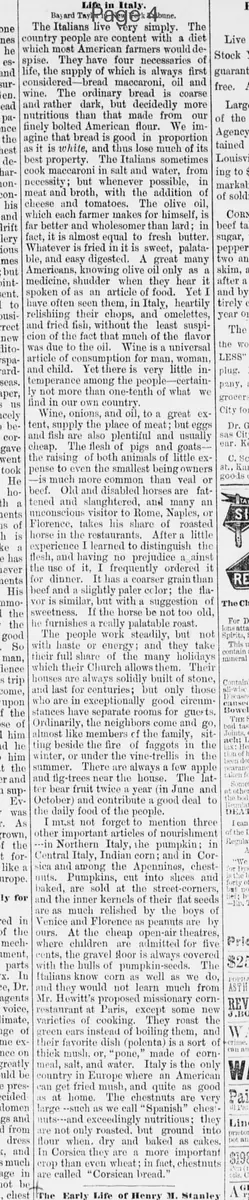
The Italians live very simply. The country people are content with a diet which most American farmers would despise. They have four necessaries of life, the supply of which is always first considered—bread, macaroni, oil and wine. The ordinary bread is coarse and rather dark, but decidedly more nutritious than that made from our finely bolted American flour. We imagine that bread is good in proportion as it is white, and thus lose much of its best property. The Italians sometimes cook macaroni in salt and water, from necessity; but whenever possible, in meat and broth, with the addition of cheese and tomatoes. The olive oil, which each farmer makes for himself, is far better and wholesomer than lard; in fact, it is almost equal to fresh butter. Whatever is fried in it is sweet, palatable, and easy digested. A great many Americans, knowing olive oil only as a medicine, shudder when they hear it spoken of as an article of food. Yet I have often seen them, in Italy, heartily relishing their chops, and omelettes, and fried fish, without the least suspicion of the fact that much of the flavor was due to the oil. Wine is a universal article of consumption for man, woman, and child. Yet there is very little intemperance among the people—certainly not more than one-tenth of what we find in our own country. Wine, onions, and oil, to a great extent, supply the place of meat; but eggs and fish are also plentiful and usually cheap. The flesh of pigs and goats—the raising of both animals of little expense to even the smallest being owners—is much more common than veal or beef. Old and disabled horses are fattened and slaughtered, and many an unconscious visitor to Rome, Naples, or Florence, takes his share of roasted horse in the restaurants. After a little experience I learned to distinguish the flesh, and having no prejudice against the use of it, I frequently ordered it for dinner. It has a coarser grain than beef and a slightly paler color; the flavor is similar, but with a suggestion of sweetness. If the horse be not too old he furnishes a really palatable roast.
The people work steadily, but not with haste or energy; and they take their full share of the many holidays which their Church allows them. Their houses are always solidly built of stone, and last for centuries; but only those who are in exceptionally good circumstances have separate rooms for guests. Ordinarily, the neighbors come and go, almost like members of the family, sitting beside the fire of faggots in the winter, or under the vine-trellis in the summer. There are always a few apple and fig-trees near the house. The latter bear fruit twice a year (in June and October) and contribute a good deal to the daily food of the people. I must not forget to mention three other important articles of nourishment—in Northern Italy, the pumpkin; in Central Italy, Indian corn; and in Corsica and among the Apennines, chestnuts. Pumpkins, cut into slices and baked, are sold at the street-corners, and the inner kernels of their flat seeds are as much relished by the boys of Venice and Florence as peanuts are by ours. At the cheap open-air theatres, where children are admitted for five cents, the gravel floor is always covered with the hulls of pumpkin-seeds. The Italians know corn as well as we do, and they would not learn much from Mr. Hewitt's proposed missionary corn-restaurant at Paris, except some new varieties of cooking. They roast the green ears instead of boiling them, and their favorite dish (polenta) is a sort of thick mush, or, "pone," made of corn meal, salt, and water. Italy is the only country in Europe where an American can get fried mush, and quite as good as at home. The chestnuts are very large—such as we call "Spanish" chestnuts—and exceedingly nutritious; they are not only roasted, but ground into flour when dry and baked as cakes. In Corsica they are a more important crop than even wheat; in fact, chestnuts are called "Corsican bread."
The people work steadily, but not with haste or energy; and they take their full share of the many holidays which their Church allows them. Their houses are always solidly built of stone, and last for centuries; but only those who are in exceptionally good circumstances have separate rooms for guests. Ordinarily, the neighbors come and go, almost like members of the family, sitting beside the fire of faggots in the winter, or under the vine-trellis in the summer. There are always a few apple and fig-trees near the house. The latter bear fruit twice a year (in June and October) and contribute a good deal to the daily food of the people. I must not forget to mention three other important articles of nourishment—in Northern Italy, the pumpkin; in Central Italy, Indian corn; and in Corsica and among the Apennines, chestnuts. Pumpkins, cut into slices and baked, are sold at the street-corners, and the inner kernels of their flat seeds are as much relished by the boys of Venice and Florence as peanuts are by ours. At the cheap open-air theatres, where children are admitted for five cents, the gravel floor is always covered with the hulls of pumpkin-seeds. The Italians know corn as well as we do, and they would not learn much from Mr. Hewitt's proposed missionary corn-restaurant at Paris, except some new varieties of cooking. They roast the green ears instead of boiling them, and their favorite dish (polenta) is a sort of thick mush, or, "pone," made of corn meal, salt, and water. Italy is the only country in Europe where an American can get fried mush, and quite as good as at home. The chestnuts are very large—such as we call "Spanish" chestnuts—and exceedingly nutritious; they are not only roasted, but ground into flour when dry and baked as cakes. In Corsica they are a more important crop than even wheat; in fact, chestnuts are called "Corsican bread."
What sub-type of article is it?
Economic
What keywords are associated?
Italian Diet
Olive Oil
Wine Consumption
Polenta
Chestnuts Corsica
Horse Meat
Rural Italy
Where did it happen?
Italy
Foreign News Details
Primary Location
Italy
Event Details
Detailed account of Italian rural life, including simple diet based on bread, macaroni, olive oil, wine, regional staples like pumpkins, corn (polenta), and chestnuts; low meat consumption with pork, goat, and horse; steady work with holidays; stone houses and communal living.