Thank you for visiting SNEWPapers!
Sign up free
Editorial
October 19, 1820
Kentucky Gazette
Lexington, Fayette County, Kentucky
What is this article about?
Editorial criticizes judicial encroachments on jury trials, arguing for legislative protection of constitutional rights including arguments on law constitutionality and double jeopardy prohibition. References cases like Fayette Circuit Court and Judge Spencer's decision.
Clipping
OCR Quality
95%
Excellent
Full Text
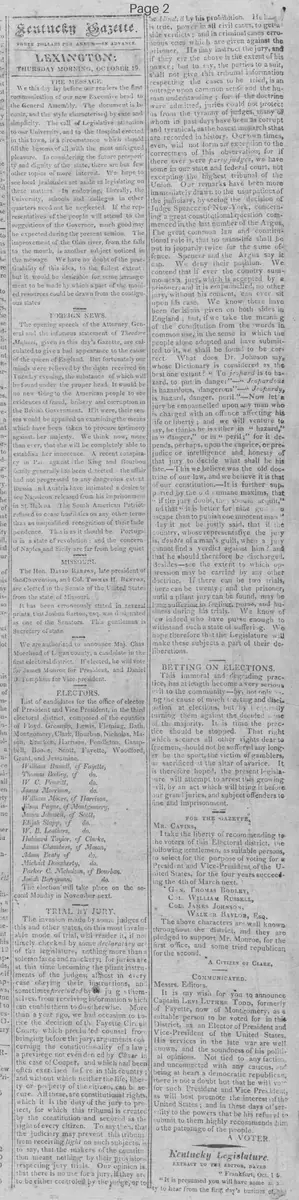
TRIAL BY JURY.
The invasion made by some judges of this and other states, on this most invaluable mode of trial, will render it, if not timely checked by some declaratory act of the legislature, nothing more than a solemn farce and mockery; for juries are at this time becoming the pliant instruments of the judges; almost in every case obeying their instructions, and sometimes precluded by the judges themselves, from receiving information which can enable them to do otherwise. More than a year ago, we had occasion to notice the decision of the Fayette Circuit Court, which precluded counsel from bringing before the jury, arguments concerning the constitutionality of a law; a privilege not even denied by Chase in the case of Cooper, and which had been often exercised before in this country; and without which neither the life, liberty or property of the citizen, can be secure. All these, are constitutional rights, which it is the duty of the jury to protect, for which this tribunal is created by the constitution and secured as the right of every citizen. To say then, that the judiciary may prevent this tribunal from receiving light on such subjects, is to say, that the makers of the constitution meant nothing by their provisions respecting jury trials. Our opinion is, that there is no use for a jury, if they are to be either controlled by the judge, or to be blinded by his prohibition. He has, it is true, power in all civil cases, to get a side verdicts: and in criminal cases erroneous ones which are given against the prisoner. He may instruct the jury, and if they err the above is the extent of his power; but to say, the parties to a suit, shall not give this tribunal information respecting the cases to be tried, is an outrage upon common sense and the human understanding; for if the doctrine were admitted, juries could not protect us from the tyranny of judges, many of whom in past days have been as corrupt and tyrannical, as the basest monarchs that are recorded in history. Our own times, even, will not form an exception to the correctness of this observation; for if there ever were party judges, we have some in our state and federal courts, not excepting the highest tribunal of the Union. Our remarks have been more immediately drawn to the usurpations of the judiciary, by seeing the decision of Judge Spencer of New-York, concerning a great constitutional question commenced in the last number of the Argus.
The great common law and constitutional rule is, that no man's life shall be put in jeopardy twice for the same offence. Spencer and the Argus say it can. We deny their position. We contend that if ever the country summons a jury, which is accepted by the prisoner, and it is empannelled, no other jury, without his consent, can ever sit upon his case. We know there have been decisions given on both sides in England; but, if we take the meaning of the constitution from the words in common use, in the sense in which the people alone adopted and have submitted to it, we shall be found to be correct. What does Dr. Johnson say whose Dictionary is considered as the best one extant? "To jeopard is to hazard, to put in danger"—"Jeopardous is hazardous, dangerous"—"Jeopardy, is hazard, danger, peril."—Now let a jury be empannelled upon any man who is charged with an offence affecting his life or liberty; and we will venture to say, he thinks he is either in "hazard," in "danger," or in "peril;" for it depends, perhaps, upon the caprice, or prejudice or intelligence and honesty of that jury to decide what shall be his fate.—This we believe was the old doctrine of our law, and we believe it is that of our constitution. It is further supported by the old humane maxims, that "if the jury doubt, they should acquit," and that "it is better for nine guilty to escape than to punish one innocent man."
May it not be justly said, that if the country, whose representative the jury is, doubts of a man's guilt, when a jury cannot find a verdict against him? and that he should therefore be discharged. Besides see the extent to which oppression may be carried by any other doctrine. If there can be two trials, there can be twenty; and the prisoner, until a pliant jury can be found, may be long suffering in feeling, purse, and business during his trials. We know of few indeed who have purse enough to withstand such a state of suffering. We hope therefore that the Legislature will make these subjects a part of their deliberations.
The invasion made by some judges of this and other states, on this most invaluable mode of trial, will render it, if not timely checked by some declaratory act of the legislature, nothing more than a solemn farce and mockery; for juries are at this time becoming the pliant instruments of the judges; almost in every case obeying their instructions, and sometimes precluded by the judges themselves, from receiving information which can enable them to do otherwise. More than a year ago, we had occasion to notice the decision of the Fayette Circuit Court, which precluded counsel from bringing before the jury, arguments concerning the constitutionality of a law; a privilege not even denied by Chase in the case of Cooper, and which had been often exercised before in this country; and without which neither the life, liberty or property of the citizen, can be secure. All these, are constitutional rights, which it is the duty of the jury to protect, for which this tribunal is created by the constitution and secured as the right of every citizen. To say then, that the judiciary may prevent this tribunal from receiving light on such subjects, is to say, that the makers of the constitution meant nothing by their provisions respecting jury trials. Our opinion is, that there is no use for a jury, if they are to be either controlled by the judge, or to be blinded by his prohibition. He has, it is true, power in all civil cases, to get a side verdicts: and in criminal cases erroneous ones which are given against the prisoner. He may instruct the jury, and if they err the above is the extent of his power; but to say, the parties to a suit, shall not give this tribunal information respecting the cases to be tried, is an outrage upon common sense and the human understanding; for if the doctrine were admitted, juries could not protect us from the tyranny of judges, many of whom in past days have been as corrupt and tyrannical, as the basest monarchs that are recorded in history. Our own times, even, will not form an exception to the correctness of this observation; for if there ever were party judges, we have some in our state and federal courts, not excepting the highest tribunal of the Union. Our remarks have been more immediately drawn to the usurpations of the judiciary, by seeing the decision of Judge Spencer of New-York, concerning a great constitutional question commenced in the last number of the Argus.
The great common law and constitutional rule is, that no man's life shall be put in jeopardy twice for the same offence. Spencer and the Argus say it can. We deny their position. We contend that if ever the country summons a jury, which is accepted by the prisoner, and it is empannelled, no other jury, without his consent, can ever sit upon his case. We know there have been decisions given on both sides in England; but, if we take the meaning of the constitution from the words in common use, in the sense in which the people alone adopted and have submitted to it, we shall be found to be correct. What does Dr. Johnson say whose Dictionary is considered as the best one extant? "To jeopard is to hazard, to put in danger"—"Jeopardous is hazardous, dangerous"—"Jeopardy, is hazard, danger, peril."—Now let a jury be empannelled upon any man who is charged with an offence affecting his life or liberty; and we will venture to say, he thinks he is either in "hazard," in "danger," or in "peril;" for it depends, perhaps, upon the caprice, or prejudice or intelligence and honesty of that jury to decide what shall be his fate.—This we believe was the old doctrine of our law, and we believe it is that of our constitution. It is further supported by the old humane maxims, that "if the jury doubt, they should acquit," and that "it is better for nine guilty to escape than to punish one innocent man."
May it not be justly said, that if the country, whose representative the jury is, doubts of a man's guilt, when a jury cannot find a verdict against him? and that he should therefore be discharged. Besides see the extent to which oppression may be carried by any other doctrine. If there can be two trials, there can be twenty; and the prisoner, until a pliant jury can be found, may be long suffering in feeling, purse, and business during his trials. We know of few indeed who have purse enough to withstand such a state of suffering. We hope therefore that the Legislature will make these subjects a part of their deliberations.
What sub-type of article is it?
Constitutional
Legal Reform
Crime Or Punishment
What keywords are associated?
Jury Trials
Judicial Usurpation
Double Jeopardy
Constitutional Rights
Fayette Circuit
Judge Spencer
Legal Tyranny
What entities or persons were involved?
Judges
Fayette Circuit Court
Chase
Cooper
Judge Spencer
New York
Argus
Dr. Johnson
Editorial Details
Primary Topic
Defense Of Jury Trial Independence And Double Jeopardy Protection
Stance / Tone
Strongly Critical Of Judicial Overreach And Supportive Of Jury Rights
Key Figures
Judges
Fayette Circuit Court
Chase
Cooper
Judge Spencer
New York
Argus
Dr. Johnson
Key Arguments
Judges Are Invading Jury Trial Rights, Making Juries Pliant Instruments.
Fayette Circuit Court Decision Precluded Constitutional Arguments Before Juries.
Juries Must Protect Constitutional Rights Like Life, Liberty, Property.
Judges Cannot Prevent Juries From Receiving Information On Cases.
No Double Jeopardy: Once Jury Empanelled, No Retrial Without Consent.
Constitutional Meaning Of 'Jeopardy' Implies Hazard From First Jury.
Better Nine Guilty Escape Than One Innocent Punished.
Multiple Trials Enable Oppression; Legislature Should Act.