Thank you for visiting SNEWPapers!
Sign up free
The New Hampshire Gazette And Historical Chronicle
Portsmouth, Greenland, Rockingham County, New Hampshire
What is this article about?
Lord Chatham's speech in the House of Lords on May 4 supporting the Duke of Richmond's motion on the Middlesex Election, criticizing the House of Commons' actions, defending magistrates, attributing Wilkes' rise to government measures, calling for Parliament's dissolution, and declaring support for triennial parliaments.
Clipping
OCR Quality
Full Text
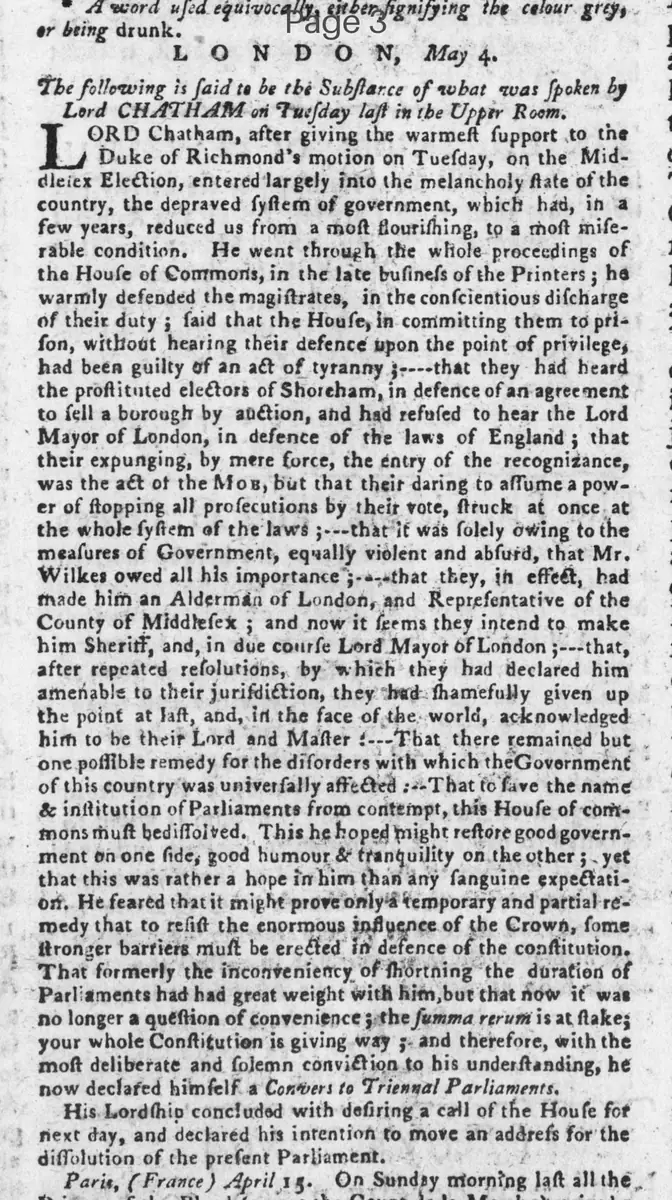
The following is said to be the Substance of what was spoken by Lord CHATHAM on Tuesday last in the Upper House.
LORD Chatham, after giving the warmest support to the Duke of Richmond's motion on Tuesday, on the Middlesex Election, entered largely into the melancholy state of the country, the depraved system of government, which had, in a few years, reduced us from a most flourishing, to a most miserable condition. He went through the whole proceedings of the House of Commons, in the late business of the Printers; he warmly defended the magistrates, in the conscientious discharge of their duty; said that the House, in committing them to prison, without hearing their defence upon the point of privilege, had been guilty of an act of tyranny;----that they had heard the prostituted electors of Shoreham, in defence of an agreement to sell a borough by auction, and had refused to hear the Lord Mayor of London, in defence of the laws of England; that their expunging, by mere force, the entry of the recognizance, was the act of the Mob, but that their daring to assume a power of stopping all prosecutions by their vote, struck at once, at the whole system of the laws;---that it was solely owing to the measures of Government, equally violent and absurd, that Mr. Wilkes owed all his importance;----that they, in effect, had made him an Alderman of London, and Representative of the County of Middlesex; and now it seems they intend to make him Sheriff, and, in due course Lord Mayor of London;---that, after repeated resolutions, by which they had declared him amenable to their jurisdiction, they had shamefully given up the point at last, and, in the face of the world, acknowledged him to be their Lord and Master!---That there remained but one possible remedy for the disorders with which the Government of this country was universally affected:--That to save the name & institution of Parliaments from contempt, this House of Commons must be dissolved. This he hoped might restore good government on one side; good humour & tranquility on the other; --yet that this was rather a hope in him than any sanguine expectation. He feared that it might prove only a temporary and partial remedy that to resist the enormous influence of the Crown, some stronger barriers must be erected in defence of the constitution. That formerly the inconveniency of shortening the duration of Parliaments had had great weight with him, but that now it was no longer a question of convenience; the summa rerum is at stake; your whole Constitution is giving way; and therefore, with the most deliberate and solemn conviction to his understanding, he now declared himself a Convert to Triennial Parliaments.
His Lordship concluded with desiring a call of the House for next day, and declared his intention to move an address for the dissolution of the present Parliament.
What sub-type of article is it?
What keywords are associated?
What entities or persons were involved?
Where did it happen?
Foreign News Details
Primary Location
London
Event Date
May 4
Key Persons
Outcome
call for dissolution of the house of commons and declaration in favor of triennial parliaments.
Event Details
Lord Chatham supported the Duke of Richmond's motion on the Middlesex Election, criticized the depraved system of government and House of Commons proceedings on printers and Shoreham electors, defended magistrates and the Lord Mayor, blamed government measures for Mr. Wilkes' importance, and urged dissolution of Parliament as a remedy, converting to support triennial parliaments. He intended to move an address for dissolution.