Thank you for visiting SNEWPapers!
Sign up free
Letter to Editor
April 30, 1796
Gazette Of The United States
Philadelphia, Philadelphia County, Pennsylvania
What is this article about?
Pseudonymous letter to Mr. Fenno critiques the rise of superstitious novels and romances, warning they erode rational philosophy and foster ignorance, especially among women, likening the mind to a chameleon that absorbs harmful ideas from poor reading.
Clipping
OCR Quality
98%
Excellent
Full Text
FOR THE GAZETTE OF THE UNITED STATES.
Mr. Fenno,
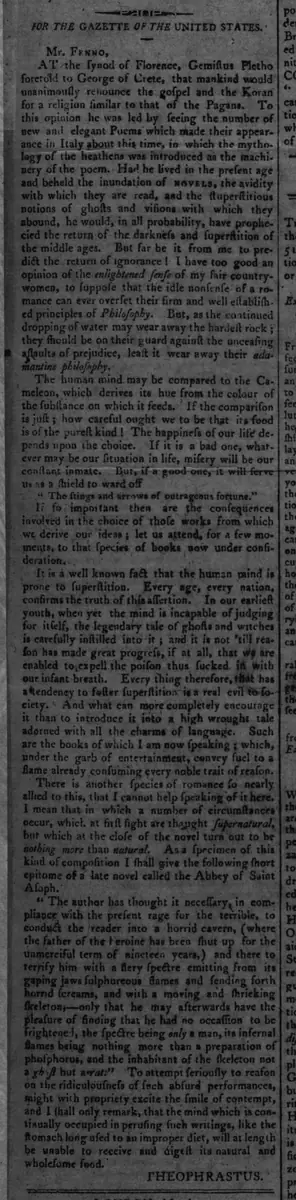
At the synod of Florence, Gemistus Pletho foretold to George of Crete, that mankind would unanimously renounce the gospel and the Koran for a religion similar to that of the Pagans. To this opinion he was led by seeing the number of new and elegant poems which made their appearance in Italy about this time, in which the mythology of the heathens was introduced as the machinery of the poem. Had he lived in the present age and beheld the inundation of novels, the avidity with which they are read, and the superstitious notions of ghosts and visions with which they abound, he would, in all probability, have prophesied the return of the darkness and superstition of the middle ages. But far be it from me to predict the return of ignorance! I have too good an opinion of the enlightened sense of my fair country-women, to suppose that the idle nonsense of a romance can ever overturn their firm and well established principles of Philosophy. But, as the continued dropping of water may wear away the hardest rock; they should be on their guard against the unceasing assaults of prejudice, lest it wear away their adamantine philosophy.
The human mind may be compared to the Chameleon, which derives its hue from the colour of the substance on which it feeds. If the comparison is just; how careful ought we to be that its food is of the purest kind! The happiness of our life depends upon the choice. If it is a bad one, whatever may be our situation in life, misery will be our constant inmate. But, if a good one, it will serve us as a shield to ward off
'The stings and arrows of outrageous fortune.'
If so important then are the consequences involved in the choice of those works from which we derive our ideas; let us attend, for a few moments, to that species of books now under consideration.
It is a well known fact that the human mind is prone to superstition. Every age, every nation, confirms the truth of this assertion. In our earliest youth, when yet the mind is incapable of judging for itself, the legendary tale of ghosts and witches is carefully instilled into it; and it is not 'till reason has made great progress, if at all, that we are enabled to expel the poison thus sucked in with our infant breath. Every thing therefore, that has a tendency to foster superstition is a real evil to society. And what can more completely encourage it than to introduce it into a high wrought tale adorned with all the charms of language. Such are the books of which I am now speaking; which, under the garb of entertainment, convey fuel to a flame already consuming every noble trait of reason.
There is another species of romance so nearly allied to this, that I cannot help speaking of it here. I mean that in which a number of circumstances occur, which, at first sight are thought supernatural, but which at the close of the novel turn out to be nothing more than natural. As a specimen of this kind of composition I shall give the following short epitome of a late novel called the Abbey of Saint Augustin.
'The author has thought it necessary, in compliance with the present rage for the terrible, to conduct the reader into a horrid cavern, (where the father of the heroine has been shut up for the unmerciful term of nineteen years,) and there to terrify him with a fiery spectre emitting from its gaping jaws sulphureous flames and ending forth horrid screams, and with a moving and shrieking skeleton—only that he may afterwards have the pleasure of finding that he had no occasion to be frightened, the spectre being only a man, its infernal flames being nothing more than a preparation of phosphorus, and the inhabitant of the skeleton not a ghost but a rat.' To attempt seriously to reason on the ridiculousness of such absurd performances, might with propriety excite the smile of contempt, and I shall only remark, that the mind which is continually occupied in perusing such writings, like the stomach long used to an improper diet, will at length be unable to receive and digest its natural and wholesome food.
THEOPHRASTUS.
Mr. Fenno,
At the synod of Florence, Gemistus Pletho foretold to George of Crete, that mankind would unanimously renounce the gospel and the Koran for a religion similar to that of the Pagans. To this opinion he was led by seeing the number of new and elegant poems which made their appearance in Italy about this time, in which the mythology of the heathens was introduced as the machinery of the poem. Had he lived in the present age and beheld the inundation of novels, the avidity with which they are read, and the superstitious notions of ghosts and visions with which they abound, he would, in all probability, have prophesied the return of the darkness and superstition of the middle ages. But far be it from me to predict the return of ignorance! I have too good an opinion of the enlightened sense of my fair country-women, to suppose that the idle nonsense of a romance can ever overturn their firm and well established principles of Philosophy. But, as the continued dropping of water may wear away the hardest rock; they should be on their guard against the unceasing assaults of prejudice, lest it wear away their adamantine philosophy.
The human mind may be compared to the Chameleon, which derives its hue from the colour of the substance on which it feeds. If the comparison is just; how careful ought we to be that its food is of the purest kind! The happiness of our life depends upon the choice. If it is a bad one, whatever may be our situation in life, misery will be our constant inmate. But, if a good one, it will serve us as a shield to ward off
'The stings and arrows of outrageous fortune.'
If so important then are the consequences involved in the choice of those works from which we derive our ideas; let us attend, for a few moments, to that species of books now under consideration.
It is a well known fact that the human mind is prone to superstition. Every age, every nation, confirms the truth of this assertion. In our earliest youth, when yet the mind is incapable of judging for itself, the legendary tale of ghosts and witches is carefully instilled into it; and it is not 'till reason has made great progress, if at all, that we are enabled to expel the poison thus sucked in with our infant breath. Every thing therefore, that has a tendency to foster superstition is a real evil to society. And what can more completely encourage it than to introduce it into a high wrought tale adorned with all the charms of language. Such are the books of which I am now speaking; which, under the garb of entertainment, convey fuel to a flame already consuming every noble trait of reason.
There is another species of romance so nearly allied to this, that I cannot help speaking of it here. I mean that in which a number of circumstances occur, which, at first sight are thought supernatural, but which at the close of the novel turn out to be nothing more than natural. As a specimen of this kind of composition I shall give the following short epitome of a late novel called the Abbey of Saint Augustin.
'The author has thought it necessary, in compliance with the present rage for the terrible, to conduct the reader into a horrid cavern, (where the father of the heroine has been shut up for the unmerciful term of nineteen years,) and there to terrify him with a fiery spectre emitting from its gaping jaws sulphureous flames and ending forth horrid screams, and with a moving and shrieking skeleton—only that he may afterwards have the pleasure of finding that he had no occasion to be frightened, the spectre being only a man, its infernal flames being nothing more than a preparation of phosphorus, and the inhabitant of the skeleton not a ghost but a rat.' To attempt seriously to reason on the ridiculousness of such absurd performances, might with propriety excite the smile of contempt, and I shall only remark, that the mind which is continually occupied in perusing such writings, like the stomach long used to an improper diet, will at length be unable to receive and digest its natural and wholesome food.
THEOPHRASTUS.
What sub-type of article is it?
Persuasive
Philosophical
Ethical Moral
What themes does it cover?
Morality
What keywords are associated?
Superstition
Novels
Romances
Philosophy
Women's Reading
Moral Danger
Rational Thought
Literary Critique
What entities or persons were involved?
Theophrastus
Mr. Fenno
Letter to Editor Details
Author
Theophrastus
Recipient
Mr. Fenno
Main Argument
novels and romances that promote superstition undermine rational philosophy and moral principles, particularly endangering women's enlightenment; readers should guard against such literature as it poisons the mind like impure food.
Notable Details
References Synod Of Florence And Gemistus Pletho
Compares Human Mind To Chameleon
Quotes Shakespeare: 'The Stings And Arrows Of Outrageous Fortune'
Epitome Of Novel 'The Abbey Of Saint Augustin' Critiquing False Supernatural Elements