Thank you for visiting SNEWPapers!
Sign up free
Story
December 12, 1904
The Chickasha Daily Express
Chickasha, Grady County, Oklahoma
What is this article about?
Historical account of Native American communication methods using blankets, smoke, fires, mirrors, and horse maneuvers to signal dangers, buffalo herds, and returning parties across distances up to 50 miles.
Clipping
OCR Quality
98%
Excellent
Full Text
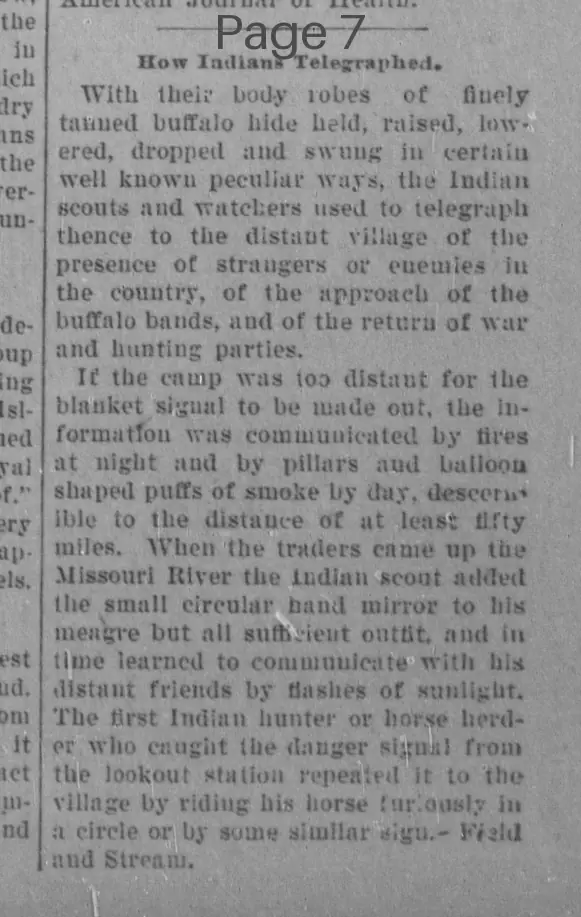
How Indians Telegraphed.
With their bony lobes of finely tanned buffalo hide held, raised, lowered, dropped and swung in certain well known peculiar ways, the Indian scouts and watchers used to telegraph thence to the distant village of the presence of strangers or enemies in the country, of the approach of the buffalo bands, and of the return of war and hunting parties.
If the camp was too distant for the blanket signal to be made out, the information was communicated by fires at night and by pillars and balloon shaped puffs of smoke by day, discernible to the distance of at least fifty miles. When the traders came up the Missouri River the Indian scout added the small circular hand mirror to his meagre but all sufficient outfit, and in time learned to communicate with his distant friends by flashes of sunlight.
The first Indian hunter or horse herder who caught the danger signal from the lookout station repeated it to the village by riding his horse furiously in a circle or by some similar sign.
Field and Stream.
With their bony lobes of finely tanned buffalo hide held, raised, lowered, dropped and swung in certain well known peculiar ways, the Indian scouts and watchers used to telegraph thence to the distant village of the presence of strangers or enemies in the country, of the approach of the buffalo bands, and of the return of war and hunting parties.
If the camp was too distant for the blanket signal to be made out, the information was communicated by fires at night and by pillars and balloon shaped puffs of smoke by day, discernible to the distance of at least fifty miles. When the traders came up the Missouri River the Indian scout added the small circular hand mirror to his meagre but all sufficient outfit, and in time learned to communicate with his distant friends by flashes of sunlight.
The first Indian hunter or horse herder who caught the danger signal from the lookout station repeated it to the village by riding his horse furiously in a circle or by some similar sign.
Field and Stream.
What sub-type of article is it?
Curiosity
Historical Event
What themes does it cover?
Survival
What keywords are associated?
Indian Signaling
Blanket Signals
Smoke Signals
Mirror Flashes
Horse Signals
Where did it happen?
Missouri River
Story Details
Location
Missouri River
Story Details
Indians used blanket signals, smoke puffs, fires, mirror flashes, and horse riding to communicate presence of strangers, enemies, buffalo, and returning parties over long distances.