Thank you for visiting SNEWPapers!
Sign up free
The Gazette
Portland, Cumberland County, Maine
What is this article about?
Rev. Dr. Cutler's note describes ancient earthworks and mounds at Marietta in the western territory, including squares, walls, and conic mounds, estimated over 1,000 years old based on tree growth. Conjectures suggest defensive and religious purposes, possibly by ancient tribes similar to Mexicans.
Clipping
OCR Quality
Full Text
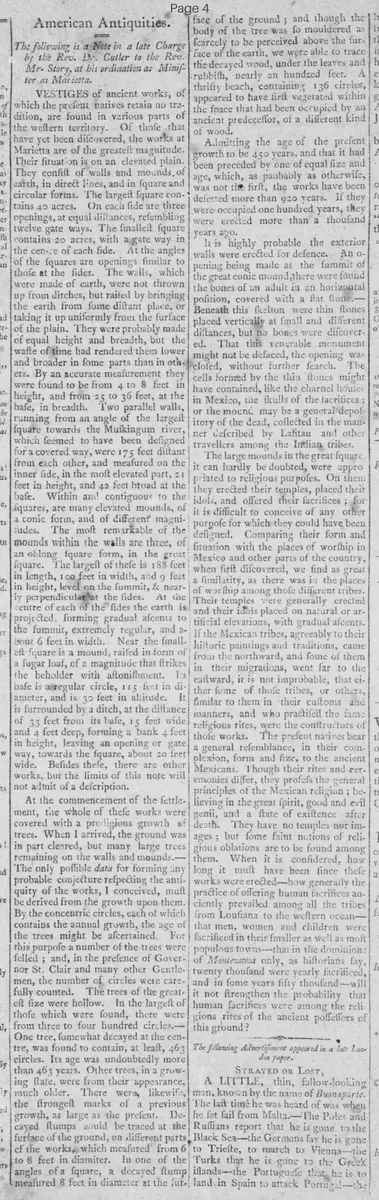
The following is a Note in a late Charge by the Rev. Dr. Cutler to the Rev. Mr. Story, at his ordination as Minister at Marietta.
VESTIGES of ancient works, of which the present natives retain no tradition, are found in various parts of the western territory. Of those that have yet been discovered, the works at Marietta are of the greatest magnitude. Their situation is on an elevated plain. They consist of walls and mounds of earth, in direct lines, and in square and circular forms. The largest square contains 40 acres. On each side are three openings, at equal distances, resembling twelve gate ways. The smallest square contains 20 acres, with a gate way in the centre of each side. At the angles of the squares are openings similar to those at the sides. The walls, which were made of earth, were not thrown up from ditches, but raised by bringing the earth from some distant place, or taking it up uniformly from the surface of the plain. They were probably made of equal height and breadth, but the waste of time had rendered them lower and broader in some parts than in others. By an accurate measurement they were found to be from 4 to 8 feet in height, and from 25 to 36 feet, at the base, in breadth. Two parallel walls, running from an angle of the largest square towards the Muskingum river, which seemed to have been designed for a covered way, were 175 feet distant from each other, and measured on the inner side, in the most elevated part, 21 feet in height, and 42 feet broad at the base. Within and contiguous to the squares, are many elevated mounds, of a conic form, and of different magnitudes. The most remarkable of the mounds within the walls are three, of an oblong square form, in the great square. The largest of these is 188 feet in length, 100 feet in width, and 9 feet in height, level on the summit, & nearly perpendicular at the sides. At the centre of each of the sides the earth is projected, forming gradual ascents to the summit, extremely regular, and about 6 feet in width. Near the smallest square is a mound, raised in form of a sugar loaf, of a magnitude that strikes the beholder with astonishment. Its base is a regular circle, 15 feet in diameter, and is 3 feet in altitude. It is surrounded by a ditch, at the distance of 33 feet from its base, 15 feet wide and 4 feet deep, forming a bank 4 feet in height, leaving an opening or gate way, towards the square, about 20 feet wide. Besides these, there are other works, but the limits of this note will not admit of a description.
At the commencement of the settlement, the whole of these works were covered with a prodigious growth of trees. When I arrived, the ground was in part cleared, but many large trees remaining on the walls and mounds.—The only possible data for forming any probable conjecture respecting the antiquity of the works, I conceived, must be derived from the growth upon them. By the concentric circles, each of which contains the annual growth, the age of the trees might be ascertained. For this purpose a number of the trees were felled; and, in the presence of Governor St. Clair and many other Gentlemen, the number of circles were carefully counted. The trees of the greatest size were hollow. In the largest of those which were found, there were from three to four hundred circles.—One tree, somewhat decayed at the centre, was found to contain, at least, 463 circles. Its age was undoubtedly more than 463 years. Other trees, in a growing state, were from their appearance much older. There were likewise, the strongest marks of a previous growth, as large as the present. Decayed stumps could be traced at the surface of the ground, on different parts of the works, which measured from 6 to 8 feet in diameter. In one of the angles of a square, a decayed stump measured 8 feet in diameter at the surface of the ground: and though the body of the tree was so mouldered as scarcely to be perceived above the surface of the earth, we were able to trace the decayed wood, under the leaves and rubbish, nearly an hundred feet. A thrifty beech, containing 136 circles, appeared to have first vegetated within the space that had been occupied by an ancient predecessor, of a different kind of wood.
Admitting the age of the present growth to be 450 years, and that it had been preceded by one of equal size and age, which, as probably as otherwise, was not the first, the works have been deserted more than 920 years. If they were occupied one hundred years, they were erected more than a thousand years ago.
It is highly probable the exterior walls were erected for defence. An Opening being made at the summit of the great conic mound, there were found the bones of an adult in an horizontal position, covered with a flat stone.—Beneath this skeleton were thin stones placed vertically at small and different distances, but no bones were discovered. That this venerable monument might not be defaced, the opening was closed, without further search. The cells formed by the thin stones might have contained, like the charnel houses in Mexico, the skulls of the sacrifices; or the mound may be a general depository of the dead, collected in the manner described by Lafitau and other travellers among the Indian tribes.
The large mounds in the great square it can hardly be doubted, were appropriated to religious purposes. On them they erected their temples, placed their idols, and offered their sacrifices: for it is difficult to conceive of any other purpose for which they could have been designed. Comparing their form and situation with the places of worship in Mexico and other parts of the country, when first discovered, we find as great a similarity, as there was in the places of worship among those different tribes. Their temples were generally erected and their idols placed on natural or artificial elevations, with gradual ascents.
If the Mexican tribes, agreeably to their historic paintings and traditions, came from the northward, and some of them in their migrations, went far to the eastward, it is not improbable, that either some of those tribes, or others, similar to them in their customs and manners, and who practised the same religious rites, were the constructors of those works. The present natives bear a general resemblance, in their complexion, form and size, to the ancient Mexicans. Though their rites and ceremonies differ, they profess the general principles of the Mexican religion; believing in the great spirit, good and evil genii, and a state of existence after death. They have no temples nor images: but some faint notions of religious oblations are to be found among them. When it is considered, how long it must have been since these works were erected—how generally the practice of offering human sacrifices anciently prevailed among all the tribes from Louisiana to the western ocean—that men, women and children were sacrificed in their smaller as well as most populous towns—that in the dominion of Montezuma only, as historians say, twenty thousand were yearly sacrificed, and in some years fifty thousand—will it not strengthen the probability that human sacrifices were among the religious rites of the ancient possessors of this ground?
What sub-type of article is it?
What keywords are associated?
What entities or persons were involved?
Where did it happen?
Domestic News Details
Primary Location
Marietta
Key Persons
Outcome
works estimated to be over 1,000 years old; possible defensive and religious purposes including human sacrifices; bones found in one mound.
Event Details
Description of ancient earthworks including squares up to 40 acres, walls 4-8 feet high and 25-36 feet wide at base, parallel walls to Muskingum river, various conic and oblong mounds; tree ring analysis dates abandonment over 920 years ago; conjectures link to ancient tribes similar to Mexicans with religious rites.