Thank you for visiting SNEWPapers!
Sign up free
Literary
July 18, 1849
Edgefield Advertiser
Edgefield, Edgefield County, South Carolina
What is this article about?
Joseph A. Sner, Esq., concludes remarks at Rose Cottage Academy's student examination, thanking attendees, advocating for education as a duty to children, society, and America. He contrasts U.S. merit-based opportunities with European class rigidity, cites historical figures, quotes Gray and Burns, and urges youth to uphold virtue.
Clipping
OCR Quality
95%
Excellent
Full Text
(FOR THE ADVERTISER.)
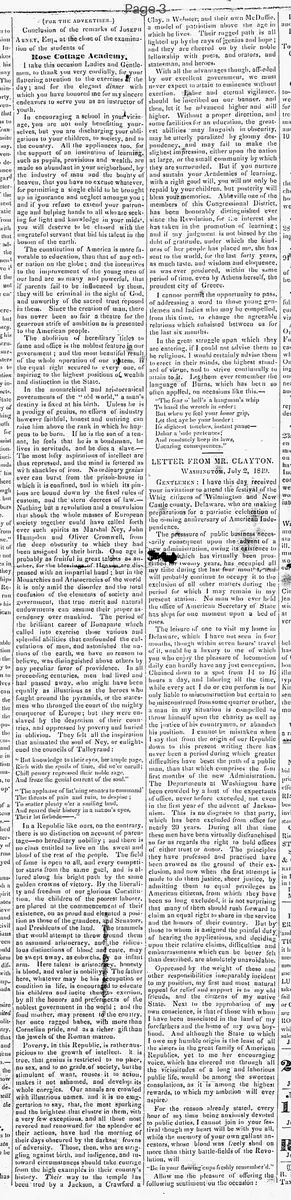
Conclusion of the remarks of Joseph A. Sner, Esq. at the close of the examination of the students of Rose Cottage Academy.
I take this occasion Ladies and Gentlemen, to thank you very cordially, for your flattering attention to the exercises the day; and for the elegant dinner with which you have honored me for my sincere endeavors to serve you as an instructor of youth.
In encouraging a school in your vicinity, you are not only benefitting yourselves, but you are discharging your obligations to your children, to Society, and to the country. All the appliances too, for the support of an institution of learning, such as pupils, provisions and wealth, are made so abundant in your neighborhood, by the industry of man and the bounty of heaven, that you have no excuse whatever, for permitting a single child to be brought up in ignorance and neglect amongst you; and if you refuse to extend your patronage and helping hands to all who are seeking for light and knowledge in your midst, you will deserve to be classed with the ungrateful servant that hid his talent in the bosom of the earth.
The constitution of America is more favorable to education, than that of any other nation on the globe; and the incentives to the improvement of the young men of our land are so many and powerful, that if parents fail to be influenced by them, they will be criminal in the sight of God, and unworthy of the sacred trust reposed in them. Since the creation of man, there has never been so fair a theatre for the generous strife of ambition as is presented to the American people.
The abolition of hereditary titles to fame and office is the noblest feature in our government; and the most beautiful result of the whole operation of our system, is the equal right secured to every one, of aspiring to the highest positions of wealth and distinction in the State.
In the monarchical and aristocratical governments of the old world, a man's destiny is fixed at his birth. Unless he is a prodigy of genius, no efforts of industry however faithful, honest and untiring can raise him above the rank in which he happens to be born. If he is the son of a tenant, he feels that he is a bondsman, he lives in servitude, and he dies a slave. The most lofty aspirations of intellect are thus repressed, and the mind is fettered as with shackles of iron. No ordinary genius ever can burst from the prison-house in which it is confined, and in which its pinions are bound down by the fixed rules of custom, and the stern decrees of law.
Nothing but a revolution and a convulsion that shook the whole masses of European society together could have called forth ever such spirits as Marshal Ney, John Hampden and Oliver Cromwell, from the deep obscurity to which they had been assigned by their birth. One age is probably as fruitful in great talents as another, for the blessings of Heaven are dispensed with an impartial hand; but in the Monarchies and Aristocracies of the world it is only amid the disorder and the total confusion of the elements of society and government, that true merit and natural endowments can assume their proper ascendency over mankind. The period of the brilliant career of Bonaparte which called into exercise those various and splendid abilities that confounded the calculations of men, and astonished the nations of the earth, we have no reason to believe, was distinguished above others by any peculiar favor of providence. In all preceeding centuries, men had lived and had passed away, who might have been equally as illustrious as the heroes who fought around the pyramids, or the statesmen who thronged the court of the mighty conqueror of Europe; but they were enslaved by the despotism of their countries, and oppressed by poverty and buried in oblivion. They felt all the inspiration that animated the soul of Ney, or enlightened the councils of Talleyrand:
But knowledge to their eyes, her ample page
Rich with the spoils of time, did ne'er unroll;
Chill penury repressed their noble rage.
And froze the genial current of the soul.
The applause of list'ning senates to command
The threats of pain and ruin, to despise;
To scatter plenty o'er a smiling land,
And read their history in a nation's eyes,
Their lot forbade—
In a Republic like ours, on the contrary, there is no distinction on account of parentage—no hereditary nobility; and there is no class entitled to live on the sweat and blood of the rest of the people. The field of fame is open to all, and every competitor starts from the same goal, and is allured along his bright path by the same golden crowns of victory. By the liberality and freedom of our glorious Constitution, the children of the poorest laborer, are placed at the commencement of their existence, on as proud and elevated a position as those of the grandees, and Senators, and Presidents of the land. The trammels that would attempt to throw round them an assumed aristocracy, and the ridiculous distinctions of blood and caste, may be swept away, as cobwebs, by an infant arm. Here talent is aristocracy, honesty is blood, and valor is nobility. The father here, whatever may be his occupation or condition in life, is encouraged to educate his children and incite them to exertion, by all the honors and preferments of the noblest government in the world; and the fond mother, may present to the country, her once ragged babes, with more than Cornelian pride, and as a richer gift than the jewels of the Roman matron.
Poverty, in this Republic, is rather auspicious to the growth of intellect. It is true, that genius is restricted to no place, no sex, and to no grade of society, but the stimulant of want, rouses it to action, makes it not ashamed, and develops its whole energies. Our annals are crowded with illustrious names, and it is no exaggeration to say, that the most sparkling and the brightest—that cluster in them, with a very few exceptions, and all those most revered and renowned for the splendor of their actions, have had the morning of their days obscured by the darkest frowns of adversity. Those, then, who are struggling against birth, and indigence, and untoward circumstances should take courage from the high examples in their country's history. Their way to the Temple has been trod by a Jackson, a Crawford, a Clay, a Webster; and their own McDuffie, a model of patriotism above the age in which he lives. Their rugged path is all lighted up by the rays of genius and hope; and they are cheered on by their noble fellowship with poets, and orators, and statesman, and heroes.
With all the advantages though, afforded by our excellent government, we must never expect to attain to eminence without exertion. Labor and eternal vigilance, should be inscribed on our banner, and then, let it be advanced higher and still higher. Without a proper direction, and some facilities for an education, the greatest abilities may languish in obscurity, may be utterly paralyzed by gloomy despondency, and may fail to make the slightest impression, either upon the nation at large, or the small community by which they are surrounded. But if you nurture and sustain your Academies of learning, with a right good will, you will not only be repaid by your children, but posterity will bless your memories. Abbeville one of the members of this Congressional District, has been honorably distinguished ever since the Revolution, for the interest she has taken in the promotion of learning; and if my judgment is not biased by the debt of gratitude, under which the kindness of her people has placed me, she has sent to the world, for the last forty years, as much taste, and wisdom and eloquence, as was ever produced, within the same period of time, even by Athens herself, the proudest city of Greece.
I cannot permit the opportunity to pass, of addressing a word to those young gentlemen and ladies who may be compelled, from this time, to change the agreeable relations which subsisted between us for the last six months.
In the great struggle upon which they are entering, if I could not advise them to be religious, I would certainly advise them to erect in their minds, the highest standard of virtue, and to strive continually to attain to it. Let them ever remember the language of Burns, which has been so often applied, on occasions like this.—
The fear o' hell's a hangman's whip
To hand the wretch in order:
But when ye feel your honor grip,
Let that aye be your border:
Its slightest touches, instant pause—
Debar a' side pretences;
And resolutely keep its laws,
Uncaring consequences.
Conclusion of the remarks of Joseph A. Sner, Esq. at the close of the examination of the students of Rose Cottage Academy.
I take this occasion Ladies and Gentlemen, to thank you very cordially, for your flattering attention to the exercises the day; and for the elegant dinner with which you have honored me for my sincere endeavors to serve you as an instructor of youth.
In encouraging a school in your vicinity, you are not only benefitting yourselves, but you are discharging your obligations to your children, to Society, and to the country. All the appliances too, for the support of an institution of learning, such as pupils, provisions and wealth, are made so abundant in your neighborhood, by the industry of man and the bounty of heaven, that you have no excuse whatever, for permitting a single child to be brought up in ignorance and neglect amongst you; and if you refuse to extend your patronage and helping hands to all who are seeking for light and knowledge in your midst, you will deserve to be classed with the ungrateful servant that hid his talent in the bosom of the earth.
The constitution of America is more favorable to education, than that of any other nation on the globe; and the incentives to the improvement of the young men of our land are so many and powerful, that if parents fail to be influenced by them, they will be criminal in the sight of God, and unworthy of the sacred trust reposed in them. Since the creation of man, there has never been so fair a theatre for the generous strife of ambition as is presented to the American people.
The abolition of hereditary titles to fame and office is the noblest feature in our government; and the most beautiful result of the whole operation of our system, is the equal right secured to every one, of aspiring to the highest positions of wealth and distinction in the State.
In the monarchical and aristocratical governments of the old world, a man's destiny is fixed at his birth. Unless he is a prodigy of genius, no efforts of industry however faithful, honest and untiring can raise him above the rank in which he happens to be born. If he is the son of a tenant, he feels that he is a bondsman, he lives in servitude, and he dies a slave. The most lofty aspirations of intellect are thus repressed, and the mind is fettered as with shackles of iron. No ordinary genius ever can burst from the prison-house in which it is confined, and in which its pinions are bound down by the fixed rules of custom, and the stern decrees of law.
Nothing but a revolution and a convulsion that shook the whole masses of European society together could have called forth ever such spirits as Marshal Ney, John Hampden and Oliver Cromwell, from the deep obscurity to which they had been assigned by their birth. One age is probably as fruitful in great talents as another, for the blessings of Heaven are dispensed with an impartial hand; but in the Monarchies and Aristocracies of the world it is only amid the disorder and the total confusion of the elements of society and government, that true merit and natural endowments can assume their proper ascendency over mankind. The period of the brilliant career of Bonaparte which called into exercise those various and splendid abilities that confounded the calculations of men, and astonished the nations of the earth, we have no reason to believe, was distinguished above others by any peculiar favor of providence. In all preceeding centuries, men had lived and had passed away, who might have been equally as illustrious as the heroes who fought around the pyramids, or the statesmen who thronged the court of the mighty conqueror of Europe; but they were enslaved by the despotism of their countries, and oppressed by poverty and buried in oblivion. They felt all the inspiration that animated the soul of Ney, or enlightened the councils of Talleyrand:
But knowledge to their eyes, her ample page
Rich with the spoils of time, did ne'er unroll;
Chill penury repressed their noble rage.
And froze the genial current of the soul.
The applause of list'ning senates to command
The threats of pain and ruin, to despise;
To scatter plenty o'er a smiling land,
And read their history in a nation's eyes,
Their lot forbade—
In a Republic like ours, on the contrary, there is no distinction on account of parentage—no hereditary nobility; and there is no class entitled to live on the sweat and blood of the rest of the people. The field of fame is open to all, and every competitor starts from the same goal, and is allured along his bright path by the same golden crowns of victory. By the liberality and freedom of our glorious Constitution, the children of the poorest laborer, are placed at the commencement of their existence, on as proud and elevated a position as those of the grandees, and Senators, and Presidents of the land. The trammels that would attempt to throw round them an assumed aristocracy, and the ridiculous distinctions of blood and caste, may be swept away, as cobwebs, by an infant arm. Here talent is aristocracy, honesty is blood, and valor is nobility. The father here, whatever may be his occupation or condition in life, is encouraged to educate his children and incite them to exertion, by all the honors and preferments of the noblest government in the world; and the fond mother, may present to the country, her once ragged babes, with more than Cornelian pride, and as a richer gift than the jewels of the Roman matron.
Poverty, in this Republic, is rather auspicious to the growth of intellect. It is true, that genius is restricted to no place, no sex, and to no grade of society, but the stimulant of want, rouses it to action, makes it not ashamed, and develops its whole energies. Our annals are crowded with illustrious names, and it is no exaggeration to say, that the most sparkling and the brightest—that cluster in them, with a very few exceptions, and all those most revered and renowned for the splendor of their actions, have had the morning of their days obscured by the darkest frowns of adversity. Those, then, who are struggling against birth, and indigence, and untoward circumstances should take courage from the high examples in their country's history. Their way to the Temple has been trod by a Jackson, a Crawford, a Clay, a Webster; and their own McDuffie, a model of patriotism above the age in which he lives. Their rugged path is all lighted up by the rays of genius and hope; and they are cheered on by their noble fellowship with poets, and orators, and statesman, and heroes.
With all the advantages though, afforded by our excellent government, we must never expect to attain to eminence without exertion. Labor and eternal vigilance, should be inscribed on our banner, and then, let it be advanced higher and still higher. Without a proper direction, and some facilities for an education, the greatest abilities may languish in obscurity, may be utterly paralyzed by gloomy despondency, and may fail to make the slightest impression, either upon the nation at large, or the small community by which they are surrounded. But if you nurture and sustain your Academies of learning, with a right good will, you will not only be repaid by your children, but posterity will bless your memories. Abbeville one of the members of this Congressional District, has been honorably distinguished ever since the Revolution, for the interest she has taken in the promotion of learning; and if my judgment is not biased by the debt of gratitude, under which the kindness of her people has placed me, she has sent to the world, for the last forty years, as much taste, and wisdom and eloquence, as was ever produced, within the same period of time, even by Athens herself, the proudest city of Greece.
I cannot permit the opportunity to pass, of addressing a word to those young gentlemen and ladies who may be compelled, from this time, to change the agreeable relations which subsisted between us for the last six months.
In the great struggle upon which they are entering, if I could not advise them to be religious, I would certainly advise them to erect in their minds, the highest standard of virtue, and to strive continually to attain to it. Let them ever remember the language of Burns, which has been so often applied, on occasions like this.—
The fear o' hell's a hangman's whip
To hand the wretch in order:
But when ye feel your honor grip,
Let that aye be your border:
Its slightest touches, instant pause—
Debar a' side pretences;
And resolutely keep its laws,
Uncaring consequences.
What sub-type of article is it?
Essay
What themes does it cover?
Liberty Freedom
Political
Moral Virtue
What keywords are associated?
Education
American Constitution
Social Mobility
Meritocracy
Virtue
Poverty
Historical Figures
Abbeville Academy
What entities or persons were involved?
Joseph A. Sner, Esq.
Literary Details
Title
Conclusion Of The Remarks Of Joseph A. Sner, Esq. At The Close Of The Examination Of The Students Of Rose Cottage Academy.
Author
Joseph A. Sner, Esq.
Subject
Closing Remarks At The Examination Of Students At Rose Cottage Academy
Form / Style
Oratorical Prose Address
Key Lines
But Knowledge To Their Eyes, Her Ample Page
Rich With The Spoils Of Time, Did Ne'er Unroll;
Chill Penury Repressed Their Noble Rage.
And Froze The Genial Current Of The Soul.
The Applause Of List'ning Senates To Command
The Threats Of Pain And Ruin, To Despise;
To Scatter Plenty O'er A Smiling Land,
And Read Their History In A Nation's Eyes,
Their Lot Forbade—
The Fear O' Hell's A Hangman's Whip
To Hand The Wretch In Order:
But When Ye Feel Your Honor Grip,
Let That Aye Be Your Border:
Its Slightest Touches, Instant Pause—
Debar A' Side Pretences;
And Resolutely Keep Its Laws,
Uncaring Consequences.