Thank you for visiting SNEWPapers!
Sign up free
Editorial
August 24, 1928
The Organized Farmer
Red Wing, Goodhue County, Minnesota
What is this article about?
W.C.T.U. editorial warns that legalizing alcohol sales, even without saloons, inevitably revives them and associated vices, using Canada's failed government-controlled system as evidence, which led to widespread drinking spots, bootlegging, and social ills like increased female drunkenness and prostitution.
Clipping
OCR Quality
80%
Good
Full Text
W. C. T. U. Notes
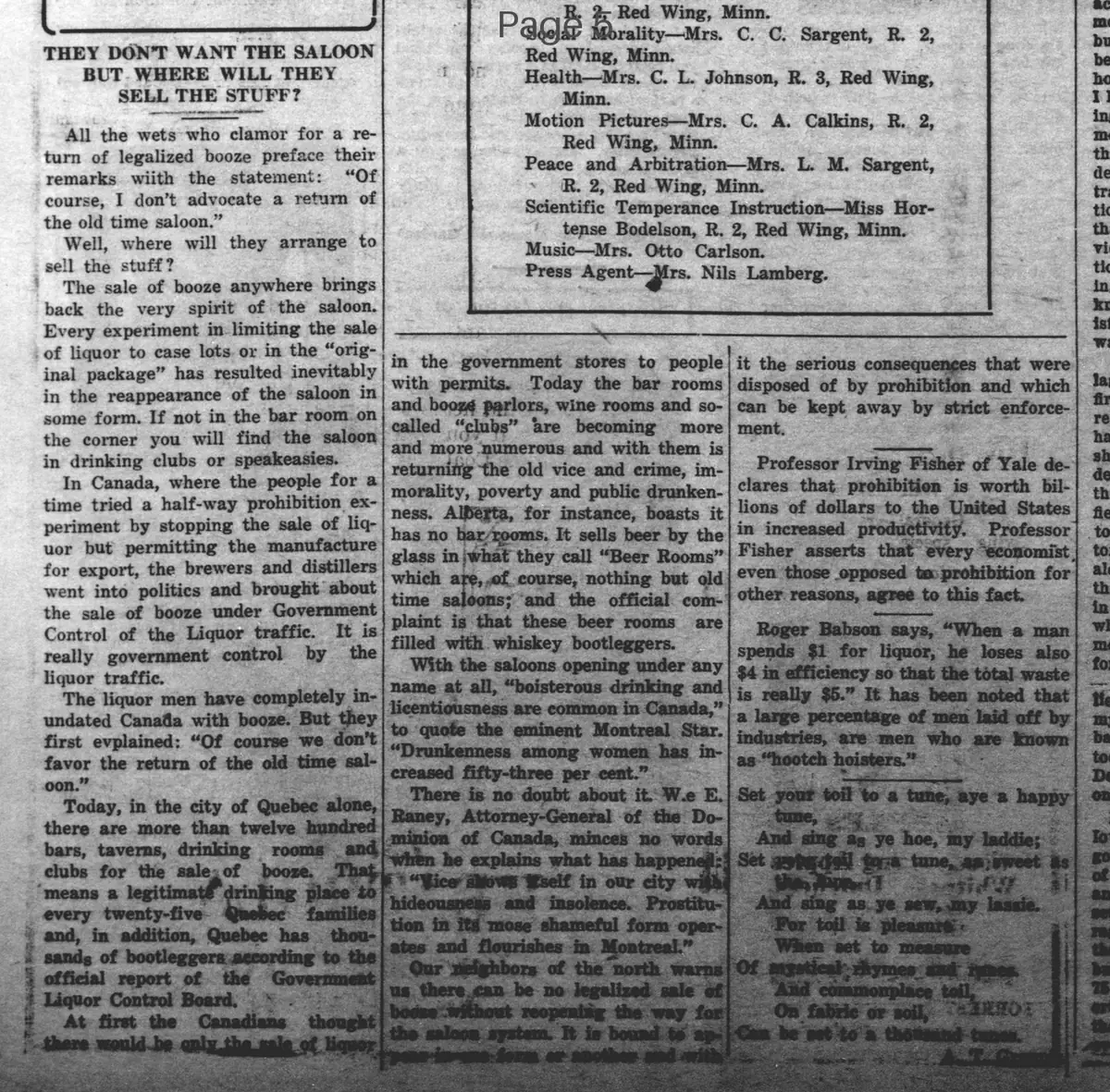
THEY DON'T WANT THE SALOON BUT WHERE WILL THEY SELL THE STUFF?
All the wets who clamor for a return of legalized booze preface their remarks with the statement: "Of course, I don't advocate a return of the old time saloon."
Well, where will they arrange to sell the stuff?
The sale of booze anywhere brings back the very spirit of the saloon. Every experiment in limiting the sale of liquor to case lots or in the "original package" has resulted inevitably in the reappearance of the saloon in some form. If not in the bar room on the corner you will find the saloon in drinking clubs or speakeasies.
In Canada, where the people for a time tried a half-way prohibition experiment by stopping the sale of liquor but permitting the manufacture for export, the brewers and distillers went into politics and brought about the sale of booze under Government Control of the Liquor traffic. It is really government control by the liquor traffic.
The liquor men have completely inundated Canada with booze. But they first explained: "Of course we don't favor the return of the old time saloon."
Today, in the city of Quebec alone, there are more than twelve hundred bars, taverns, drinking rooms and clubs for the sale of booze. That means a legitimate drinking place to every twenty-five Quebec families and, in addition, Quebec has thousands of bootleggers according to the official report of the Government Liquor Control Board.
At first the Canadians thought there would be only the sale of liquor in the government stores to people with permits. Today the bar rooms and booze parlors, wine rooms and so-called "clubs" are becoming more and more numerous and with them is returning the old vice and crime, immorality, poverty and public drunkenness. Alberta, for instance, boasts it has no bar rooms. It sells beer by the glass in what they call "Beer Rooms" which are, of course, nothing but old time saloons; and the official complaint is that these beer rooms are filled with whiskey bootleggers.
With the saloons opening under any name at all, "boisterous drinking and licentiousness are common in Canada," to quote the eminent Montreal Star. "Drunkenness among women has increased fifty-three per cent."
There is no doubt about it. W. E. Raney, Attorney-General of the Dominion of Canada, minces no words when he explains what has happened: "Vice shows itself in our city with hideousness and insolence. Prostitution in its most shameful form operates and flourishes in Montreal."
Our neighbors of the north warn us there can be no legalized sale of booze without reopening the way for the saloon system. It is bound to appear.
With the serious consequences that were disposed of by prohibition and which can be kept away by strict enforcement.
Professor Irving Fisher of Yale declares that prohibition is worth billions of dollars to the United States in increased productivity. Professor Fisher asserts that every economist even those opposed to prohibition for other reasons, agree to this fact.
Roger Babson says, "When a man spends $1 for liquor, he loses also $4 in efficiency so that the total waste is really $5." It has been noted that a large percentage of men laid off by industries, are men who are known as "hootch hoisters."
THEY DON'T WANT THE SALOON BUT WHERE WILL THEY SELL THE STUFF?
All the wets who clamor for a return of legalized booze preface their remarks with the statement: "Of course, I don't advocate a return of the old time saloon."
Well, where will they arrange to sell the stuff?
The sale of booze anywhere brings back the very spirit of the saloon. Every experiment in limiting the sale of liquor to case lots or in the "original package" has resulted inevitably in the reappearance of the saloon in some form. If not in the bar room on the corner you will find the saloon in drinking clubs or speakeasies.
In Canada, where the people for a time tried a half-way prohibition experiment by stopping the sale of liquor but permitting the manufacture for export, the brewers and distillers went into politics and brought about the sale of booze under Government Control of the Liquor traffic. It is really government control by the liquor traffic.
The liquor men have completely inundated Canada with booze. But they first explained: "Of course we don't favor the return of the old time saloon."
Today, in the city of Quebec alone, there are more than twelve hundred bars, taverns, drinking rooms and clubs for the sale of booze. That means a legitimate drinking place to every twenty-five Quebec families and, in addition, Quebec has thousands of bootleggers according to the official report of the Government Liquor Control Board.
At first the Canadians thought there would be only the sale of liquor in the government stores to people with permits. Today the bar rooms and booze parlors, wine rooms and so-called "clubs" are becoming more and more numerous and with them is returning the old vice and crime, immorality, poverty and public drunkenness. Alberta, for instance, boasts it has no bar rooms. It sells beer by the glass in what they call "Beer Rooms" which are, of course, nothing but old time saloons; and the official complaint is that these beer rooms are filled with whiskey bootleggers.
With the saloons opening under any name at all, "boisterous drinking and licentiousness are common in Canada," to quote the eminent Montreal Star. "Drunkenness among women has increased fifty-three per cent."
There is no doubt about it. W. E. Raney, Attorney-General of the Dominion of Canada, minces no words when he explains what has happened: "Vice shows itself in our city with hideousness and insolence. Prostitution in its most shameful form operates and flourishes in Montreal."
Our neighbors of the north warn us there can be no legalized sale of booze without reopening the way for the saloon system. It is bound to appear.
With the serious consequences that were disposed of by prohibition and which can be kept away by strict enforcement.
Professor Irving Fisher of Yale declares that prohibition is worth billions of dollars to the United States in increased productivity. Professor Fisher asserts that every economist even those opposed to prohibition for other reasons, agree to this fact.
Roger Babson says, "When a man spends $1 for liquor, he loses also $4 in efficiency so that the total waste is really $5." It has been noted that a large percentage of men laid off by industries, are men who are known as "hootch hoisters."
What sub-type of article is it?
Temperance
Moral Or Religious
Social Reform
What keywords are associated?
Prohibition
Saloons
Liquor Control
Temperance
Canada Experiment
Bootleggers
Vice Crime
Women Drunkenness
What entities or persons were involved?
W.C.T.U.
Canada
Quebec
Alberta
W.E. Raney
Montreal Star
Professor Irving Fisher
Roger Babson
Editorial Details
Primary Topic
Opposition To Legalized Alcohol Sales And Return Of Saloons
Stance / Tone
Strongly Pro Prohibition Warning Against Partial Measures
Key Figures
W.C.T.U.
Canada
Quebec
Alberta
W.E. Raney
Montreal Star
Professor Irving Fisher
Roger Babson
Key Arguments
Sale Of Booze Anywhere Revives The Saloon Spirit
Experiments In Limited Sales Lead To Saloons In New Forms Like Clubs Or Speakeasies
Canada's Government Controlled Liquor Sales Resulted In Over 1200 Drinking Places In Quebec Alone
Canada Sees Rising Vice, Crime, Immorality, Poverty, And Public Drunkenness
Drunkenness Among Women Increased 53% In Canada
Prostitution Flourishes In Montreal
Prohibition Increases Productivity Worth Billions
Spending On Liquor Causes Efficiency Losses