Thank you for visiting SNEWPapers!
Sign up free
Literary
July 29, 1835
The Rhode Island Republican
Newport, Newport County, Rhode Island
What is this article about?
A poem by Moore on love born of sorrow precedes a first-person narrative of the author's friend Leonard Graham, whose promising romance with a village beauty ends when she rejects him after he contracts smallpox, leaving him scarred; he rises professionally and remains single, viewing the event as providential.
Clipping
OCR Quality
95%
Excellent
Full Text
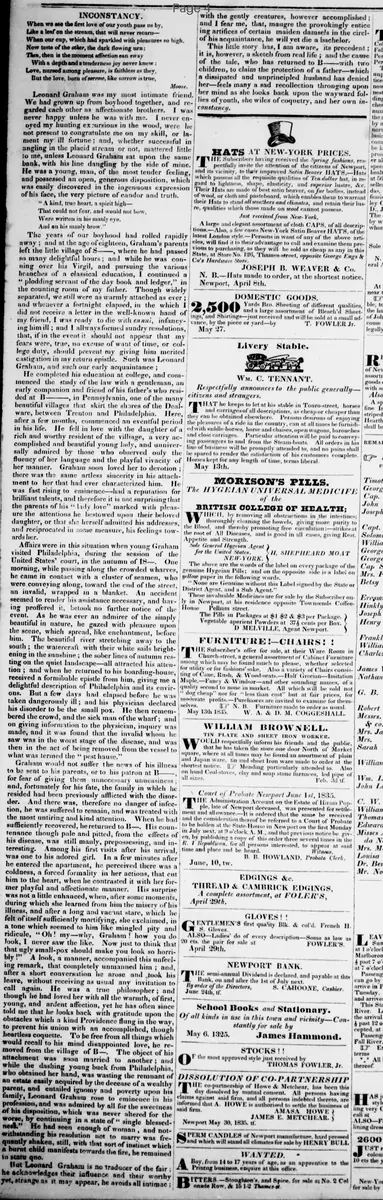
When we see the first love of our youth pass us by,
Like a leaf on the stream, that will never return;
When our cup, which had sparkled with pleasure so high,
Now tastes of the other, the dark flowing urn;
Then, then is the moment affection can sway
With a depth and a tenderness joy never knew:
Love, nursed among pleasures, is faithless as they;
But the love, born of sorrow, like sorrow is true.
Moore.
Leonard Graham was my most intimate friend. We had grown up from boyhood together, and regarded each other as affectionate brothers. I was never happy unless he was with me. I never enjoyed my hunting excursions in the wood, were he not present to congratulate me on my skill, or lament my ill fortune; and, whether successful in angling in the placid stream or not, mattered little to me, unless Leonard Graham sat upon the same bank, with his line dangling by the side of mine.
He was a young man, of the most tender feeling, and possessed an open, generous disposition, which was easily discovered in the ingenuous expression of his face, the very picture of candor and truth.
"A kind, true heart, a spirit high
That could not fear, and would not bow,
Were written in his manly eye,
And on his manly brow."
The years of our boyhood had rolled rapidly away; and at the age of eighteen, Graham's parents left the little village of S--, where he had passed so many delightful hours; and while he was conning over his Virgil, and pursuing the various branches of a classical education, I continued a "plodding servant of the day book and ledger," in the counting room of my father. Though widely separated, we still were as warmly attached as ever; and whenever a fortnight elapsed, in the which I did not receive a letter in the well-known hand of my friend, I was ready to die with ennui, fancying him ill; and I always formed sundry resolutions, that, if in the event it should not appear that my fears were true, no excuse of want of time, or college duty, should prevent my giving him merited castigation in my return epistle. Such was Leonard Graham, and such our early acquaintance;
He completed his education at college, and commenced the study of the law with a gentleman, an early companion and friend of his father's who resided at B in Pennsylvania, one of the many beautiful villages that skirt the shores of the Delaware, between Trenton and Philadelphia. Here, after a few months, commenced an eventful period in his life. He fell in love with the daughter of a rich and worthy resident of the village, a very accomplished and beautiful young lady, and universally admired by those who observed only the fluency of her language and the playful vivacity of her manner. Graham soon loved her to devotion; there was the same artless sincerity in his attachment to her that had ever characterized him.
He was fast rising to eminence--had a reputation for brilliant talents, and therefore it is not surprising that the parents of his "lady love" marked with pleasure the attentions he bestowed upon their beloved daughter, or that she herself admitted his addresses, and reciprocated in some measure, his feelings towards her.
Affairs were in this situation when young Graham visited Philadelphia, during the session of the United States' court, in the autumn of 18--. One morning, while passing along the crowded wharves, he came in contact with a cluster of seamen, who were conveying along, toward the end of the street, an invalid, wrapped in a blanket. An accident seemed to render his assistance necessary, and having proffered it, he took no further notice of the event. As he was ever an admirer of the simply beautiful in nature, he gazed with pleasure upon the scene, which spread, like enchantment, before him. The beautiful river stretching away to the south; the watercraft with their white sails brightening in the sunshine; the sober tints of autumn resting on the quiet landscape--all attracted his attention; and when he returned to his boarding-house, received a formidable epistle from him, giving me a delightful description of Philadelphia and its environs.
But a few days had elapsed before he was taken dangerously ill; and his physician declared his disorder to be the small pox. He then remembered the crowd, and the sick man of the wharf; and on giving information to the physician, inquiry was made, and it was found that the invalid whom he saw was in the worst stage of the disease, and was then in the act of being removed from the vessel to what was termed the "pest house."
Graham would not suffer the news of his illness to be sent to his parents, or to his patron at B--, for fear of giving them unnecessary uneasiness; and, fortunately for his fate, the family in which he resided had been previously afflicted with the disorder. And there was, therefore no danger of infection, he was suffered to remain, and was treated with the most untiring and kind attention. When he had sufficiently recovered, he returned to B--. His countenance though pale and pitted, from the effects of his disease, was still manly, prepossessing, and interesting. Among his first visits after his arrival, was one to his adored girl. In a few minutes after he entered the apartment, he perceived there was a coldness, a forced formality in her actions, that cut him to the heart, when he contrasted it with her former playful and affectionate manner.
His surprise was not a little enhanced, when, after some moments, during which she learned from him the misery of his illness, and after a long and vacant stare, which he felt of itself sufficiently mortifying, she exclaimed, in a tone which seemed to him like mingled pity and ridicule, "Oh! my--why, Graham! how you do look, I never saw the like. Now just to think that that ugly small-pox should make you look so horribly!" A look, a manner, accompanied this unfeeling remark, that completely unmanned him; and, after a short conversation he arose and took his leave, without receiving as usual any invitation to call again. He was a true philosopher; and though he had loved her with all the warmth, of first, young, and ardent affection, yet he has often since told me that he looks back with gratitude upon the obstacles which a kind Providence flung in the way, to prevent his union with an accomplished, though heartless coquette. To be free from all things which would recall to his mind disappointed love, he removed from the village of B--. The object of his attachment was soon married to another; and while the dashing young buck from Philadelphia, who obtained her hand, was wasting the remnant of an estate easily acquired by the decease of a wealthy parent, and entailed ignominy and poverty upon his family, Leonard Graham rose to eminence in his profession, and was admired by all for the sweetness of his disposition, which was never altered for the worse, by continuing in a state of "single blessedness." He had seen enough of woman, and notwithstanding his resolution not to marry was frequently shaken, still, with that sort of instinct which a burnt child manifests towards the fire, he remained in statu quo.
But Leonard Graham is no traducer of the fair; he acknowledges their influence and their worth; yet, strange as it may appear, he avoids all intimacy with the gentle creatures, however accomplished; and I fear me, that, maugre the provokingly enticing artifices of certain maiden damsels in the circle of his acquaintance, he will yet die a bachelor.
This little story has, I am aware, its precedent; it is, however, a sketch from real life; and the heroine of the tale, who has returned to B-- with two children, to claim the protection of a father--which a dissipated and unprincipled husband has denied her--feels many a sad recollection thronging upon her mind as she looks back upon the wayward follies of youth, the wiles of coquetry, and her own inconstancy.
Like a leaf on the stream, that will never return;
When our cup, which had sparkled with pleasure so high,
Now tastes of the other, the dark flowing urn;
Then, then is the moment affection can sway
With a depth and a tenderness joy never knew:
Love, nursed among pleasures, is faithless as they;
But the love, born of sorrow, like sorrow is true.
Moore.
Leonard Graham was my most intimate friend. We had grown up from boyhood together, and regarded each other as affectionate brothers. I was never happy unless he was with me. I never enjoyed my hunting excursions in the wood, were he not present to congratulate me on my skill, or lament my ill fortune; and, whether successful in angling in the placid stream or not, mattered little to me, unless Leonard Graham sat upon the same bank, with his line dangling by the side of mine.
He was a young man, of the most tender feeling, and possessed an open, generous disposition, which was easily discovered in the ingenuous expression of his face, the very picture of candor and truth.
"A kind, true heart, a spirit high
That could not fear, and would not bow,
Were written in his manly eye,
And on his manly brow."
The years of our boyhood had rolled rapidly away; and at the age of eighteen, Graham's parents left the little village of S--, where he had passed so many delightful hours; and while he was conning over his Virgil, and pursuing the various branches of a classical education, I continued a "plodding servant of the day book and ledger," in the counting room of my father. Though widely separated, we still were as warmly attached as ever; and whenever a fortnight elapsed, in the which I did not receive a letter in the well-known hand of my friend, I was ready to die with ennui, fancying him ill; and I always formed sundry resolutions, that, if in the event it should not appear that my fears were true, no excuse of want of time, or college duty, should prevent my giving him merited castigation in my return epistle. Such was Leonard Graham, and such our early acquaintance;
He completed his education at college, and commenced the study of the law with a gentleman, an early companion and friend of his father's who resided at B in Pennsylvania, one of the many beautiful villages that skirt the shores of the Delaware, between Trenton and Philadelphia. Here, after a few months, commenced an eventful period in his life. He fell in love with the daughter of a rich and worthy resident of the village, a very accomplished and beautiful young lady, and universally admired by those who observed only the fluency of her language and the playful vivacity of her manner. Graham soon loved her to devotion; there was the same artless sincerity in his attachment to her that had ever characterized him.
He was fast rising to eminence--had a reputation for brilliant talents, and therefore it is not surprising that the parents of his "lady love" marked with pleasure the attentions he bestowed upon their beloved daughter, or that she herself admitted his addresses, and reciprocated in some measure, his feelings towards her.
Affairs were in this situation when young Graham visited Philadelphia, during the session of the United States' court, in the autumn of 18--. One morning, while passing along the crowded wharves, he came in contact with a cluster of seamen, who were conveying along, toward the end of the street, an invalid, wrapped in a blanket. An accident seemed to render his assistance necessary, and having proffered it, he took no further notice of the event. As he was ever an admirer of the simply beautiful in nature, he gazed with pleasure upon the scene, which spread, like enchantment, before him. The beautiful river stretching away to the south; the watercraft with their white sails brightening in the sunshine; the sober tints of autumn resting on the quiet landscape--all attracted his attention; and when he returned to his boarding-house, received a formidable epistle from him, giving me a delightful description of Philadelphia and its environs.
But a few days had elapsed before he was taken dangerously ill; and his physician declared his disorder to be the small pox. He then remembered the crowd, and the sick man of the wharf; and on giving information to the physician, inquiry was made, and it was found that the invalid whom he saw was in the worst stage of the disease, and was then in the act of being removed from the vessel to what was termed the "pest house."
Graham would not suffer the news of his illness to be sent to his parents, or to his patron at B--, for fear of giving them unnecessary uneasiness; and, fortunately for his fate, the family in which he resided had been previously afflicted with the disorder. And there was, therefore no danger of infection, he was suffered to remain, and was treated with the most untiring and kind attention. When he had sufficiently recovered, he returned to B--. His countenance though pale and pitted, from the effects of his disease, was still manly, prepossessing, and interesting. Among his first visits after his arrival, was one to his adored girl. In a few minutes after he entered the apartment, he perceived there was a coldness, a forced formality in her actions, that cut him to the heart, when he contrasted it with her former playful and affectionate manner.
His surprise was not a little enhanced, when, after some moments, during which she learned from him the misery of his illness, and after a long and vacant stare, which he felt of itself sufficiently mortifying, she exclaimed, in a tone which seemed to him like mingled pity and ridicule, "Oh! my--why, Graham! how you do look, I never saw the like. Now just to think that that ugly small-pox should make you look so horribly!" A look, a manner, accompanied this unfeeling remark, that completely unmanned him; and, after a short conversation he arose and took his leave, without receiving as usual any invitation to call again. He was a true philosopher; and though he had loved her with all the warmth, of first, young, and ardent affection, yet he has often since told me that he looks back with gratitude upon the obstacles which a kind Providence flung in the way, to prevent his union with an accomplished, though heartless coquette. To be free from all things which would recall to his mind disappointed love, he removed from the village of B--. The object of his attachment was soon married to another; and while the dashing young buck from Philadelphia, who obtained her hand, was wasting the remnant of an estate easily acquired by the decease of a wealthy parent, and entailed ignominy and poverty upon his family, Leonard Graham rose to eminence in his profession, and was admired by all for the sweetness of his disposition, which was never altered for the worse, by continuing in a state of "single blessedness." He had seen enough of woman, and notwithstanding his resolution not to marry was frequently shaken, still, with that sort of instinct which a burnt child manifests towards the fire, he remained in statu quo.
But Leonard Graham is no traducer of the fair; he acknowledges their influence and their worth; yet, strange as it may appear, he avoids all intimacy with the gentle creatures, however accomplished; and I fear me, that, maugre the provokingly enticing artifices of certain maiden damsels in the circle of his acquaintance, he will yet die a bachelor.
This little story has, I am aware, its precedent; it is, however, a sketch from real life; and the heroine of the tale, who has returned to B-- with two children, to claim the protection of a father--which a dissipated and unprincipled husband has denied her--feels many a sad recollection thronging upon her mind as she looks back upon the wayward follies of youth, the wiles of coquetry, and her own inconstancy.
What sub-type of article is it?
Prose Fiction
What themes does it cover?
Love Romance
Moral Virtue
What keywords are associated?
Youthful Love
Disappointed Affection
Smallpox Disfigurement
Bachelorhood
Coquetry
Literary Details
Key Lines
When We See The First Love Of Our Youth Pass Us By,
Like A Leaf On The Stream, That Will Never Return;
When Our Cup, Which Had Sparkled With Pleasure So High,
Now Tastes Of The Other, The Dark Flowing Urn;
Then, Then Is The Moment Affection Can Sway
With A Depth And A Tenderness Joy Never Knew:
Love, Nursed Among Pleasures, Is Faithless As They;
But The Love, Born Of Sorrow, Like Sorrow Is True.
"A Kind, True Heart, A Spirit High
That Could Not Fear, And Would Not Bow,
Were Written In His Manly Eye,
And On His Manly Brow."
Oh! My Why, Graham! How You Do Look, I Never Saw The Like. Now Just To Think That That Ugly Small Pox Should Make You Look So Horribly!