Thank you for visiting SNEWPapers!
Sign up free
Daily National Intelligencer
Washington, District Of Columbia
What is this article about?
Report on U.S. Senate proceedings on February 16, including readings and introductions of bills on naval medals, copper mines, relief for John Redman Coxe, a law library, appeals in D.C., and settlers' lands. House of Representatives on February 17 handled petitions for pensions, duty remissions, horse compensation, stamp duty repeal, pre-emption rights, land warrants, and resolutions on George Washington's remains, public lands, roads, import duties, and Canadian volunteers relief bill.
Clipping
OCR Quality
Full Text
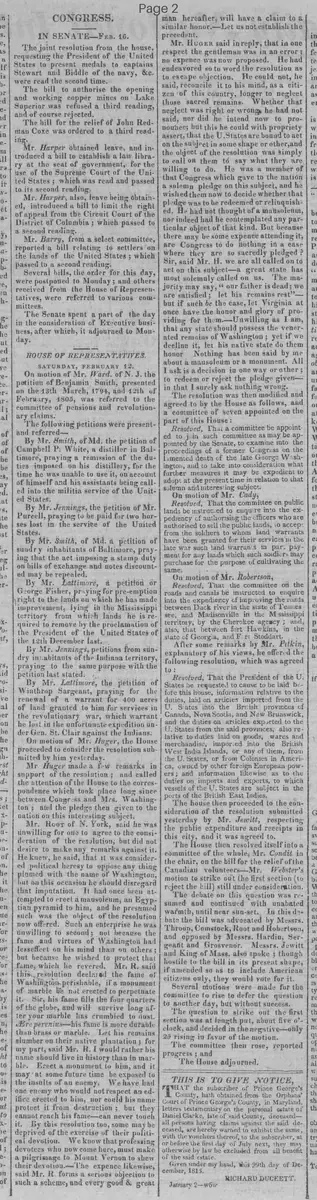
IN SENATE—FEB. 16.
The joint resolution from the house, requesting the President of the United States to present medals to captains Stewart and Biddle of the navy, &c. were read the second time.
The bill to authorise the opening and working copper mines on Lake Superior was refused a third reading, and of course rejected.
The bill for the relief of John Redman Coxe was ordered to a third reading.
Mr. Harper obtained leave, and introduced a bill to establish a law library at the seat of government, for the use of the Supreme Court of the United States; which was read and passed to its second reading.
Mr. Harper, also, leave being obtained, introduced a bill to limit the right of appeal from the Circuit Court of the District of Columbia; which passed to a second reading.
Mr. Barry, from a select committee, reported a bill relating to settlers on the lands of the United States; which passed to a second reading:
Several bills, the order for this day, were postponed to Monday; and others received from the House of Representatives: were referred to various committees.
The Senate spent a part of the day in the consideration of Executive business, after which, it adjourned to Monday.
HOUSE OF REPRESENTATIVES
SATURDAY, FEBRUARY 17.
On motion of Mr. Ward, of N. J. the petition of Benjamin Smith, presented on the 13th March, 1794, and 12th of February, 1805, was referred to the committee of pensions and revolutionary claims.
The following petitions were presented and referred—
By Mr. Smith, of Md. the petition of Campbell P. White, a distiller in Baltimore, praying a remission of the duties imposed on his distillery, for the time he was unable to use it, on account of himself and his assistants being called into the militia service of the United States.
By Mr. Jennings, the petition of Mr. Purcell, praying to be paid for two horses lost in the service of the United States.
By Mr. Smith, of Md. a petition of sundry inhabitants of Baltimore, praying that the act imposing a stamp duty on bills of exchange and notes discounted may be repealed.
By Mr. Lattimore, a petition of George Fisher, praying for pre-emption right to the lands on which he has made improvement, lying in the Mississippi territory from which lands he is required to remove by the proclamation of the President of the United States of the 12th December last.
By Mr. Jennings, petitions from sundry inhabitants of the Indiana territory, praying to the same purpose with the petition last stated:
By Mr. Lattimore, the petition of Winthrop Sargent, praying for the renewal of a warrant for 400 acres of land granted to him for services in the revolutionary war, which warrant he lost in the unfortunate expedition under Gen. St. Clair against the Indians:
On motion of Mr. Huger, the House proceeded to consider the resolution submitted by him yesterday.
Mr. Huger made a few remarks in support of the resolution; and called the attention of the House to the correspondence which took place long since between Congress and Mrs. Washington; and the pledge then given to the nation on this interesting subject.
Mr. Root of N. York, said he was unwilling for one to agree to the consideration of the resolution; but did not desire to make any remarks against it. He knew, he said, that it was considered political heresy to oppose any thing plumed with the name of Washington. but on this occasion he should disregard that imputation. It had once been attempted to erect a mausoleum, an Egyptian pyramid to him, and he presumed such was the object of the resolution now offered. Such an enterprise he was unwilling to second; not because the fame and virtues of Washington had less effect on his mind than on others; but because he wished to protect that fame, which he revered. Mr. R. said this resolution declared the fame of Washington perishable, if a monument of marble be not erected to perpetuate it. Sir, his fame fills the four quarters of the globe, and will survive long after your marble has crumbled to dust. Ere perennius—his fame is more durable than brass or marble. Let his remains slumber on their native plantation; for my part, said Mr. R. I would rather his name should live in history than in marble. Erect a monument to him, and it may at some future time be exposed to the insults of an enemy. We have had one enemy who would not respect an edifice erected to him, nor could his name protect it from destruction; but they cannot reach his fame—can never touch it. By this resolution too, some may be deprived of the exercise of their political devotion. We know that professing devotees who now come here, must make a pilgrimage to Mount Vernon to shew their devotion.—The expence likewise, said Mr. R. forms a serious objection to such a scheme, and every good & great man hereafter, will have a claim to a similar honor.—Let us not establish the precedent.
Mr. Huger said in reply, that in one respect the gentleman was in an error; no expence was now proposed. He had endeavored so to word the resolution as to escape objection. He could not, he said, reconcile it to his mind, as a citizen of this Country, longer to neglect those sacred remains. Whether that neglect was right or wrong, he had not said, nor did he intend now to pronounce; but this he could with propriety assert, that the U. States are bound to act on the subject in some shape or other, and the object of the resolution was simply to call on them to say what they are willing to do. He was a member of that Congress which gave to the nation a solemn pledge on this subject, and he wished them now to decide whether that pledge was to be redeemed or relinquished. He had not thought of a mausoleum, nor indeed had he contemplated any particular object of that kind. But because there may be some expence attending it are Congress to do nothing in a case where they are so sacredly pledged? Sir, said Mr. H. we are all called on to act on this subject—a great state has most solemnly called on us. The majority may say, "our father is dead; we are satisfied; let his remains rest" but if such be the case, let Virginia at once have the honor and glory of providing for them. Unwilling as I am, that any state should possess the venerated remains of Washington; yet if we decline it, let his native state do them honor. Nothing has been said by me about a mausoleum or a monument. All I ask is a decision in one way or other; to redeem or reject the pledge given—in that I surely ask nothing wrong.
The resolution was then modified and agreed to by the House as follows, and a committee of seven appointed on the part of this House:
Resolved, That a committee be appointed to join such committee as may be appointed by the Senate, to examine into the proceedings of a former Congress on the lamented death of the late George Washington, and to take into consideration what further measures it may be expedient to adopt at the present time in relation to that solemn and interesting subject.
On motion of Mr. Cady,
Resolved, That the committee on public lands be instructed to enquire into the expediency of authorising the officers who are authorised to sell the public lands, to accept from the soldiers to whom land warrants have been granted for their services in the late war such land warrants in part payment for any lands which such soldiers may purchase for the purpose of cultivating the same.
On motion of Mr. Robertson.
Resolved, That the committee on the roads and canals be instructed to enquire into the expediency of improving the roads between Duck river in the state of Tennessee, and Madisonville in the Mississippi territory, by the Cherokee agency; and, also, that between fort Hawkins, in the state of Georgia, and Fort Stoddart.
After some remarks by Mr. Pitkin, explanatory of his views, he offered the following resolution, which was agreed to:
Resolved, That the President of the U. States be requested to cause to be laid before this house, information relative to the duties laid on articles imported from the U. States into the British provinces of Canada, Nova Scotia, and New Brunswick, and the duties on articles exported to the U. States from the said provinces, also relative to duties laid on goods, wares and merchandise, imported into the British West India Islands, or any of them, from the U. States, or from Colonies in America, owned by other foreign European powers; and information likewise as to the duties on imports and exports, to which vessels of the U. States are subject in the ports of the British East Indies.
The house then proceeded to the consideration of the resolution submitted yesterday by Mr. Jewett, respecting the public expenditure and receipts in this city, and it was agreed to.
The House then resolved itself into a committee of the whole, Mr. Condit in the chair, on the bill for the relief of the Canadian volunteers—Mr. Webster's motion to strike out the first section (to reject the bill) still under consideration.
The debate on this question was resumed and continued with unabated warmth, until near sun-set. In this debate the bill was advocated by Messrs. Throop, Comstock, Root and Robertson, and opposed by Messrs. Hardin, Sergeant and Grosvenor. Messrs. Jewett and King of Mass. also spoke though hostile to the bill in its present shape, if amended so as to include American citizens only, they would vote for it.
Several motions were made for the committee to rise to defer the question to another day, but without success.
The question to strike out the first section was at length put, about five o'clock, and decided in the negative—only 25 rising in favor of the motion.
The committee then rose, reported progress; and
The House adjourned.
What sub-type of article is it?
What keywords are associated?
What entities or persons were involved?
Where did it happen?
Domestic News Details
Primary Location
Washington
Event Date
February 16 17
Key Persons
Outcome
various bills read, postponed, or referred; resolution on washington modified and agreed to; committee appointed; instructions to committees on lands, roads, duties; bill for canadian volunteers advanced after debate.
Event Details
Senate on Feb. 16 considered resolutions for naval medals, rejected copper mines bill, advanced relief bill for John Redman Coxe, introduced bills for law library and appeal limits, reported settlers bill, postponed others, and handled executive business. House on Feb. 17 referred petitions on pensions, duties, horses, stamp duties, pre-emption, land warrants; debated and passed modified resolution on George Washington's remains; instructed committees on soldier land payments, road improvements, import duties; agreed to resolution on expenditures; debated and advanced bill for Canadian volunteers relief.