Thank you for visiting SNEWPapers!
Sign up free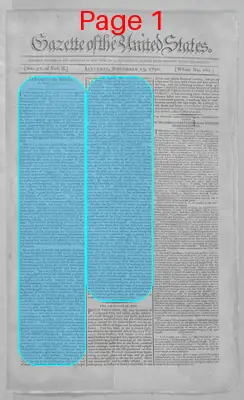
Literary
November 13, 1790
Gazette Of The United States
New York, New York County, New York
What is this article about?
In 1561 France, the Queen-mother navigates factions: Guises seek Catholic dominance, while King of Navarre, Prince of Conde, and Admiral Coligny push for Huguenot tolerance. An edict on January 28 releases religious prisoners and halts prosecutions, tacitly allowing Calvinism. Power shifts as Navarre gains palace keys, escalating religious-political tensions.
Merged-components note: Continuation of 'Discourses on Davila' across adjacent columns on page 1.
Clipping
OCR Quality
98%
Excellent
Full Text
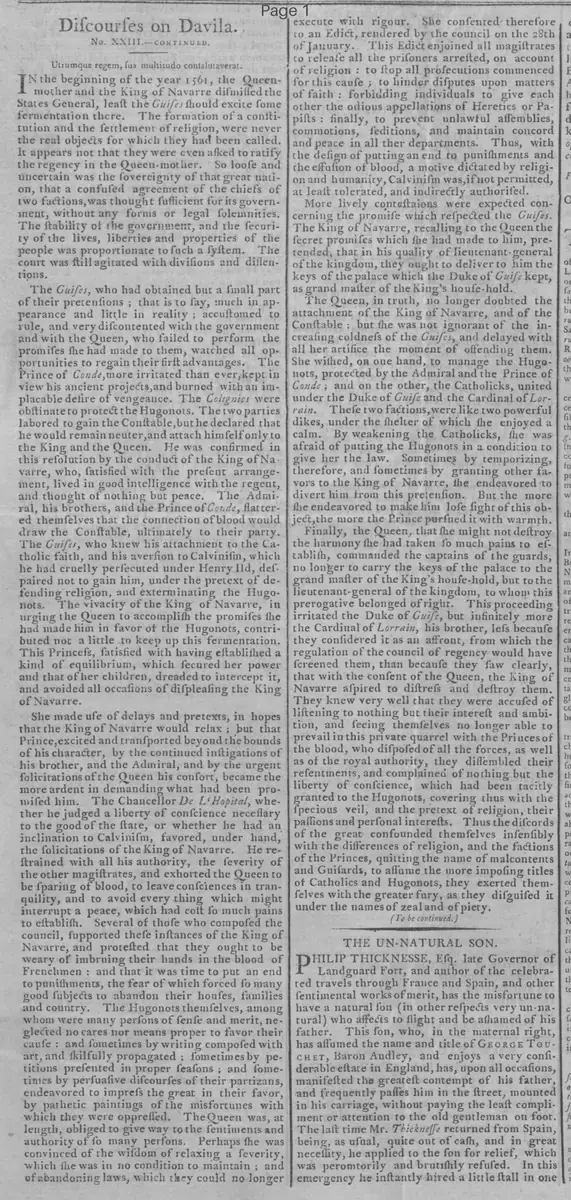
Discourses on Davila.
No. XXIII.-CONTINUED.
Utrumque regem, sua multitudo consuluerat.
In the beginning of the year 1561, the Queen-mother and the King of Navarre dismissed the States General, lest the Guises should excite some fermentation there. The formation of a constitution and the settlement of religion, were never the real objects for which they had been called. It appears not that they were even asked to ratify the regency in the Queen-mother. So loose and uncertain was the sovereignty of that great nation, that a confused agreement of the chiefs of two factions, was thought sufficient for its government, without any forms or legal solemnities. The stability of the government, and the security of the lives, liberties and properties of the people was proportionate to such a system. The court was still agitated with divisions and dissensions.
The Guises, who had obtained but a small part of their pretensions; that is to say, much in appearance and little in reality; accustomed to rule, and very discontented with the government and with the Queen, who failed to perform the promises she had made to them, watched all opportunities to regain their first advantages. The Prince of Conde, more irritated than ever, kept in view his ancient projects, and burned with an implacable desire of vengeance. The Colignies were obstinate to protect the Hugonots. The two parties labored to gain the Constable, but he declared that he would remain neuter, and attach himself only to the King and the Queen. He was confirmed in this resolution by the conduct of the King of Navarre, who, satisfied with the present arrangement, lived in good intelligence with the regent, and thought of nothing but peace. The Admiral, his brothers, and the Prince of Conde, flattered themselves that the connection of blood would draw the Constable, ultimately to their party. The Guises, who knew his attachment to the Catholic faith, and his aversion to Calvinism, which he had cruelly persecuted under Henry II, despaired not to gain him, under the pretext of defending religion, and exterminating the Hugonots. The vivacity of the King of Navarre, in urging the Queen to accomplish the promises she had made him in favor of the Hugonots, contributed not a little to keep up this fermentation. This Princess, satisfied with having established a kind of equilibrium, which secured her power and that of her children, dreaded to intercept it, and avoided all occasions of displeasing the King of Navarre. She made use of delays and pretexts, in hopes that the King of Navarre would relax; but that Prince, excited and transported beyond the bounds of his character, by the continued instigations of his brother, and the Admiral, and by the urgent solicitations of the Queen his consort, became the more ardent in demanding what had been promised him. The Chancellor De L'Hopital, whether he judged a liberty of conscience necessary to the good of the state, or whether he had an inclination to Calvinism, favored, under hand, the solicitations of the King of Navarre. He restrained with all his authority, the severity of the other magistrates, and exhorted the Queen to be sparing of blood, to leave consciences in tranquility, and to avoid every thing which might interrupt a peace, which had cost so much pains to establish. Several of those who composed the council, supported these instances of the King of Navarre, and protested that they ought to be weary of imbruing their hands in the blood of Frenchmen: and that it was time to put an end to punishments, the fear of which forced so many good subjects to abandon their houses, families and country. The Hugonots themselves, among whom were many persons of sense and merit, neglected no cares nor means proper to favor their cause: and sometimes by writings composed with art, and skilfully propagated; sometimes by petitions presented in proper seasons; and sometimes by persuasive discourses of their partisans, endeavored to impress the great in their favor, by pathetic paintings of the misfortunes with which they were oppressed. The Queen was, at length, obliged to give way to the sentiments and authority of so many persons. Perhaps she was convinced of the wisdom of relaxing a severity, which she was in no condition to maintain; and of abandoning laws, which they could no longer
execute with rigour. She consented therefore to an Edict, rendered by the council on the 28th of January. This Edict enjoined all magistrates to release all the prisoners arrested, on account of religion: to stop all prosecutions commenced for this cause; to hinder disputes upon matters of faith: forbidding individuals to give each other the odious appellations of Heretics or Papists: finally, to prevent unlawful assemblies, commotions, seditions, and maintain concord and peace in all their departments. Thus, with the design of putting an end to punishments and the effusion of blood, a motive dictated by religion and humanity, Calvinism was, if not permitted, at least tolerated, and indirectly authorised.
More lively contestations were expected concerning the promise which respected the Guises. The King of Navarre, recalling to the Queen the secret promises which she had made to him, pretended, that in his quality of lieutenant-general of the kingdom, they ought to deliver to him the keys of the palace which the Duke of Guise kept, as grand master of the King's house-hold. The Queen, in truth, no longer doubted the attachment of the King of Navarre, and of the Constable; but she was not ignorant of the increasing coldness of the Guises, and delayed with all her artifice the moment of offending them. She wished, on one hand, to manage the Hugonots, protected by the Admiral and the Prince of Conde; and on the other, the Catholics, united under the Duke of Guise and the Cardinal of Lorrain. These two factions, were like two powerful dikes, under the shelter of which she enjoyed a calm. By weakening the Catholics, she was afraid of putting the Hugonots in a condition to give her the law. Sometimes by temporizing, therefore, and sometimes by granting other favors to the King of Navarre, she endeavored to divert him from this pretension. But the more she endeavored to make him lose sight of this object, the more the Prince pursued it with warmth. Finally, the Queen, that she might not destroy the harmony she had taken so much pains to establish, commanded the captains of the guards, no longer to carry the keys of the palace to the grand master of the King's house-hold, but to the lieutenant-general of the kingdom, to whom this prerogative belonged of right. This proceeding irritated the Duke of Guise, but infinitely more the Cardinal of Lorrain, his brother, less because they considered it as an affront, from which the regulation of the council of regency would have screened them, than because they saw clearly, that with the consent of the Queen, the King of Navarre aspired to distress and destroy them. They knew very well that they were accused of listening to nothing but their interest and ambition, and seeing themselves no longer able to prevail in this private quarrel with the Princes of the blood, who disposed of all the forces, as well as of the royal authority, they dissembled their resentments, and complained of nothing but the liberty of conscience, which had been tacitly granted to the Hugonots, covering thus with the specious veil, and the pretext of religion, their passions and personal interests. Thus the discords of the great confounded themselves insensibly with the differences of religion, and the factions of the Princes, quitting the name of malcontents and Guisards, to assume the more imposing titles of Catholics and Hugonots, they exerted themselves with the greater fury, as they disguised it under the names of zeal and of piety.
(To be continued.)
No. XXIII.-CONTINUED.
Utrumque regem, sua multitudo consuluerat.
In the beginning of the year 1561, the Queen-mother and the King of Navarre dismissed the States General, lest the Guises should excite some fermentation there. The formation of a constitution and the settlement of religion, were never the real objects for which they had been called. It appears not that they were even asked to ratify the regency in the Queen-mother. So loose and uncertain was the sovereignty of that great nation, that a confused agreement of the chiefs of two factions, was thought sufficient for its government, without any forms or legal solemnities. The stability of the government, and the security of the lives, liberties and properties of the people was proportionate to such a system. The court was still agitated with divisions and dissensions.
The Guises, who had obtained but a small part of their pretensions; that is to say, much in appearance and little in reality; accustomed to rule, and very discontented with the government and with the Queen, who failed to perform the promises she had made to them, watched all opportunities to regain their first advantages. The Prince of Conde, more irritated than ever, kept in view his ancient projects, and burned with an implacable desire of vengeance. The Colignies were obstinate to protect the Hugonots. The two parties labored to gain the Constable, but he declared that he would remain neuter, and attach himself only to the King and the Queen. He was confirmed in this resolution by the conduct of the King of Navarre, who, satisfied with the present arrangement, lived in good intelligence with the regent, and thought of nothing but peace. The Admiral, his brothers, and the Prince of Conde, flattered themselves that the connection of blood would draw the Constable, ultimately to their party. The Guises, who knew his attachment to the Catholic faith, and his aversion to Calvinism, which he had cruelly persecuted under Henry II, despaired not to gain him, under the pretext of defending religion, and exterminating the Hugonots. The vivacity of the King of Navarre, in urging the Queen to accomplish the promises she had made him in favor of the Hugonots, contributed not a little to keep up this fermentation. This Princess, satisfied with having established a kind of equilibrium, which secured her power and that of her children, dreaded to intercept it, and avoided all occasions of displeasing the King of Navarre. She made use of delays and pretexts, in hopes that the King of Navarre would relax; but that Prince, excited and transported beyond the bounds of his character, by the continued instigations of his brother, and the Admiral, and by the urgent solicitations of the Queen his consort, became the more ardent in demanding what had been promised him. The Chancellor De L'Hopital, whether he judged a liberty of conscience necessary to the good of the state, or whether he had an inclination to Calvinism, favored, under hand, the solicitations of the King of Navarre. He restrained with all his authority, the severity of the other magistrates, and exhorted the Queen to be sparing of blood, to leave consciences in tranquility, and to avoid every thing which might interrupt a peace, which had cost so much pains to establish. Several of those who composed the council, supported these instances of the King of Navarre, and protested that they ought to be weary of imbruing their hands in the blood of Frenchmen: and that it was time to put an end to punishments, the fear of which forced so many good subjects to abandon their houses, families and country. The Hugonots themselves, among whom were many persons of sense and merit, neglected no cares nor means proper to favor their cause: and sometimes by writings composed with art, and skilfully propagated; sometimes by petitions presented in proper seasons; and sometimes by persuasive discourses of their partisans, endeavored to impress the great in their favor, by pathetic paintings of the misfortunes with which they were oppressed. The Queen was, at length, obliged to give way to the sentiments and authority of so many persons. Perhaps she was convinced of the wisdom of relaxing a severity, which she was in no condition to maintain; and of abandoning laws, which they could no longer
execute with rigour. She consented therefore to an Edict, rendered by the council on the 28th of January. This Edict enjoined all magistrates to release all the prisoners arrested, on account of religion: to stop all prosecutions commenced for this cause; to hinder disputes upon matters of faith: forbidding individuals to give each other the odious appellations of Heretics or Papists: finally, to prevent unlawful assemblies, commotions, seditions, and maintain concord and peace in all their departments. Thus, with the design of putting an end to punishments and the effusion of blood, a motive dictated by religion and humanity, Calvinism was, if not permitted, at least tolerated, and indirectly authorised.
More lively contestations were expected concerning the promise which respected the Guises. The King of Navarre, recalling to the Queen the secret promises which she had made to him, pretended, that in his quality of lieutenant-general of the kingdom, they ought to deliver to him the keys of the palace which the Duke of Guise kept, as grand master of the King's house-hold. The Queen, in truth, no longer doubted the attachment of the King of Navarre, and of the Constable; but she was not ignorant of the increasing coldness of the Guises, and delayed with all her artifice the moment of offending them. She wished, on one hand, to manage the Hugonots, protected by the Admiral and the Prince of Conde; and on the other, the Catholics, united under the Duke of Guise and the Cardinal of Lorrain. These two factions, were like two powerful dikes, under the shelter of which she enjoyed a calm. By weakening the Catholics, she was afraid of putting the Hugonots in a condition to give her the law. Sometimes by temporizing, therefore, and sometimes by granting other favors to the King of Navarre, she endeavored to divert him from this pretension. But the more she endeavored to make him lose sight of this object, the more the Prince pursued it with warmth. Finally, the Queen, that she might not destroy the harmony she had taken so much pains to establish, commanded the captains of the guards, no longer to carry the keys of the palace to the grand master of the King's house-hold, but to the lieutenant-general of the kingdom, to whom this prerogative belonged of right. This proceeding irritated the Duke of Guise, but infinitely more the Cardinal of Lorrain, his brother, less because they considered it as an affront, from which the regulation of the council of regency would have screened them, than because they saw clearly, that with the consent of the Queen, the King of Navarre aspired to distress and destroy them. They knew very well that they were accused of listening to nothing but their interest and ambition, and seeing themselves no longer able to prevail in this private quarrel with the Princes of the blood, who disposed of all the forces, as well as of the royal authority, they dissembled their resentments, and complained of nothing but the liberty of conscience, which had been tacitly granted to the Hugonots, covering thus with the specious veil, and the pretext of religion, their passions and personal interests. Thus the discords of the great confounded themselves insensibly with the differences of religion, and the factions of the Princes, quitting the name of malcontents and Guisards, to assume the more imposing titles of Catholics and Hugonots, they exerted themselves with the greater fury, as they disguised it under the names of zeal and of piety.
(To be continued.)
What sub-type of article is it?
Essay
What themes does it cover?
Political
Religious
Liberty Freedom
What keywords are associated?
French History
Huguenots
Guises
Queen Mother
King Of Navarre
Religious Tolerance
Political Factions
Edict Of Tolerance
Literary Details
Title
Discourses On Davila. No. Xxiii. Continued.
Subject
French Court Intrigues And Religious Tolerance In 1561
Key Lines
So Loose And Uncertain Was The Sovereignty Of That Great Nation, That A Confused Agreement Of The Chiefs Of Two Factions, Was Thought Sufficient For Its Government, Without Any Forms Or Legal Solemnities.
Thus, With The Design Of Putting An End To Punishments And The Effusion Of Blood, A Motive Dictated By Religion And Humanity, Calvinism Was, If Not Permitted, At Least Tolerated, And Indirectly Authorised.
Thus The Discords Of The Great Confounded Themselves Insensibly With The Differences Of Religion, And The Factions Of The Princes, Quitting The Name Of Malcontents And Guisards, To Assume The More Imposing Titles Of Catholics And Hugonots, They Exerted Themselves With The Greater Fury, As They Disguised It Under The Names Of Zeal And Of Piety.