Thank you for visiting SNEWPapers!
Sign up free
The Evansville Daily Journal
Evansville, Vanderburgh County, Indiana
What is this article about?
A Louisville newspaper protests Gen. Buell's military order restricting newspapers and letters on steamboats south of the city to prevent information reaching rebels, including a letter from Provost Marshal Henry Dent enforcing the rules. The paper criticizes the measure as ineffective against rebel activities in Kentucky.
Clipping
OCR Quality
Full Text
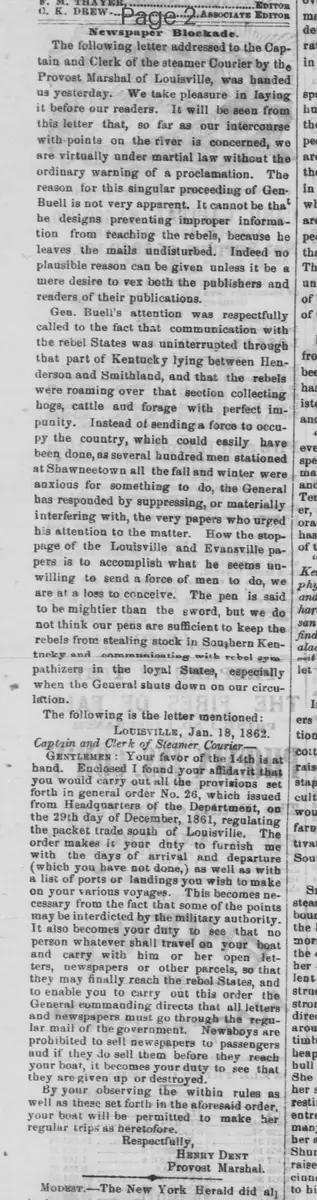
The following letter addressed to the Captain and Clerk of the steamer Courier by the Provost Marshal of Louisville, was handed us yesterday. We take pleasure in laying it before our readers. It will be seen from this letter that, so far as our intercourse with points on the river is concerned, we are virtually under martial law without the ordinary warning of a proclamation. The reason for this singular proceeding of Gen. Buell is not very apparent. It cannot be that he designs preventing improper information from reaching the rebels, because he leaves the mails undisturbed. Indeed no plausible reason can be given unless it be a mere desire to vex both the publishers and readers of their publications.
Gen. Buell's attention was respectfully called to the fact that communication with the rebel States was uninterrupted through that part of Kentucky lying between Henderson and Smithland, and that the rebels were roaming over that section collecting hogs, cattle and forage with perfect impunity. Instead of sending a force to occupy the country, which could easily have been done, as several hundred men stationed at Shawneetown all the fall and winter were anxious for something to do, the General has responded by suppressing, or materially interfering with, the very papers who urged his attention to the matter. How the stoppage of the Louisville and Evansville papers is to accomplish what he seems unwilling to send a force of men to do, we are at a loss to conceive. The pen is said to be mightier than the sword, but we do not think our pens are sufficient to keep the rebels from stealing stock in Southern Kentucky and communicating with rebel sympathizers in the loyal States, especially when the General shuts down on our circulation.
The following is the letter mentioned:
LOUISVILLE, Jan. 18, 1862.
Captain and Clerk of Steamer Courier-- Gentlemen: Your favor of the 14th is at hand. Enclosed I found your affidavit that you would carry out all the provisions set forth in general order No. 26, which issued from Headquarters of the Department, on the 29th day of December, 1861, regulating the packet trade south of Louisville. The order makes it your duty to furnish me with the days of arrival and departure (which you have not done,) as well as with a list of ports or landings you wish to make on your various voyages. This becomes necessary from the fact that some of the points may be interdicted by the military authority. It also becomes your duty to see that no person whatever shall travel on your boat and carry with him or her open letters, newspapers or other parcels, so that they may finally reach the rebel States, and to enable you to carry out this order the General commanding directs that all letters and newspapers must go through the regular mail of the government. Newsboys are prohibited to sell newspapers to passengers and if they do sell them before they reach your boat, it becomes your duty to see that they are given up or destroyed.
By your observing the within rules as well as these set forth in the aforesaid order, your boat will be permitted to make her regular trips as heretofore.
Respectfully,
Henry Dent
Provost Marshal.
What sub-type of article is it?
What themes does it cover?
What keywords are associated?
What entities or persons were involved?
Where did it happen?
Story Details
Key Persons
Location
Louisville, Kentucky; Ohio River South Of Louisville
Event Date
Jan. 18, 1862
Story Details
A Louisville newspaper complains about Gen. Buell's order No. 26 restricting transport of newspapers and letters on steamboats to prevent rebel access, publishes a letter from Provost Marshal Henry Dent enforcing compliance, and criticizes the policy as ineffective against ongoing rebel activities in southern Kentucky.