Thank you for visiting SNEWPapers!
Sign up free
Literary
April 10, 1802
The Recorder, Or, Lady's And Gentleman's Miscellany
Richmond, Virginia
What is this article about?
Dramatic narrative continuation of the Battle of Marengo, describing the French army's desperate defense, arrival of reinforcements under Desaix, turning the tide against the Austrians, resulting in victory, capture of prisoners, artillery, and standards, with Desaix's death.
Clipping
OCR Quality
95%
Excellent
Full Text
MARENGO;
OR,
THE CAMPAIGN OF ITALY:
Continued from our last.
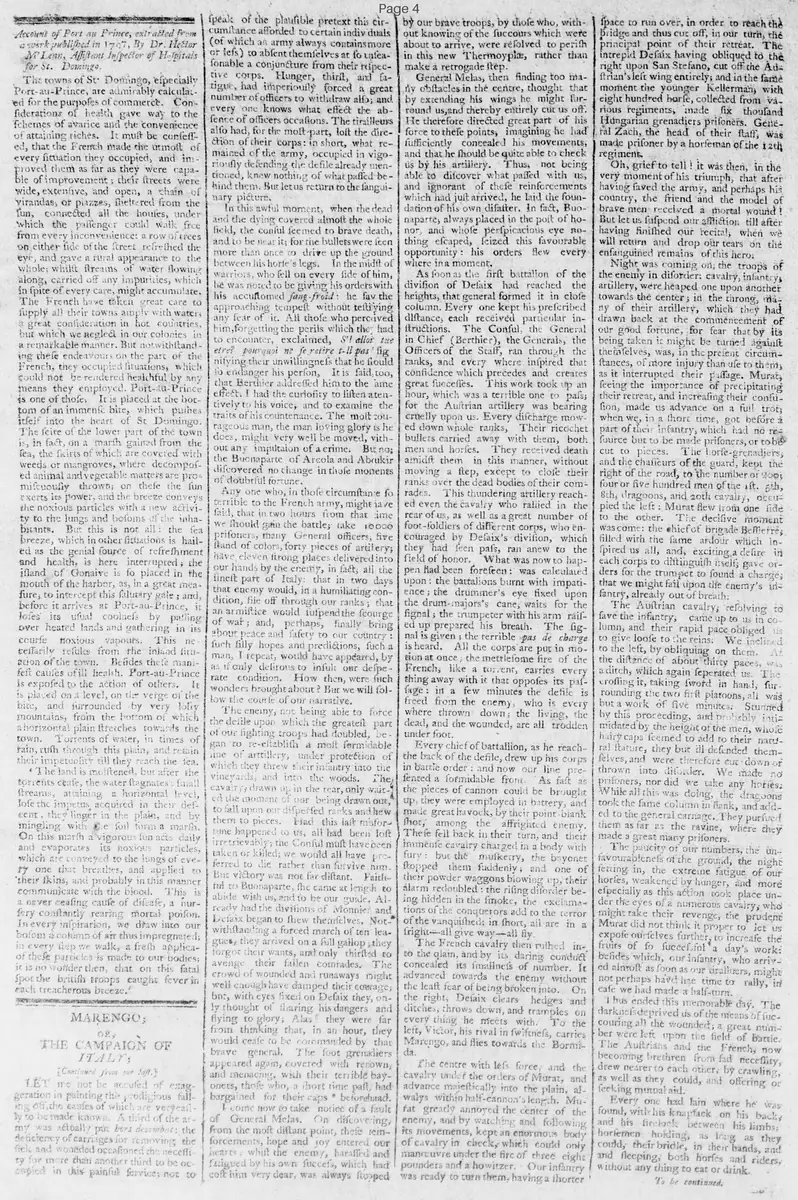
Let me not be accused of exaggeration in painting the prodigious fall of the causes of which are very easy to be made known. A third of the army was actually put hors de combat: the deficiency of carriages for removing the sick and wounded occasioned the necessity for more than another third to be occupied in this painful service; not to speak of the plausible pretext this circumstance afforded to certain individuals (of which an army always contains more or less) to absent themselves at so unreasonable a conjuncture from their respective corps. Hunger, thirst, and fatigue, had imperiously forced a great number of officers to withdraw also; and every one knows what effect the absence of officers occasions. The tirailleurs also had, for the most part, lost the direction of their corps: in short, what remained of the army, occupied in vigorously defending the defile already mentioned, knew nothing of what passed behind them. But let us return to the sanguinary picture.
In this awful moment, when the dead and the dying covered almost the whole field, the consul seemed to brave death, and to be near it; for the bullets were seen more than once to drive up the ground between his horse's legs. In the midst of warriors, who fell on every side of him, he was noted to be giving his orders with his accustomed sang-froid: he saw the approaching tempest without testifying any fear of it. All those who perceived him, forgetting the perils which they had to encounter, exclaimed, 'Shall the Emperor die? Why does he not retire?' signifying their unwillingness that he should so endanger his person. It is said, too, that Berthier addressed him to the same effect. I had the curiosity to listen attentively to his voice, and to examine the traits of his countenance. The most courageous man, the man loving glory as he does, might very well be moved, without any imputation of crime: But no: the Buonaparte of Arcola and Aboukir discovered no change in those moments of doubtful fortune.
Any one who, in those circumstances so terrible to the French army, might have said, that in two hours from that time we should gain the battle; take 5000 prisoners, many General officers, five standards of colors, forty pieces of artillery; have eleven strong places delivered into our hands by the enemy, in fact, all the finest part of Italy: that in two days that enemy would, in a humiliating condition, file off through our ranks: that an armistice would suspend the scourge of war; and, perhaps, finally bring about peace and safety to our country: such silly hopes and predictions, such a man, I repeat, would have appeared, as if only desirous to insult our desperate condition. How then, were such wonders brought about? But we will follow the course of our narrative.
The enemy, not being able to force the defile upon which the greatest part of our fighting troops had doubled, began to re-establish a most formidable line of artillery, under protection of which they threw their infantry into the vineyards, and into the woods. The cavalry drawn up in the rear, only waited the moment of our being drawn out, to fall upon our dispersed ranks and hew them to pieces. Had this last misfortune happened to us, all had been lost irretrievably; the Consul must have been taken or killed; we would all have preferred to die rather than survive him. But victory was not far distant. Faithful to Buonaparte, she came at length to abide with us, and to be our guide. Already had the divisions of Monnier and Desaix begun to show themselves. Notwithstanding a forced march of ten leagues, they arrived on a full gallop; they forgot their wants, and only thirsted to avenge their fallen comrades. The crowd of wounded and runaways might well enough have damped their courage; but, with eyes fixed on Desaix they, only thought of sharing his dangers and flying to glory; Alas! they were far from thinking that, in an hour, they would cease to be commanded by that brave general. The foot grenadiers appeared again, covered with renown, and menacing, with their terrible bayonets, those who, a short time past, had bargained for their caps beforehand.
I come now to take notice of a fault of General Melas. On discovering, from the most distant point, these reinforcements, hope and joy entered our hearts, whilst the enemy, harassed and fatigued by his own success, which had cost him very dear, was always stopped by our brave troops, by those who, without knowing of the succours which were about to arrive, were resolved to perish in this new Thermopylae, rather than make a retrograde step.
General Melas, then finding too many obstacles in the centre, thought that by extending his wings he might surround us, and thereby entirely cut us off. He therefore directed great part of his force to these points, imagining he had sufficiently concealed his movements, and that he should be quite able to check us by his artillery. Thus, not being able to discover what passed with us, and ignorant of these reinforcements which had just arrived, he laid the foundation of his own disaster. In fact, Buonaparte, always placed in the post of honor, and whose perspicacious eye nothing escaped, seized this favorable opportunity: his orders flew everywhere in a moment.
As soon as the first battalion of the division of Desaix had reached the heights, that general formed it in close column. Every one kept his prescribed distance, each received particular instructions. The Consul, the General in Chief (Berthier), the Generals, the Officers of the Staff, ran through the ranks, and everywhere inspired that confidence which precedes and creates great success. This work took up an hour, which was a terrible one to pass: for the Austrian artillery was bearing cruelly upon us. Every discharge mowed down whole ranks. Their ricochet bullets carried away with them, both men and horses. They received death amidst them in this manner, without moving a step, except to close their ranks over the dead bodies of their comrades. This thundering artillery reached even the cavalry who rallied in the rear of us, as well as a great number of foot-soldiers of different corps, who encouraged by Desaix's division, which they had seen pass, ran anew to the field of honor. What was now to happen had been foreseen: was calculated upon: the battalions burnt with impatience; the drummer's eye fixed upon the drum-major's cane; waits for the signal; the trumpeter with his arm raised up prepared his breath. The signal is given; the terrible pas de charge is heard. All the corps are put in motion at once; the mettlesome fire of the French, like a torrent, carries everything away with it that opposes its passage: in a few minutes the defile is freed from the enemy, who is everywhere thrown down; the living, the dead, and the wounded, are all trodden under foot.
Every chief of battalion, as he reached the back of the defile, drew up his corps in battle order: and now our line presented a formidable front. As fast as the pieces of cannon could be brought up, they were employed in battery, and made great havoc, by their point-blank shot, among the affrighted enemy. These fell back in their turn, and their immense cavalry charged in a body with fury: but the musketry, the bayonet stopped them suddenly; and one of their powder waggons blowing up, their alarm redoubled: the rising disorder being hidden in the smoke, the exclamations of the conquerors add to the terror of the vanquished: in short, all are in a fright—all give way—all fly.
The French cavalry then rushed into the plain, and by its daring conduct concealed its smallness of number. It advanced towards the enemy without the least fear of being broken into. On the right, Desaix clears hedges and ditches, throws down, and tramples on everything he meets with. To the left, Victor, his rival in swiftness, carries Marengo, and flies towards the Bormida. The centre with less force, and the cavalry under the orders of Murat, advance majestically into the plain, always within half-cannon's length. Murat greatly annoyed the center of the enemy, and by watching and following its movements, kept an enormous body of cavalry in check, which could only manoeuvre under the fire of three eight pounders and a howitzer. Our infantry was ready to turn them, having a shorter space to run over, in order to reach the bridge and thus cut off, in our turn, the principal point of their retreat. The intrepid Desaix having obliqued to the right upon San Stefano, cut off the Austrian's left wing entirely; and in the same moment the younger Kellerman, with eight hundred horse, collected from various regiments, made six thousand Hungarian grenadiers prisoners. General Zach, the head of their staff, was made prisoner by a horseman of the 22nd regiment.
Oh, grief to tell! it was then, in the very moment of his triumph, that after having saved the army, and perhaps his country, the friend and the model of brave men received a mortal wound! But let us suspend our affliction till after having finished our recital; when we will return and drop our tears on the ensanguined remains of this hero:
Night was coming on; the troops of the enemy in disorder: cavalry, infantry, artillery, were heaped one upon another towards the center; in the throng, many of their artillery, which they had drawn back at the commencement of our good fortune, for fear that by its being taken it might be turned against themselves, was, in the present circumstances, of more injury than use to them: as it interrupted their passage. Murat, seeing the importance of precipitating their retreat, and increasing their confusion, made us advance on a full trot when we, in a short time, got before a part of their infantry, which had no resource but to be made prisoners, or to be cut to pieces. The horse-grenadiers and the chasseurs of the guard, kept the right of the road, to the number of four or five hundred men of the 1st, 5th, 8th, dragoons, and 20th cavalry, occupied the left: Murat flew from one side to the other. The decisive moment was come: the chief of brigade Bessieres, filled with the same ardour which inspired us all, and, exciting a desire in each corps to distinguish itself, gave orders for the trumpet to sound a charge; that we might fall upon the enemy's infantry, already out of breath:
The Austrian cavalry, resolving to save the infantry, came up to us in column, and their rapid pace obliged us to give loose to the reins: We inclined to the left, by obliquing on them. At the distance of about thirty paces, was a ditch, which again separated us. The crossing it, taking sword in hand, surrounding the two first platoons, all was but a work of five minutes: Stunned by this proceeding, and probably intimidated by the height of the men, whose hairy caps seemed to add to their natural stature, they but ill defended themselves, and were therefore cut-down or thrown into disorder. We made no prisoners, nor did we take any horses. While all this was doing, the dragoons took the same column in flank, and added to the general carnage. They pursued them as far as the ravine, where they made a great many prisoners.
The paucity of our numbers, the unfavourableness of the ground, the night setting in, the extreme fatigue of our horses, weakened by hunger, and more especially as this action took place under the eyes of a numerous cavalry, who might take their revenge, the prudent Murat did not think it proper to let us expose ourselves further, to increase the fruits of so successful a day's work: besides which, our infantry, who arrived almost as soon as our cuirassiers, might not perhaps have had time to rally, in case we had made a half-turn.
Thus ended this memorable day. The darkness deprived us of the means of succouring all the wounded; a great number were left upon the field of battle. The Austrians and the French, now becoming brethren from sad necessity, drew nearer to each other, by crawling, as well as they could, and offering or seeking mutual aid.
Every one had lain where he was found, with his knapsack on his back, and his firelock between his limbs; horsemen holding, as long as they could, their bridle in their hands, and sleeping; both horses and riders, without anything to eat or drink.
To be continued.
OR,
THE CAMPAIGN OF ITALY:
Continued from our last.
Let me not be accused of exaggeration in painting the prodigious fall of the causes of which are very easy to be made known. A third of the army was actually put hors de combat: the deficiency of carriages for removing the sick and wounded occasioned the necessity for more than another third to be occupied in this painful service; not to speak of the plausible pretext this circumstance afforded to certain individuals (of which an army always contains more or less) to absent themselves at so unreasonable a conjuncture from their respective corps. Hunger, thirst, and fatigue, had imperiously forced a great number of officers to withdraw also; and every one knows what effect the absence of officers occasions. The tirailleurs also had, for the most part, lost the direction of their corps: in short, what remained of the army, occupied in vigorously defending the defile already mentioned, knew nothing of what passed behind them. But let us return to the sanguinary picture.
In this awful moment, when the dead and the dying covered almost the whole field, the consul seemed to brave death, and to be near it; for the bullets were seen more than once to drive up the ground between his horse's legs. In the midst of warriors, who fell on every side of him, he was noted to be giving his orders with his accustomed sang-froid: he saw the approaching tempest without testifying any fear of it. All those who perceived him, forgetting the perils which they had to encounter, exclaimed, 'Shall the Emperor die? Why does he not retire?' signifying their unwillingness that he should so endanger his person. It is said, too, that Berthier addressed him to the same effect. I had the curiosity to listen attentively to his voice, and to examine the traits of his countenance. The most courageous man, the man loving glory as he does, might very well be moved, without any imputation of crime: But no: the Buonaparte of Arcola and Aboukir discovered no change in those moments of doubtful fortune.
Any one who, in those circumstances so terrible to the French army, might have said, that in two hours from that time we should gain the battle; take 5000 prisoners, many General officers, five standards of colors, forty pieces of artillery; have eleven strong places delivered into our hands by the enemy, in fact, all the finest part of Italy: that in two days that enemy would, in a humiliating condition, file off through our ranks: that an armistice would suspend the scourge of war; and, perhaps, finally bring about peace and safety to our country: such silly hopes and predictions, such a man, I repeat, would have appeared, as if only desirous to insult our desperate condition. How then, were such wonders brought about? But we will follow the course of our narrative.
The enemy, not being able to force the defile upon which the greatest part of our fighting troops had doubled, began to re-establish a most formidable line of artillery, under protection of which they threw their infantry into the vineyards, and into the woods. The cavalry drawn up in the rear, only waited the moment of our being drawn out, to fall upon our dispersed ranks and hew them to pieces. Had this last misfortune happened to us, all had been lost irretrievably; the Consul must have been taken or killed; we would all have preferred to die rather than survive him. But victory was not far distant. Faithful to Buonaparte, she came at length to abide with us, and to be our guide. Already had the divisions of Monnier and Desaix begun to show themselves. Notwithstanding a forced march of ten leagues, they arrived on a full gallop; they forgot their wants, and only thirsted to avenge their fallen comrades. The crowd of wounded and runaways might well enough have damped their courage; but, with eyes fixed on Desaix they, only thought of sharing his dangers and flying to glory; Alas! they were far from thinking that, in an hour, they would cease to be commanded by that brave general. The foot grenadiers appeared again, covered with renown, and menacing, with their terrible bayonets, those who, a short time past, had bargained for their caps beforehand.
I come now to take notice of a fault of General Melas. On discovering, from the most distant point, these reinforcements, hope and joy entered our hearts, whilst the enemy, harassed and fatigued by his own success, which had cost him very dear, was always stopped by our brave troops, by those who, without knowing of the succours which were about to arrive, were resolved to perish in this new Thermopylae, rather than make a retrograde step.
General Melas, then finding too many obstacles in the centre, thought that by extending his wings he might surround us, and thereby entirely cut us off. He therefore directed great part of his force to these points, imagining he had sufficiently concealed his movements, and that he should be quite able to check us by his artillery. Thus, not being able to discover what passed with us, and ignorant of these reinforcements which had just arrived, he laid the foundation of his own disaster. In fact, Buonaparte, always placed in the post of honor, and whose perspicacious eye nothing escaped, seized this favorable opportunity: his orders flew everywhere in a moment.
As soon as the first battalion of the division of Desaix had reached the heights, that general formed it in close column. Every one kept his prescribed distance, each received particular instructions. The Consul, the General in Chief (Berthier), the Generals, the Officers of the Staff, ran through the ranks, and everywhere inspired that confidence which precedes and creates great success. This work took up an hour, which was a terrible one to pass: for the Austrian artillery was bearing cruelly upon us. Every discharge mowed down whole ranks. Their ricochet bullets carried away with them, both men and horses. They received death amidst them in this manner, without moving a step, except to close their ranks over the dead bodies of their comrades. This thundering artillery reached even the cavalry who rallied in the rear of us, as well as a great number of foot-soldiers of different corps, who encouraged by Desaix's division, which they had seen pass, ran anew to the field of honor. What was now to happen had been foreseen: was calculated upon: the battalions burnt with impatience; the drummer's eye fixed upon the drum-major's cane; waits for the signal; the trumpeter with his arm raised up prepared his breath. The signal is given; the terrible pas de charge is heard. All the corps are put in motion at once; the mettlesome fire of the French, like a torrent, carries everything away with it that opposes its passage: in a few minutes the defile is freed from the enemy, who is everywhere thrown down; the living, the dead, and the wounded, are all trodden under foot.
Every chief of battalion, as he reached the back of the defile, drew up his corps in battle order: and now our line presented a formidable front. As fast as the pieces of cannon could be brought up, they were employed in battery, and made great havoc, by their point-blank shot, among the affrighted enemy. These fell back in their turn, and their immense cavalry charged in a body with fury: but the musketry, the bayonet stopped them suddenly; and one of their powder waggons blowing up, their alarm redoubled: the rising disorder being hidden in the smoke, the exclamations of the conquerors add to the terror of the vanquished: in short, all are in a fright—all give way—all fly.
The French cavalry then rushed into the plain, and by its daring conduct concealed its smallness of number. It advanced towards the enemy without the least fear of being broken into. On the right, Desaix clears hedges and ditches, throws down, and tramples on everything he meets with. To the left, Victor, his rival in swiftness, carries Marengo, and flies towards the Bormida. The centre with less force, and the cavalry under the orders of Murat, advance majestically into the plain, always within half-cannon's length. Murat greatly annoyed the center of the enemy, and by watching and following its movements, kept an enormous body of cavalry in check, which could only manoeuvre under the fire of three eight pounders and a howitzer. Our infantry was ready to turn them, having a shorter space to run over, in order to reach the bridge and thus cut off, in our turn, the principal point of their retreat. The intrepid Desaix having obliqued to the right upon San Stefano, cut off the Austrian's left wing entirely; and in the same moment the younger Kellerman, with eight hundred horse, collected from various regiments, made six thousand Hungarian grenadiers prisoners. General Zach, the head of their staff, was made prisoner by a horseman of the 22nd regiment.
Oh, grief to tell! it was then, in the very moment of his triumph, that after having saved the army, and perhaps his country, the friend and the model of brave men received a mortal wound! But let us suspend our affliction till after having finished our recital; when we will return and drop our tears on the ensanguined remains of this hero:
Night was coming on; the troops of the enemy in disorder: cavalry, infantry, artillery, were heaped one upon another towards the center; in the throng, many of their artillery, which they had drawn back at the commencement of our good fortune, for fear that by its being taken it might be turned against themselves, was, in the present circumstances, of more injury than use to them: as it interrupted their passage. Murat, seeing the importance of precipitating their retreat, and increasing their confusion, made us advance on a full trot when we, in a short time, got before a part of their infantry, which had no resource but to be made prisoners, or to be cut to pieces. The horse-grenadiers and the chasseurs of the guard, kept the right of the road, to the number of four or five hundred men of the 1st, 5th, 8th, dragoons, and 20th cavalry, occupied the left: Murat flew from one side to the other. The decisive moment was come: the chief of brigade Bessieres, filled with the same ardour which inspired us all, and, exciting a desire in each corps to distinguish itself, gave orders for the trumpet to sound a charge; that we might fall upon the enemy's infantry, already out of breath:
The Austrian cavalry, resolving to save the infantry, came up to us in column, and their rapid pace obliged us to give loose to the reins: We inclined to the left, by obliquing on them. At the distance of about thirty paces, was a ditch, which again separated us. The crossing it, taking sword in hand, surrounding the two first platoons, all was but a work of five minutes: Stunned by this proceeding, and probably intimidated by the height of the men, whose hairy caps seemed to add to their natural stature, they but ill defended themselves, and were therefore cut-down or thrown into disorder. We made no prisoners, nor did we take any horses. While all this was doing, the dragoons took the same column in flank, and added to the general carnage. They pursued them as far as the ravine, where they made a great many prisoners.
The paucity of our numbers, the unfavourableness of the ground, the night setting in, the extreme fatigue of our horses, weakened by hunger, and more especially as this action took place under the eyes of a numerous cavalry, who might take their revenge, the prudent Murat did not think it proper to let us expose ourselves further, to increase the fruits of so successful a day's work: besides which, our infantry, who arrived almost as soon as our cuirassiers, might not perhaps have had time to rally, in case we had made a half-turn.
Thus ended this memorable day. The darkness deprived us of the means of succouring all the wounded; a great number were left upon the field of battle. The Austrians and the French, now becoming brethren from sad necessity, drew nearer to each other, by crawling, as well as they could, and offering or seeking mutual aid.
Every one had lain where he was found, with his knapsack on his back, and his firelock between his limbs; horsemen holding, as long as they could, their bridle in their hands, and sleeping; both horses and riders, without anything to eat or drink.
To be continued.
What sub-type of article is it?
Prose Fiction
What themes does it cover?
War Peace
Patriotism
What keywords are associated?
Battle Of Marengo
Napoleon Buonaparte
General Desaix
Austrian Army
French Victory
Military Reinforcements
Cavalry Charge
Literary Details
Title
Marengo; Or, The Campaign Of Italy: Continued From Our Last.
Subject
The Battle Of Marengo
Form / Style
Narrative Account Of A Military Campaign
Key Lines
In This Awful Moment, When The Dead And The Dying Covered Almost The Whole Field, The Consul Seemed To Brave Death, And To Be Near It; For The Bullets Were Seen More Than Once To Drive Up The Ground Between His Horse's Legs.
Oh, Grief To Tell! It Was Then, In The Very Moment Of His Triumph, That After Having Saved The Army, And Perhaps His Country, The Friend And The Model Of Brave Men Received A Mortal Wound!
Thus Ended This Memorable Day.