Thank you for visiting SNEWPapers!
Sign up free
The Daily Cincinnati Republican, And Commercial Register
Cincinnati, Hamilton County, Ohio
What is this article about?
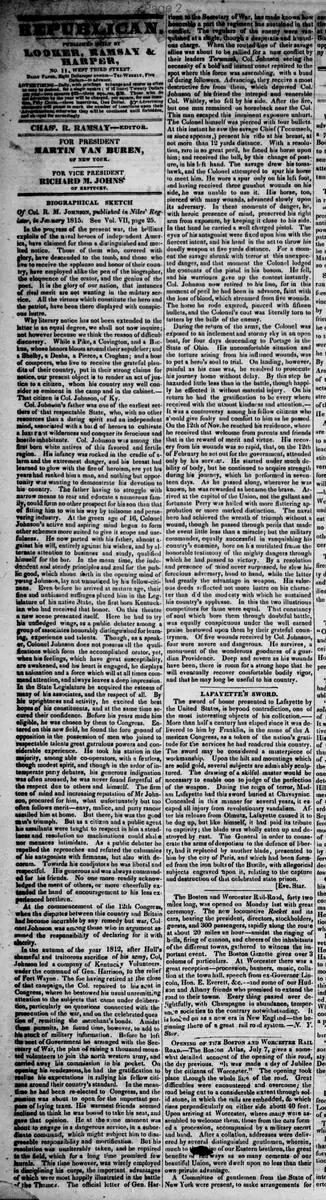
Biographical sketch of Col. Richard M. Johnson, highlighting his early life in Kentucky, political career in legislature and Congress, and heroic actions in the War of 1812, including leading volunteers and a daring charge against Tecumseh at the Battle of the Thames, where he sustained multiple wounds.
Merged-components note: Continuation of the biographical sketch of Col. R. M. Johnson.
Clipping
OCR Quality
Full Text
PRESIDENT
MARTIN
VAN BUREN,
OF NEW YORK.
FOR VICE PRESIDENT
RICHARD M. JOHNSON
OF KENTUCKY.
BIOGRAPHICAL
SKETCH
Of Col. R. M. Johnson, published in Niles' Register, in January 1815. See Vol. VII, page 25.
In the progress of the present war, the brilliant exploits of the naval heroes of independent America, have claimed for them a distinguished and merited notice. Those of them who, covered with glory, have descended to the tomb, and those who live to receive the applause and honor of their country, have employed alike the pen of the biographer, the eloquence of the orator, and the genius of the poet. It is the glory of our nation, that instances of rival merit are not wanting in the military service. All the virtues which constitute the hero and the patriot, have been there displayed with conspicuous lustre.
Why literary notice has not been extended to the latter in an equal degree, we shall not now inquire; not however because we think the reason of difficult discovery. While a Pike, a Covington, and a Backus, whose honors bloom around their sepulcher; and Shelby, a Desha, a Pierce, a Croghan; and a host of compeers, who live to receive the grateful plaudits of their country, put in their strong claims for notice, our present object is to render an act of justice to a citizen, whom his country may well consider as eminent in the camp and in the cabinet.— That citizen is Col. Johnson, of Ky.
Col. Johnson's father was one of the earliest settlers of that respectable State, who, with no other resources than a daring spirit and an independent mind, associated with a band of heroes to cultivate luxuriant wilderness and conquer its ferocious and hostile inhabitants. Col. Johnson was among the first born white natives of this favored and fertile region. His infancy was rocked in the cradle of alarm and the extremest danger, and his breast had learned to glow with the fire of heroism, ere yet his years had ranked him a man, and nothing but opportunity was wanting to demonstrate his devotion to his country. The father having to struggle with narrow means to rear and educate a numerous family, could form no other prospect for his son than that of hiring him to win his way by toilsome and persevering industry. At the green age of 16, Colonel Johnson's active and aspiring mind began to form other schemes more suited to give it scope and usefulness. He now parted with his father, almost against his will, entirely against his wishes, and by alternate attention to business and study, qualified himself for the bar. In the mean time, the independent and steady principles and zeal for the public good, which shone forth in the opening mind of young Johnson, lay not unnoticed by his fellow-citizens. Even before he arrived at mature age, their fine and unbiassed suffrages placed him in the Legislature of his native State, the first born Kentuckian who had received that honor. On this theatre new scene presented itself. Here he had to try his unfledged wings, as a public debater among a group of associates honorably distinguished for learning, experience and talents. Though, as a speaker, Colonel Johnson does not possess all the qualifications which form the accomplished orator, yet, when his feelings, which have great susceptibility, are awakened, and his heart is engaged, he displays an animation and a force which will at all times command attention, and always leaves a deep impression. In the State Legislature he acquired the esteem of many of his associates, and the respect of all. By his uprightness and activity, he excited the best hopes of his constituents, and at the same time secured their confidence. Before his years made him eligible, he was chosen by them to Congress. Entered on this new field, he found the foreground of opposition in the possession of men who joined to respectable talents great garrulous powers and considerable experience. He took his station in the majority, among able co-operators, with a fearless, though modest spirit, and though in the ardor of intemperate party debates, his generous indignation was often aroused, he was never found forgetful of the respect due to others and himself. The firm tone of mind and increasing reputation of Mr. Johnson, procured for him, what unfortunately but too often follows merit—envy, malice, and party rancor assailed him at home. But there, his was the good man's triumph. But as a citizen and a public agent his assailants were taught to respect in him a steadiness and resolution no machinations could shake nor menaces intimidate. As a public debater he repelled the reproaches and refuted the calumnies of his antagonists with firmness, but also with decorum. Towards his coadjutors he was liberal and respectful. His generous aid was always commanded for his friends. No one more readily acknowledged the merit of others, or more cheerfully extended the hand of encouragement to his less experienced brethren.
At the commencement of the 12th Congress, when the disputes between this country and Britain had become incurable by any remedy but war, Colonel Johnson was among those who in argument assumed the responsibility of declaring for it with alacrity.
In the autumn of the year 1812, after Hull's shameful and traitorous sacrifice of his army, Col. Johnson led a company of Kentucky Volunteers, under the command of Gen. Harrison, to the relief of Fort Wayne. The foe having retired at the close of that campaign, the Col. repaired to his seat in Congress, where he bestowed his usual unremitting attention to the subjects that came under deliberation, particularly on questions connected with the prosecution of the war, and on the celebrated question of remitting the merchant's bonds. Amidst these pursuits, he found time, however, to add to his stock of military information. Before he left the seat of Government he arranged with the Secretary of War, the plan of raising a thousand mounted volunteers to join the north western army, and carried away his commission in his pocket. On opening his rendezvous, he had the gratification to realize his expectations in rallying his fellow citizens around their country's standard. In the mean time he had been re-elected to Congress, and the session was about to open for the important purpose of laying taxes. His warmest friends seemed inclined to think he was bound to take his seat, and have that opinion. He at the same time was about to engage in a dangerous service, in a subordinate command, which might subject him to disagreeable responsibility and mortification. But his resolution was unalterably taken, and he repaired to the field, which for a long time promised few laurels. This time however, was wisely employed in disciplining his corps, the important advantages of which were most happily illustrated in the battle of the Thames. The official letter of Gen. Harrison to the Secretary of War, has made known how honorable a part the regiment has sustained in that conflict. The regulars of the enemy were vanquished at a single, though a desperate and hazardous charge. When the routed line of their savage allies was about to be rallied for a new conflict by their leaders Tecumseh, Col. Johnson seeing the necessity of a bold and instant onset repaired to the spot where this force was assembling, with a band of daring followers. Advancing, they receive a most destructive fire from them, which deprived Col. Johnson of his friend the intrepid and venerable Col. Whitley, who fell by his side. After the fire but one man remained on horseback near the Col. This man escaped this imminent exposure unhurt. The Colonel himself was pierced with four bullets. At this instant he saw the savage Chief (Tecumseh, as since appears.) present his rifle at his breast, at not more than 12 yards distance. With a resolution, rare in so great peril, he faced his horse upon him; and received the ball, by this change of posture, in his left hand. The savage drew his tomahawk, and the Colonel attempted to spur his horse to meet him. He wore a spur only on his left foot, and having received three gunshot wounds on his side, he was unable to use it. His horse, too, pierced with many wounds, advanced slowly upon its adversary. In these moments of danger, he, with heroic presence of mind, preserved his right arm from exposure, by keeping it close to his side. In that hand he carried a well charged pistol. The eyes of his antagonist were fixed upon him with the fiercest intent, and his hand in the act to throw his deadly weapon at five yards distance. For a moment the savage shrunk with terror at this unexpected danger, and that moment the Colonel lodged the contents of the pistol in his bosom. He fell and his warriors gave up the contest instantly. Col. Johnson now retired to his line, for in this moment of peril he had been in advance, faint with the loss of blood, which streamed from five wounds. The horse he rode expired, pierced with fifteen bullets, and the Colonel's coat was literally torn to tatters by the balls of the enemy.
During the return of the army, the Colonel was exposed to an inclement and stormy sky in an open boat, for four days descending to Portage in the State of Ohio. His uncomfortable situation and the torture arising from his inflamed wounds, was to put a hero's soul to trial. On landing, however painful as his case was, he resolved to prosecute his journey home without delay. By this step he hazarded little less than in the battle, though happily he effected it without material injury. On his return he had the gratification to be every where received with the utmost kindness and attention.— It was a controversy among his fellow citizens who should give fealty and comfort to him as he passed. On the 12th of Nov. he reached his residence, where he received that welcome from parents and friends that is the reward of merit and virtue. His recovery from his wounds was so rapid, that, on the 12th of February he set out for the government, attended only by his servant. He started under much debility of body, but he continued to acquire strength during his journey, which he performed in seventeen days. As he passed along, wherever he was known, he was rewarded as became the brave. Arrived at the capitol of the Union, not the gallant and fortunate Perry was hailed with more flattering approbation or more marked distinction. The naval hero had achieved the wreath of triumph without a wound, though he passed through perils that made the event little less than a miracle; but the military commander, equally successful in vanquishing his country's enemies, bore on his mutilated frame the honorable testimony of the mighty dangers through which he had passed to victory. By a resolution and presence of mind never surpassed, he slew his ferocious adversary, hand to hand, while the latter had greatly the advantage in weapon. His valorous deeds reflected not more lustre on his character than did the modesty with which he sustained his country's applause. In this the two illustrious competitors for fame were equal. That constancy of soul which bore them through doubtful battle, was equally conspicuous under the well earned praise bestowed upon them by their grateful countrymen. Of five wounds received by Col. Johnson, four were severe and dangerous. He survives, a monument of the wondrous goodness of a guardian Providence. Deep and severe as his wounds have been, there is room for a strong hope that he will eventually recover comfortable bodily vigor, and that he may long be useful to his country.
What sub-type of article is it?
What themes does it cover?
What keywords are associated?
What entities or persons were involved?
Where did it happen?
Story Details
Key Persons
Location
Kentucky, Fort Wayne, Battle Of The Thames, Ohio
Event Date
1812 1814
Story Details
Col. Richard M. Johnson, born in Kentucky, rises from humble beginnings to become a lawyer, legislator, and Congressman advocating for the War of 1812. He leads Kentucky volunteers under Gen. Harrison, plays a key role in the Battle of the Thames by charging Native American forces, mortally wounding Tecumseh in hand-to-hand combat despite sustaining five wounds, and recovers to continue public service.