Thank you for visiting SNEWPapers!
Sign up free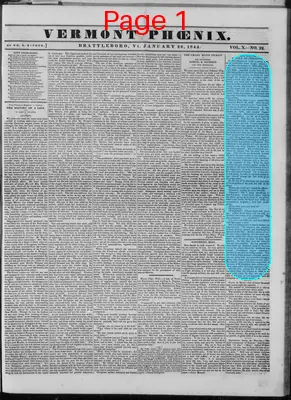
Literary
January 26, 1844
Vermont Phœnix
Brattleboro, Bellows Falls, Ludlow, Windham County, Windsor County, Vermont
What is this article about?
In 1840, an insane young man escaped from Brattleboro, VT, stole a watch in Springfield, MA, and was imprisoned under the alias Richard Roe. Mistreated for refusing to work due to insanity, his true identity from Wallingford, VT, was discovered upon release, leading to his family's care.
Clipping
OCR Quality
95%
Excellent
Full Text
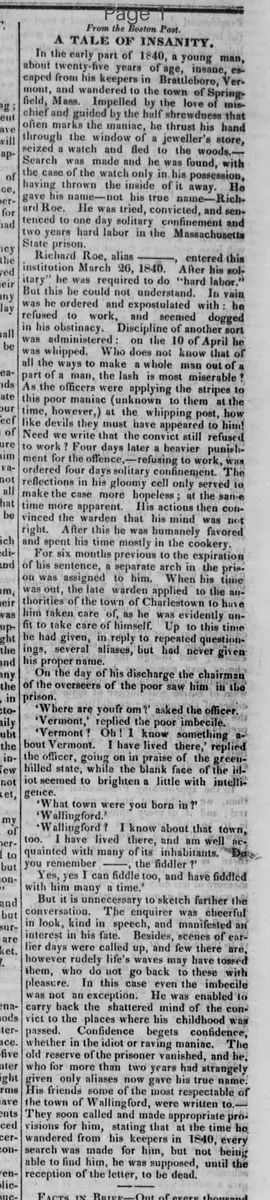
From the Boston Post.
A TALE OF INSANITY
In the early part of 1840, a young man, about twenty-five years of age, insane, escaped from his keepers in Brattleboro, Vermont, and wandered to the town of Springfield, Mass. Impelled by the love of mischief and guided by the half shrewdness that often marks the maniac, he thrust his hand through the window of a jeweller's store, seized a watch and fled to the woods. Search was made and he was found, with the case of the watch only in his possession, having thrown the inside of it away. He gave his name—not his true name—Richard Roe. He was tried, convicted, and sentenced to one day solitary confinement and two years hard labor in the Massachusetts State prison.
Richard Roe, alias entered this institution March 26, 1840. After his solitary he was required to do "hard labor." But this he could not understand. In vain was he ordered and expostulated with: he refused to work, and seemed dogged in his obstinacy. Discipline of another sort was administered: on the 10 of April he was whipped. Who does not know that of all the ways to make a whole man out of a part of a man, the lash is most miserable? As the officers were applying the stripes to this poor maniac (unknown to them at the time, however,) at the whipping post, how like devils they must have appeared to him! Need we write that the convict still refused to work? Four days later a heavier punishment for the offence,—refusing to work, was ordered four days solitary confinement. The reflections in his gloomy cell only served to make the case more hopeless: at the same time more apparent. His actions then convinced the warden that his mind was not right. After this he was humanely favored and spent his time mostly in the cookery.
For six months previous to the expiration of his sentence, a separate arch in the prison was assigned to him. When his time was out, the late warden applied to the authorities of the town of Charlestown to have him taken care of, as he was evidently unfit to take care of himself. Up to this time he had given, in reply to repeated questionings, several aliases, but had never given his proper name.
On the day of his discharge the chairmen of the overseers of the poor saw him in the prison.
'Where are you from?' asked the officer.
'Vermont,' replied the poor imbecile.
'Vermont? Oh! I know something about Vermont. I have lived there,' replied the officer, going on in praise of the green-hilled state, while the blank face of the idiot seemed to brighten a little with intelligence.
'What town were you born in?'
'Wallingford.'
'Wallingford? I know about that town too. I have lived there, and am well acquainted with many of its inhabitants. Do you remember the fiddler?'
'Yes, yes I can fiddle too, and have fiddled with him many a time.'
But it is unnecessary to sketch farther the conversation. The enquirer was cheerful in look, kind in speech, and manifested an interest in his fate. Besides, scenes of earlier days were called up, and few there are, however rudely life's waves may have tossed them, who do not go back to these with pleasure. In this case even the imbecile was not an exception. He was enabled to carry back the shattered mind of the convict to the places where his childhood was passed. Confidence begets confidence, whether in the idiot or raving maniac. The old reserve of the prisoner vanished, and he, who for more than two years had strangely given only aliases now gave his true name.
His friends some of the most respectable of the town of Wallingford, were written to. They soon called and made appropriate provisions for him, stating that at the time he wandered from his keepers in 1840, every search was made for him, but not being able to find him, he was supposed, until the reception of the letter, to be dead.
A TALE OF INSANITY
In the early part of 1840, a young man, about twenty-five years of age, insane, escaped from his keepers in Brattleboro, Vermont, and wandered to the town of Springfield, Mass. Impelled by the love of mischief and guided by the half shrewdness that often marks the maniac, he thrust his hand through the window of a jeweller's store, seized a watch and fled to the woods. Search was made and he was found, with the case of the watch only in his possession, having thrown the inside of it away. He gave his name—not his true name—Richard Roe. He was tried, convicted, and sentenced to one day solitary confinement and two years hard labor in the Massachusetts State prison.
Richard Roe, alias entered this institution March 26, 1840. After his solitary he was required to do "hard labor." But this he could not understand. In vain was he ordered and expostulated with: he refused to work, and seemed dogged in his obstinacy. Discipline of another sort was administered: on the 10 of April he was whipped. Who does not know that of all the ways to make a whole man out of a part of a man, the lash is most miserable? As the officers were applying the stripes to this poor maniac (unknown to them at the time, however,) at the whipping post, how like devils they must have appeared to him! Need we write that the convict still refused to work? Four days later a heavier punishment for the offence,—refusing to work, was ordered four days solitary confinement. The reflections in his gloomy cell only served to make the case more hopeless: at the same time more apparent. His actions then convinced the warden that his mind was not right. After this he was humanely favored and spent his time mostly in the cookery.
For six months previous to the expiration of his sentence, a separate arch in the prison was assigned to him. When his time was out, the late warden applied to the authorities of the town of Charlestown to have him taken care of, as he was evidently unfit to take care of himself. Up to this time he had given, in reply to repeated questionings, several aliases, but had never given his proper name.
On the day of his discharge the chairmen of the overseers of the poor saw him in the prison.
'Where are you from?' asked the officer.
'Vermont,' replied the poor imbecile.
'Vermont? Oh! I know something about Vermont. I have lived there,' replied the officer, going on in praise of the green-hilled state, while the blank face of the idiot seemed to brighten a little with intelligence.
'What town were you born in?'
'Wallingford.'
'Wallingford? I know about that town too. I have lived there, and am well acquainted with many of its inhabitants. Do you remember the fiddler?'
'Yes, yes I can fiddle too, and have fiddled with him many a time.'
But it is unnecessary to sketch farther the conversation. The enquirer was cheerful in look, kind in speech, and manifested an interest in his fate. Besides, scenes of earlier days were called up, and few there are, however rudely life's waves may have tossed them, who do not go back to these with pleasure. In this case even the imbecile was not an exception. He was enabled to carry back the shattered mind of the convict to the places where his childhood was passed. Confidence begets confidence, whether in the idiot or raving maniac. The old reserve of the prisoner vanished, and he, who for more than two years had strangely given only aliases now gave his true name.
His friends some of the most respectable of the town of Wallingford, were written to. They soon called and made appropriate provisions for him, stating that at the time he wandered from his keepers in 1840, every search was made for him, but not being able to find him, he was supposed, until the reception of the letter, to be dead.
What sub-type of article is it?
Prose Fiction
What themes does it cover?
Moral Virtue
Political
What keywords are associated?
Insanity
Prison
Escape
Alias
Vermont
Massachusetts
Whipping
Reform
Literary Details
Title
A Tale Of Insanity
Key Lines
'Where Are You From?' Asked The Officer.
'Vermont,' Replied The Poor Imbecile.
'What Town Were You Born In?'
'Wallingford.'
Who Does Not Know That Of All The Ways To Make A Whole Man Out Of A Part Of A Man, The Lash Is Most Miserable?