Thank you for visiting SNEWPapers!
Sign up free
Story
July 24, 1887
Telegram Herald
Grand Rapids, Kent County, Michigan
What is this article about?
During the Civil War, young Doc substitutes for 18-year-old John Paxton, serves bravely as a soldier, returns home dying from fever and hardship, and dies peacefully after seeing the love vine grow, cared for by Lucy Paxton and others.
Clipping
OCR Quality
75%
Good
Full Text
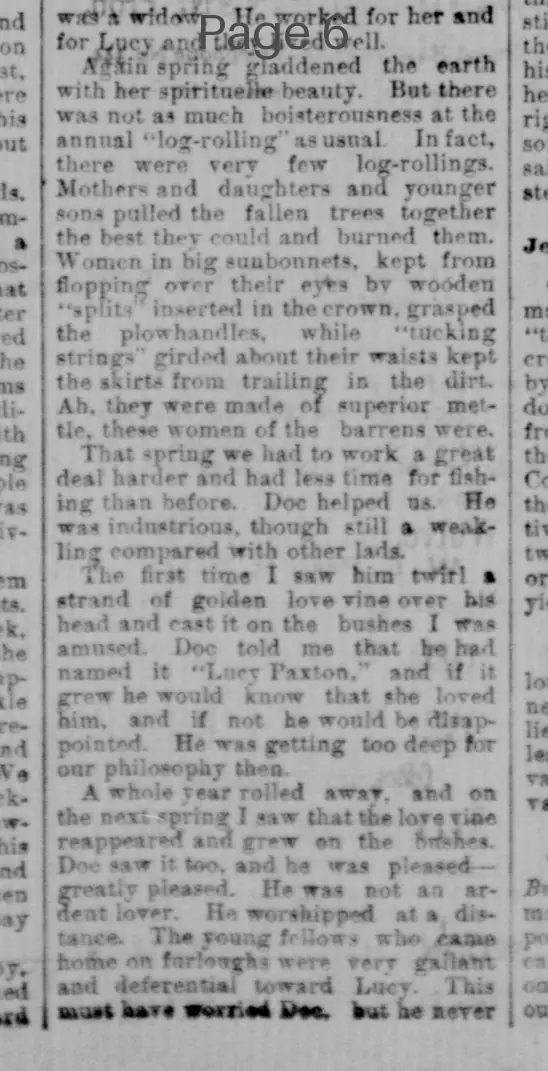
Then came that call for men; that plucking of the very flower of the South in rivalry. O remorseless war!
John Paxton was 18, and he must go to the war and leave his mother and Lucy to fight the harder battle at home. The enrolling officer, that agent of war whose approach was dreaded so much, he told us that.
When he left Doc followed him out to the gate. After a short talk the officer departed after shaking Doc by the hand.
"I've learned somethin'," he said with a radiant face when he came back. "The enrolling officer says that John can stay at home if he can get a substitute. I'm going to be his substitute."
Of course John Paxton did not want to agree to the proposition. It looked unmanly for him to stay and send a little fellow like Doc. But the latter argued, "I ain't got nobody to care for, an' if I get hurt nobody'll be the loser. You've got Mrs. Paxton and-and Lucy," he stammered, "an' you ought to stay an' make the crop. Besides, I want to git to be a big Gener'l some time, maybe, an' then I'll-I'll-well, I want to go, anyhow, an' I'm going as your substitute." And he went.
Poor little Doc! Friend and playmate of our childhood. His delicate form that had been so nourished and cherished by his doting mother -and our mother had loved him as one of her own- when they brought him home, wasted with privation and hardship, and the hectic fever burned on his cheeks, he looked very much like our little old Doc. It was springtime again then. There was a lull in the wild tempest of war. Bronzed and bearded our heroes came home. Bowed with defeat, tattered and torn, ragged veterans of a hundred battles.
There were so many heroic deeds that the recital of daring achievements grew commonplace. They did not like to talk about it. Our Doc had been every inch a soldier. He had acquitted himself nobly. He was going to die, as so many stronger men had died, without a stain on his fair escutcheon. It was Lucy Paxton's hand that plucked the sweet bouquets which found their way to his feeble hands. It was her mother who sat with our mother and counted the pulse beats of our Doc as life was fading fast away.
One day he roused himself from his stupor, and with a light in his eyes I had never seen before, he asked me to go and see if the "love vine" had begun growing. I did as he requested, and found the golden threads entwined around the low gallberry bushes.
"Is it a-growing," he asked when I came in.
"Yes; it is running everywhere," I answered.
"I knowed it. That's a sure sign. I'm so glad."
That was the last word he ever uttered.
Lucy Paxton is the noble wife of an honest farmer. She is a good woman, and she points out a little mound in the old graveyard to her children, when they go there meeting days, and they scrape away the green mold, and the lichens, and spell out the letters on it. D-O-C. Doc."—M. M. Folsom in Atlanta Constitution.
John Paxton was 18, and he must go to the war and leave his mother and Lucy to fight the harder battle at home. The enrolling officer, that agent of war whose approach was dreaded so much, he told us that.
When he left Doc followed him out to the gate. After a short talk the officer departed after shaking Doc by the hand.
"I've learned somethin'," he said with a radiant face when he came back. "The enrolling officer says that John can stay at home if he can get a substitute. I'm going to be his substitute."
Of course John Paxton did not want to agree to the proposition. It looked unmanly for him to stay and send a little fellow like Doc. But the latter argued, "I ain't got nobody to care for, an' if I get hurt nobody'll be the loser. You've got Mrs. Paxton and-and Lucy," he stammered, "an' you ought to stay an' make the crop. Besides, I want to git to be a big Gener'l some time, maybe, an' then I'll-I'll-well, I want to go, anyhow, an' I'm going as your substitute." And he went.
Poor little Doc! Friend and playmate of our childhood. His delicate form that had been so nourished and cherished by his doting mother -and our mother had loved him as one of her own- when they brought him home, wasted with privation and hardship, and the hectic fever burned on his cheeks, he looked very much like our little old Doc. It was springtime again then. There was a lull in the wild tempest of war. Bronzed and bearded our heroes came home. Bowed with defeat, tattered and torn, ragged veterans of a hundred battles.
There were so many heroic deeds that the recital of daring achievements grew commonplace. They did not like to talk about it. Our Doc had been every inch a soldier. He had acquitted himself nobly. He was going to die, as so many stronger men had died, without a stain on his fair escutcheon. It was Lucy Paxton's hand that plucked the sweet bouquets which found their way to his feeble hands. It was her mother who sat with our mother and counted the pulse beats of our Doc as life was fading fast away.
One day he roused himself from his stupor, and with a light in his eyes I had never seen before, he asked me to go and see if the "love vine" had begun growing. I did as he requested, and found the golden threads entwined around the low gallberry bushes.
"Is it a-growing," he asked when I came in.
"Yes; it is running everywhere," I answered.
"I knowed it. That's a sure sign. I'm so glad."
That was the last word he ever uttered.
Lucy Paxton is the noble wife of an honest farmer. She is a good woman, and she points out a little mound in the old graveyard to her children, when they go there meeting days, and they scrape away the green mold, and the lichens, and spell out the letters on it. D-O-C. Doc."—M. M. Folsom in Atlanta Constitution.
What sub-type of article is it?
Heroic Act
Tragedy
Biography
What themes does it cover?
Bravery Heroism
Tragedy
Family
What keywords are associated?
Civil War Substitute
Boy Soldier
Heroic Sacrifice
War Tragedy
Love Vine Omen
What entities or persons were involved?
John Paxton
Doc
Lucy Paxton
Mrs. Paxton
Where did it happen?
Southern Home
Story Details
Key Persons
John Paxton
Doc
Lucy Paxton
Mrs. Paxton
Location
Southern Home
Event Date
Civil War Era
Story Details
Young Doc insists on substituting for John Paxton in the war, serves nobly despite hardships, returns dying from fever, and dies content after seeing the love vine grow, symbolizing hope.