Thank you for visiting SNEWPapers!
Sign up free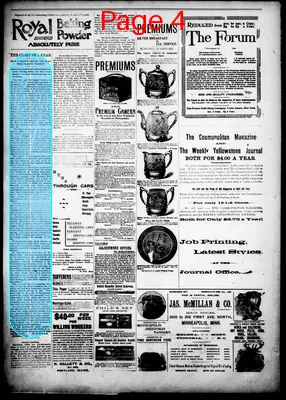
Editorial
February 13, 1894
The Yellowstone Journal
Miles City, Custer County, Montana
What is this article about?
An 1893 editorial critiques the Democratic free trade policy and Wilson tariff bill for causing economic depression, contrasting it with prosperity under Republican protectionism. Cites reports from R.G. Dun and Bradstreet's, historical precedents, and urges policy reversal. Signed H.A. Barclay, Arickaree, Colo.
Clipping

OCR Quality
98%
Excellent
Full Text
THE STORY OF A YEAR
HOW A MIGHTY NATION HAS SUNK
FROM PLENTY TO WANT.
Industries Crippled and Ruined and Prosperity Fleeing Before the Free Trade
Specter—An Open Letter to the Hon. W.
L. Wilson.
One year ago the largest trade ever known in this country gave promise of prosperity and national wealth beyond all precedent. Mills were crowded with work and all kinds of business stimulated, giving promises of the best results. New enterprises started up to swell the vast volume of commercial trade, and every sign of enterprise was hung out over every door in the land. Yet in one year the hopes have all been blasted. The sun of prosperity has gone down, and gloomy clouds have covered the sky.
During the presidential campaign the pledge was made that "if you will only elect Cleveland your wheat will bring a dollar a bushel, corn will go up to the highest figure, and the nation will enjoy the greatest blessings ever known." R. G. Dun, in his weekly report, shows how this promise has been fulfilled on Dec. 29:
"Starting with the largest trade ever known, mills crowded with work and all business stimulated with high hopes, the year 1893 has proved in sudden shrinkage of trade, in commercial disasters and depression of industries the worst for 50 years. The year closes with prices of many products the lowest ever known, with millions of workers seeking in vain for work, and with charity laboring to keep back suffering and starvation in all our cities."
The report of Bradstreet's gives but little more encouragement and confirms the sad testimony not only of R. G. Dun & Co., but of every hopeless citizen of the United States.
The history of this nation, which is in a large measure taken from the words and sentiments of leading statesmen, such as Washington, Adams, Jefferson, Madison, Jackson, Clay, Webster, Lincoln, Garfield, Harrison and a host of others, shows that in the periods of free trade, low tariff or tariff for revenue financial disasters have always come upon the land. It is also true that the national distress brought on by such unwise and un-American legislation has never been removed until the people came to their senses and compelled the politicians to pass a high protective tariff law.
I would say to you, in the language of Mr. Cleveland, "it is a condition, not a theory, that confronts us," and would remind you that the condition is a sad one, and that it is the legitimate result of the free trade policy of your executive and of the principle set forth in the Wilson tariff bill, of which you are the author. Reports from 650 correspondents of the American Protective Tariff league, from 44 states of the Union show that the present depression is due to the feeling created by threats of tariff reform. It is reported that a delegation from West Virginia has waited on you, protesting against the passage of the bill.
If you persist in this great reform of which the party make their boast, you will only intensify the feeling of dissatisfaction and will increase the financial distress.
An able writer on protection, D. H. Mason, says: "All the prosperity enjoyed by the American people—absolutely all the prosperity, without any reservation whatever—from the foundation of the United States government down to the present time, has been under the reign of protective principles, and all the hard times suffered by the American people in the same period have been preceded either by a heavy reduction of duties on imports or by insufficient protection, thus refuting all free trade theories on the subject."
This, you will find by consulting history, is true in every instance, one of which you probably remember—the disastrous period ending in 1861. You know that in 32 years of Republican control the nation has surpassed every other nation of the earth and has enjoyed more financial and commercial prosperity than we have had till that time since the discovery by Columbus.
Are you not aware that the report of your bill and the threats of reform have ruined the sheep industry already and have severely injured the coal, lumber, lead and silver interests of the country? Do you not know that manufacturers have closed their works and thrown millions of hands out of work because of the threats of tariff legislation?
Let the Democratic party abandon their fatal policy, and the wheels of industry will again move on, and distress will disappear.
H. A. Barclay.
Arickaree, Colo.
HOW A MIGHTY NATION HAS SUNK
FROM PLENTY TO WANT.
Industries Crippled and Ruined and Prosperity Fleeing Before the Free Trade
Specter—An Open Letter to the Hon. W.
L. Wilson.
One year ago the largest trade ever known in this country gave promise of prosperity and national wealth beyond all precedent. Mills were crowded with work and all kinds of business stimulated, giving promises of the best results. New enterprises started up to swell the vast volume of commercial trade, and every sign of enterprise was hung out over every door in the land. Yet in one year the hopes have all been blasted. The sun of prosperity has gone down, and gloomy clouds have covered the sky.
During the presidential campaign the pledge was made that "if you will only elect Cleveland your wheat will bring a dollar a bushel, corn will go up to the highest figure, and the nation will enjoy the greatest blessings ever known." R. G. Dun, in his weekly report, shows how this promise has been fulfilled on Dec. 29:
"Starting with the largest trade ever known, mills crowded with work and all business stimulated with high hopes, the year 1893 has proved in sudden shrinkage of trade, in commercial disasters and depression of industries the worst for 50 years. The year closes with prices of many products the lowest ever known, with millions of workers seeking in vain for work, and with charity laboring to keep back suffering and starvation in all our cities."
The report of Bradstreet's gives but little more encouragement and confirms the sad testimony not only of R. G. Dun & Co., but of every hopeless citizen of the United States.
The history of this nation, which is in a large measure taken from the words and sentiments of leading statesmen, such as Washington, Adams, Jefferson, Madison, Jackson, Clay, Webster, Lincoln, Garfield, Harrison and a host of others, shows that in the periods of free trade, low tariff or tariff for revenue financial disasters have always come upon the land. It is also true that the national distress brought on by such unwise and un-American legislation has never been removed until the people came to their senses and compelled the politicians to pass a high protective tariff law.
I would say to you, in the language of Mr. Cleveland, "it is a condition, not a theory, that confronts us," and would remind you that the condition is a sad one, and that it is the legitimate result of the free trade policy of your executive and of the principle set forth in the Wilson tariff bill, of which you are the author. Reports from 650 correspondents of the American Protective Tariff league, from 44 states of the Union show that the present depression is due to the feeling created by threats of tariff reform. It is reported that a delegation from West Virginia has waited on you, protesting against the passage of the bill.
If you persist in this great reform of which the party make their boast, you will only intensify the feeling of dissatisfaction and will increase the financial distress.
An able writer on protection, D. H. Mason, says: "All the prosperity enjoyed by the American people—absolutely all the prosperity, without any reservation whatever—from the foundation of the United States government down to the present time, has been under the reign of protective principles, and all the hard times suffered by the American people in the same period have been preceded either by a heavy reduction of duties on imports or by insufficient protection, thus refuting all free trade theories on the subject."
This, you will find by consulting history, is true in every instance, one of which you probably remember—the disastrous period ending in 1861. You know that in 32 years of Republican control the nation has surpassed every other nation of the earth and has enjoyed more financial and commercial prosperity than we have had till that time since the discovery by Columbus.
Are you not aware that the report of your bill and the threats of reform have ruined the sheep industry already and have severely injured the coal, lumber, lead and silver interests of the country? Do you not know that manufacturers have closed their works and thrown millions of hands out of work because of the threats of tariff legislation?
Let the Democratic party abandon their fatal policy, and the wheels of industry will again move on, and distress will disappear.
H. A. Barclay.
Arickaree, Colo.
What sub-type of article is it?
Economic Policy
Trade Or Commerce
Partisan Politics
What keywords are associated?
Free Trade
Tariff Reform
Economic Depression
Protectionism
Wilson Bill
Democratic Policy
Industrial Ruin
Prosperity Under Republicans
What entities or persons were involved?
Hon. W. L. Wilson
Cleveland
R. G. Dun
Bradstreet's
Washington
Adams
Jefferson
Madison
Jackson
Clay
Webster
Lincoln
Garfield
Harrison
D. H. Mason
American Protective Tariff League
Democratic Party
Republican Party
H. A. Barclay
Editorial Details
Primary Topic
Criticism Of Free Trade Policy And Wilson Tariff Bill Causing 1893 Economic Depression
Stance / Tone
Strongly Pro Protectionist And Anti Free Trade
Key Figures
Hon. W. L. Wilson
Cleveland
R. G. Dun
Bradstreet's
Washington
Adams
Jefferson
Madison
Jackson
Clay
Webster
Lincoln
Garfield
Harrison
D. H. Mason
American Protective Tariff League
Democratic Party
Republican Party
H. A. Barclay
Key Arguments
One Year Ago, Largest Trade Promised Prosperity, But Now Industries Crippled By Free Trade Specter
Presidential Campaign Promised High Prices For Wheat And Corn Under Cleveland, But 1893 Brought Worst Depression In 50 Years
Historical Free Trade Periods Led To Financial Disasters, Relieved Only By High Protective Tariffs
Current Depression Due To Threats Of Tariff Reform In Wilson Bill
All American Prosperity Under Protective Principles, Hard Times From Reduced Duties
Republican Control For 32 Years Brought Unprecedented Prosperity
Wilson Bill Threatens Sheep, Coal, Lumber, Lead, Silver Industries And Manufacturers
Abandoning Democratic Free Trade Policy Will Restore Industry And End Distress