Thank you for visiting SNEWPapers!
Sign up free
Editorial
June 12, 1828
Phenix Gazette
Alexandria, Virginia
What is this article about?
Editorial from Cleaveland Herald presents extracts from Gen. Jackson's 1823 letter and 1825 resignation to question his veracity on reluctance to serve in U.S. Senate, urging readers to judge facts on his political suitability.
Clipping
OCR Quality
98%
Excellent
Full Text
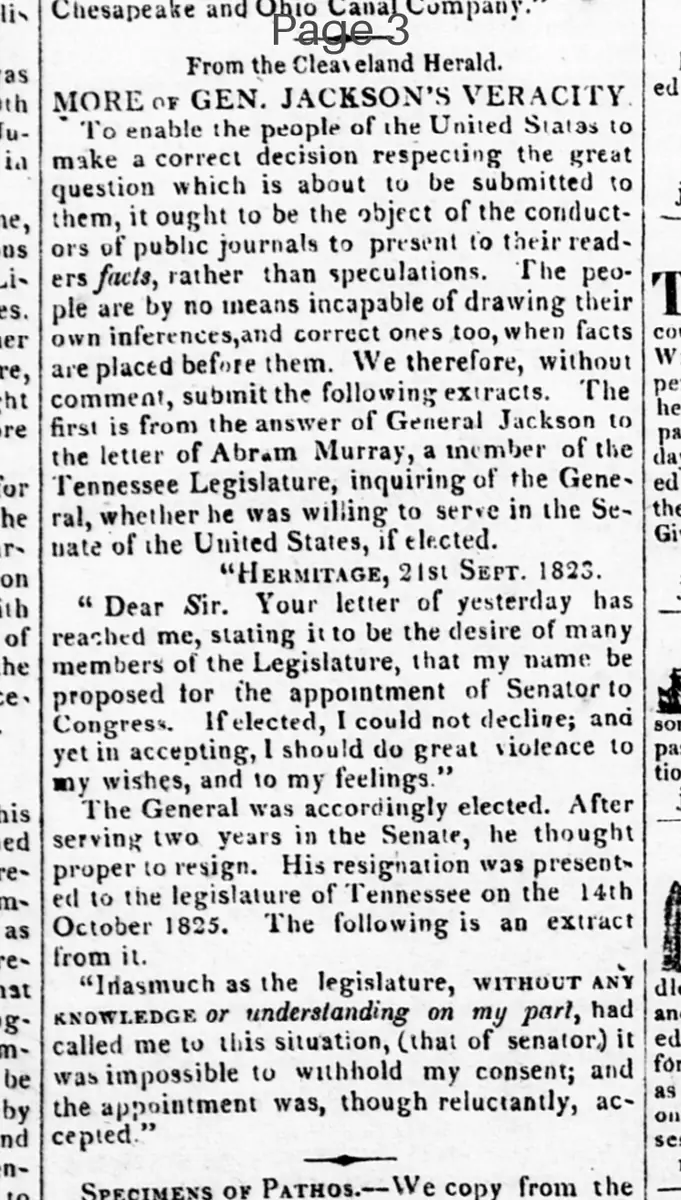
From the Cleaveland Herald.
MORE OF GEN. JACKSON'S VERACITY
To enable the people of the United States to make a correct decision respecting the great question which is about to be submitted to them, it ought to be the object of the conductors of public journals to present to their readers facts, rather than speculations. The people are by no means incapable of drawing their own inferences, and correct ones too, when facts are placed before them. We therefore, without comment, submit the following extracts. The first is from the answer of General Jackson to the letter of Abram Murray, a member of the Tennessee Legislature, inquiring of the General, whether he was willing to serve in the Senate of the United States, if elected.
"Hermitage, 21st Sept. 1823.
"Dear Sir. Your letter of yesterday has reached me, stating it to be the desire of many members of the Legislature, that my name be proposed for the appointment of Senator to Congress. If elected, I could not decline; and yet in accepting, I should do great violence to my wishes, and to my feelings"
The General was accordingly elected. After serving two years in the Senate, he thought proper to resign. His resignation was presented to the legislature of Tennessee on the 14th October 1825. The following is an extract from it.
"Inasmuch as the legislature, without any knowledge or understanding on my part, had called me to this situation, (that of senator) it was impossible to withhold my consent; and the appointment was, though reluctantly, accepted."
MORE OF GEN. JACKSON'S VERACITY
To enable the people of the United States to make a correct decision respecting the great question which is about to be submitted to them, it ought to be the object of the conductors of public journals to present to their readers facts, rather than speculations. The people are by no means incapable of drawing their own inferences, and correct ones too, when facts are placed before them. We therefore, without comment, submit the following extracts. The first is from the answer of General Jackson to the letter of Abram Murray, a member of the Tennessee Legislature, inquiring of the General, whether he was willing to serve in the Senate of the United States, if elected.
"Hermitage, 21st Sept. 1823.
"Dear Sir. Your letter of yesterday has reached me, stating it to be the desire of many members of the Legislature, that my name be proposed for the appointment of Senator to Congress. If elected, I could not decline; and yet in accepting, I should do great violence to my wishes, and to my feelings"
The General was accordingly elected. After serving two years in the Senate, he thought proper to resign. His resignation was presented to the legislature of Tennessee on the 14th October 1825. The following is an extract from it.
"Inasmuch as the legislature, without any knowledge or understanding on my part, had called me to this situation, (that of senator) it was impossible to withhold my consent; and the appointment was, though reluctantly, accepted."
What sub-type of article is it?
Partisan Politics
What keywords are associated?
Jackson Veracity
Senate Election
Tennessee Legislature
Political Reluctance
What entities or persons were involved?
General Jackson
Abram Murray
Tennessee Legislature
Editorial Details
Primary Topic
Questioning General Jackson's Veracity Regarding Senate Service
Stance / Tone
Critical Of Jackson's Consistency
Key Figures
General Jackson
Abram Murray
Tennessee Legislature
Key Arguments
Jackson Expressed Reluctance To Serve In Senate In 1823 Letter
Despite Reluctance, He Was Elected And Served Two Years
Resigned In 1825 Citing Similar Forced Acceptance