Thank you for visiting SNEWPapers!
Sign up free
Richmond Enquirer
Richmond, Richmond County, Virginia
What is this article about?
Earl Selkirk's colony in Rupert's Land faced destruction twice in 1815-1816 due to rivalry with the North Western Fur Company, resulting in deaths and property loss; Selkirk sought to rebuild despite British government inaction.
Clipping
OCR Quality
Full Text
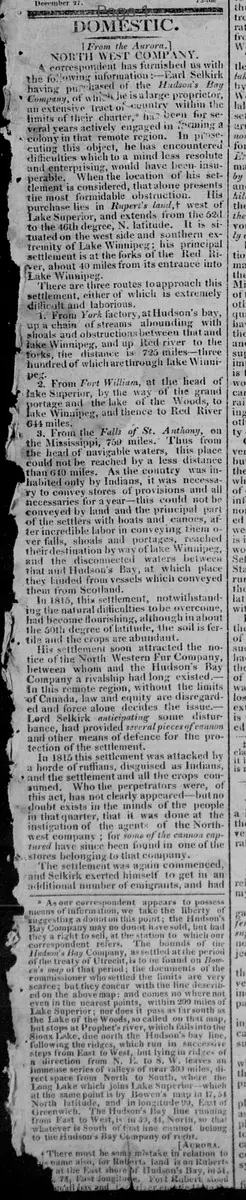
[From the Aurora.]
NORTH WEST COMPANY.
A correspondent has furnished us with the following information:—Earl Selkirk having purchased of the Hudson's Bay Company, of which he is a large proprietor, an extensive tract of country within the limits of their charter, has been for several years actively engaged in forming a colony in that remote region. In prosecuting this object, he has encountered difficulties which to a mind less resolute and enterprising, would have been insuperable. When the location of his settlement is considered, that alone presents the most formidable obstruction. His purchase lies in Rupert's land, west of Lake Superior, and extends from the 52d to the 46th degree, N. latitude. It is situated on the west side and southern extremity of Lake Winnipeg; his principal settlement is at the forks of the Red River, about 40 miles from its entrance into Lake Winnipeg.
There are three routes to approach this settlement, either of which is extremely difficult and laborious.
1. From York factory, at Hudson's bay, up a chain of streams abounding with shoals and obstructions between that and lake Winnipeg, and up Red river to the forks. the distance is 725 miles—three hundred of which are through lake Winnipeg.
2. From Fort William, at the head of lake Superior, by the way of the grand portage and the lake of the Woods, to lake Winnipeg, and thence to Red River 644 miles.
3. From the Falls of St. Anthony, on the Mississippi. 759 miles. Thus from the head of navigable waters, this place could not be reached by a less distance than 600 miles. As the country was inhabited only by Indians, it was necessary to convey stores of provisions and all necessaries for a year—this could not be conveyed by land and the principal part of the settlers with boats and canoes, after incredible labor in conveying them over falls, shoals and portages, reached their destination by way of lake Winnipeg. and the disconnected waters between that and Hudson's Bay, at which place they landed from vessels which conveyed them from Scotland.
In 1815. this settlement, notwithstanding the natural difficulties to be overcome, had become flourishing, although in about the 50th degree of latitude, the soil is fertile and the crops are abundant.
His settlement soon attracted the notice of the North Western Fur Company, between whom and the Hudson's Bay Company a rivalship had long existed. In this remote region, without the limits of Canada. law and equity are disregarded and force alone decides the issue.—
Lord Selkirk anticipating some disturbance, had provided several pieces of cannon and other means of defence for the protection of the settlement.
In 1815 this settlement was attacked by a horde of ruffians, disguised as Indians, and the settlement and all the crops consumed. Who the perpetrators were, of this act, has not clearly appeared—but no doubt exists in the minds of the people in that quarter, that it was done at the instigation of the agents of the North-west company ; for some of the cannon captured have since been found in one of the stores belonging to that company.
The settlement was again commenced. and Selkirk exerted himself to get in an additional number of emigrants, and had himself been for some time in this country, when, on the 19th of June, 1816, the settlement was again attacked and totally destroyed, the governor and twenty of the settlers were killed. When the news of this reached the fort of lake Superior, lord Selkirk was himself, with two companies of men in his employ (principally from De Meuron's regiment) at the Sault St. Mary's, where the valuable depots of furs, of the North-western Company are established.
His men insisted on making immediate reprisals on the North-west; they determined to burn the valuable furs and other property. and seize several vessels then lying in the river, and with them to sail and capture Fort William, which belongs to the North-west Company.
But the forbearance of Lord Selkirk forbade this, and after much difficulty, he pacified them. Since which he proceeded on towards his settlement, and it appears on his way seized some agents of the North West Company and sent them to Montreal for trial.
In this affair it is astonishing that the British government should suffer this species of warfare, carried on by the subjects of that crown, without interference.
In Selkirk's conduct there is much to admire. After seeing his great exertions to ameliorate the condition of his countrymen thus blasted, and his favorite object destroyed, he still retained sufficient moderation to prevent his enraged followers from committing outrages on the North West Company.
The route he now takes to reach his settlement is by the St. Lawrence, and the lakes, to the head of lake Superior, thence by the grand portage to the Lake of the Woods, and by several small streams to lake Winnipeg and up Red River to his settlement. He has with him a supply of arms, and among them several pieces of cannon. These, as also a large supply of corn for subsisting his men, were shipped from Erie in this state. This route presents so many obstructions that he anticipates that by the Mississippi will be the most eligible. and accordingly an agent of his left Mackinac, while the writer of this was there, in August last, to explore the head of the Mississippi and Red River, and endeavor to find where the heads of them most nearly approximated.
Here the facility of water communication between the lakes and Mississippi may be remarked. The large boats of the fur traders regularly ply between lake Michigan and the Mississippi, by the way of the Fox and Wisconsin river, with no other impediment than a portage of three quarters of a mile between them. We have now military posts established at the mouths of these rivers, (at Green bay and Prairie du Chien) which, if properly supported, will effectually command this important pass. The land at the portage is low, and no great amount of labour would be necessary to connect them by a canal. Indeed, at present, after high rains, the water overflows the surrounding level grounds, from one river to the other, and boats pass without the necessity of a portage or canal.
Of the country west of lake Superior very little is known by the people at large, but when it is considered that we are on the eve of having the boundaries of that, which will be hereafter important, portion of our country definitively settled, any information may be useful. Should the northern boundary, as is generally believed in that country, be a line drawn due west from the Lake of the Woods, which is in the 49th degree of north latitude, it would place the most valuable portion of Selkirk's settlement within the United States territory. But should the line be run direct from the Lake of the Woods to the head of the Mississippi, which is in latitude 47 deg. 42 min. north. it will be without our boundaries.
It may not be improper to observe that the individual fur traders in that country of both nations. cordially wish Selkirk success, for the North Western Company had monopolized the whole trade within their limits to themselves, and an attempt of an individual to trade with the Indians was not only attended with the risk of losing his property but his life. Their extensive influence over the Indians too, is well known, and was effectually exerted during the war.
It is impossible that lord Selkirk could claim any territory within our boundary: and it is very probable, that the Mississippi head is not yet actually determined.
As our correspondent appears to possess means of information, we take the liberty of suggesting a doubt on this point; the Hudson's Bay Company may no doubt have sold, but had they a right to sell, at the station to which our correspondent refers. The bounds of the Hudson's Bay Company, as settled at the period of the treaty of Utrecht. is to be found on Bowen's map of that period; the documents of the commissioner who settled the limits are very scarce; but they concur with the line described on the above map: and comes no where not even in the nearest points, within 200 miles of Lake Superior; nor does it pass as far south as the Lake of the Woods, so called on that map, but stops at Prophet's river, which falls into the Sioux Lake, due north the Hudson's bay line. following the ridges, which run in successive steps from East to West, but lying in ridges of a direction from N. E. to S. W. leaves an immense series of valleys of near 300 miles. direct space from North to South, where the Long Lake which joins Lake Superior—which at this same point is by Bowen's map in 47, 51 North latitude, and in longitude 90, East of Greenwich. The Hudson's Bay line running from East to West, is in 55, 48, North, so that whatever is South of that line cannot belong to the Hudson's Bay Company of right.
[AURORA.]
There must be some mistake in relation to its name also, for Rupert's land is on Rupert's at the East shore by Hudson's Bay, in St. 74, East Longitude. Fort Rupert stood saalbay and their epys tiotatay.
What sub-type of article is it?
What keywords are associated?
What entities or persons were involved?
Where did it happen?
Foreign News Details
Primary Location
Rupert's Land
Event Date
1815 1816
Key Persons
Outcome
settlement attacked and destroyed in 1815 and on 19th june 1816; governor and twenty settlers killed in 1816
Event Details
Earl Selkirk established a colony in Rupert's Land west of Lake Superior on the Red River. The settlement faced attacks by ruffians disguised as Indians, likely instigated by the North Western Fur Company, destroying crops and the settlement in 1815 and 1816. Selkirk restrained his men from reprisals and proceeded to rebuild, seizing some North West agents.