Thank you for visiting SNEWPapers!
Sign up free
The Centre Reporter
Centre Hall, Centre County, Pennsylvania
What is this article about?
The New York Herald defends New Orleans against Senator Morton's claim that it is a 'dead city,' highlighting its historical French and Spanish influences, pre-war prosperity as a trade hub for the Mississippi and Gulf, and post-war economic strength with 1870 census data showing 191,000 population and massive cotton exports in 1872-73 exceeding $600 million.
Clipping
OCR Quality
Full Text
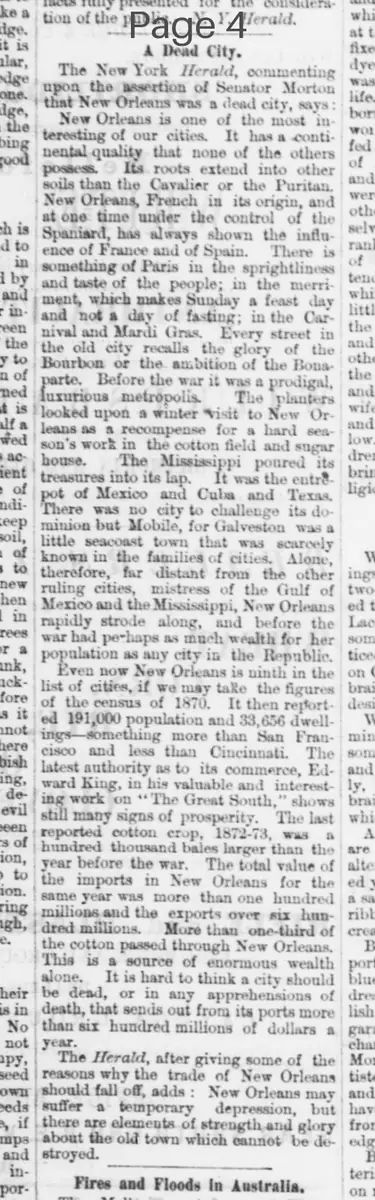
The New York Herald, commenting upon the assertion of Senator Morton that New Orleans was a dead city, says:
New Orleans is one of the most interesting of our cities. It has a continental quality that none of the others possess. Its roots extend into other soils than the Cavalier or the Puritan. New Orleans, French in its origin, and at one time under the control of the Spaniard, has always shown the influence of France and of Spain. There is something of Paris in the sprightliness and taste of the people; in the merriment, which makes Sunday a feast day and not a day of fasting; in the Carnival and Mardi Gras. Every street in the old city recalls the glory of the Bourbon or the ambition of the Bonaparte. Before the war it was a prodigal, luxurious metropolis. The planters looked upon a winter visit to New Orleans as a recompense for a hard season's work in the cotton field and sugar house.
The Mississippi poured its treasures into its lap. It was the entrepot of Mexico and Cuba and Texas. There was no city to challenge its dominion but Mobile, for Galveston was a little seacoast town that was scarcely known in the family of cities. Alone, therefore, far distant from the other ruling cities, mistress of the Gulf of Mexico and the Mississippi, New Orleans rapidly strode along, and before the war had perhaps as much wealth for her population as any city in the Republic.
Even now New Orleans is ninth in the list of cities, if we may take the figures of the census of 1870. It then reported 191,000 population and 33,656 dwellings—something more than San Francisco and less than Cincinnati. The latest authority as to its commerce, Edward King, in his valuable and interesting work on "The Great South," shows still many signs of prosperity. The last reported cotton crop, 1872-73, was a hundred thousand bales larger than the year before the war. The total value of the imports in New Orleans for the same year was more than one hundred millions and the exports over six hundred millions. More than one-third of the cotton passed through New Orleans. This is a source of enormous wealth alone. It is hard to think a city should be dead, or in any apprehensions of death, that sends out from its ports more than six hundred millions of dollars a year.
The Herald, after giving some of the reasons why the trade of New Orleans should fall off, adds: New Orleans may suffer a temporary depression, but there are elements of strength and glory about the old town which cannot be destroyed.
What sub-type of article is it?
What themes does it cover?
What keywords are associated?
What entities or persons were involved?
Where did it happen?
Story Details
Key Persons
Location
New Orleans
Event Date
1870 1873
Story Details
The New York Herald rebuts Senator Morton's claim that New Orleans is a dead city by detailing its cultural heritage from French and Spanish influences, pre-Civil War prosperity as a trade entrepot, and post-war economic vitality evidenced by 1870 census figures and 1872-73 trade volumes exceeding $600 million in exports.