Thank you for visiting SNEWPapers!
Sign up free
Richmond Enquirer
Richmond, Richmond County, Virginia
What is this article about?
In the House of Lords on October 3, Mr. Brougham delivers a defense speech for Queen Caroline against adultery charges, denying improprieties, critiquing the prosecution's evidence, and highlighting her mistreatment by British society and family.
Clipping
OCR Quality
Full Text
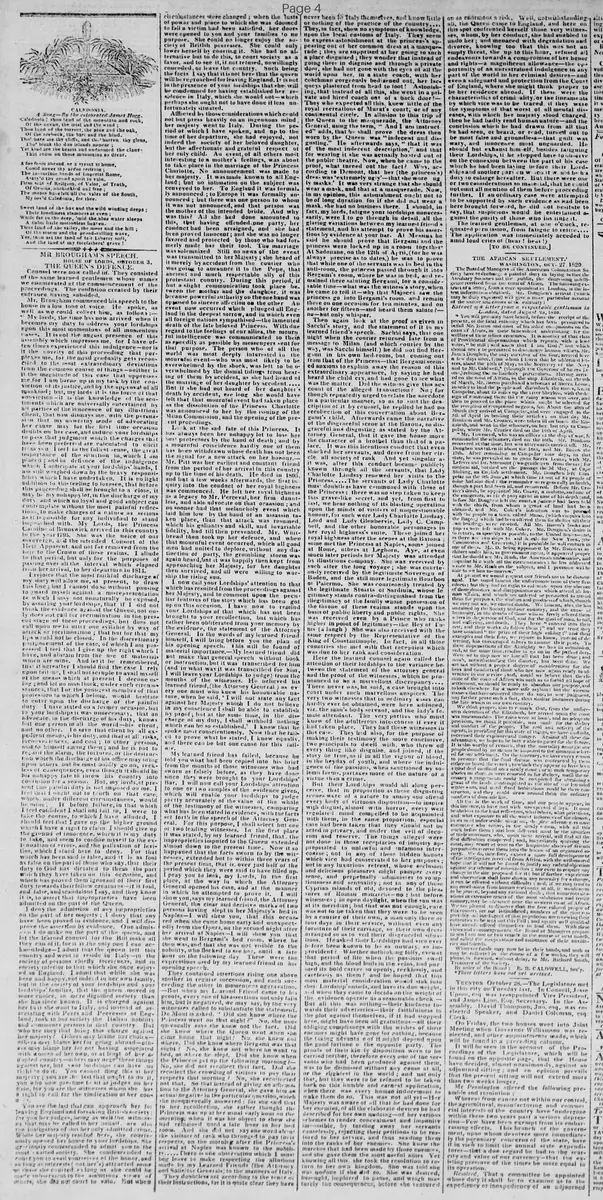
HOUSE OF LORDS, OCTOBER 3.
THE QUEEN'S DEFENCE.
Counsel were now called in. They consisted of the same learned gentlemen whose names we enumerated at the commencement of the proceedings. The confusion created by their entrance having subsided.
Mr. Brougham commenced his speech to the house in a low tone of voice. He spoke, as well as we could collect him, as follows:-
My lords, the time has now arrived when it becomes my duty to address your lordships upon this most momentous of all momentous cases. It is not the august presence of this assembly which impresses me, for I have often times experienced this indulgence-nor is it the novelty of this proceeding that perplexes me, for the mind gradually gets reconciled to the most extraordinary deviations from the common course of things-neither is it the magnitude of this case that oppresses me, for I am borne up in my task by the conviction of its justice, and by the approval of all mankind; but, my lords, it is the force of that conviction-it is the knowledge of the sentiments which are universally entertained by all parties of the innocence of my illustrious client, that now dismays me, with the persuasion that my unworthy mode of advocating her cause may for the first time occasion doubts on her case, and induce your lordships to pass that judgment which the charges that have been preferred are calculated to elicit from you. I feel in the fullest sense, the great importance of the situation in which I am placed; and in defence of the indulgence which I anticipate at your lordships' hands, I am still weighed down by the heavy responsibility which I have undertaken. It is no light addition to the feeling to foresee, that before this proceeding shall be brought to a close, it may be my unhappy lot, in the discharge of my duty, and which no loyal and good subject can contemplate without the most painful reflection, to make charges of a nature as serious as it is possible for any individual to stand impeached with. My Lords, the Princess Caroline of Brunswick arrived in this country in the year 1795. She was the niece of our sovereign, and the intended Consort of the Heir Apparent, and not far removed from the heir to the Crown of these realms. I allude to that period, but only for the purposes of passing over all the interval which elapsed from her arrival, to her departure in 1814. I rejoice that the most faithful discharge of my duty will allow me, at present, to draw this line; but I cannot do so without pausing to guard myself against a misrepresentation to which I may not unnaturally be exposed, by assuring your lordships, that if I did not think the evidence against the Queen, not only does not call for recrimination in the present stage of these proceedings, but does not call upon me to utter one syllable by way of attack or recrimination; that but for that my lips would not be closed. In the discretionary postponement of the case, of which I am possessed I feel that I give up the right which I have, and abstain from the use of materials which are mine. And let it be remembered, that if hereafter I should find the case I rely upon fail me, I shall not scruple to avail myself of the means which at present I decline using; and let no man think, under such circumstances, that I, for the youngest member of that profession to which I belong, would hesitate to enter upon the discharge of the painful duty. I have stated on a former occasion, but to your lordships it was unnecessary, that an advocate, in the discharge of his duty, knows but one person in all the world-his client, and no other. To save that client by all expedient means, is his duty, and that at all risks, jeopardies, and costs; to others, and to himself among them; and he is not to regard the alarm, the tortures, or the destruction which the discharge of his office may bring upon others but he must boldly go on, reckless of consequences, even though it should be his unhappy fate to throw his country into confusion for a season. But, my lords, at present this painful duty is not imposed on me. I feel that I ought not to touch on that case, which, under different circumstances, would be mine. It before failure, in that which I feel confident I shall not fail in, I were to take the course, to which I have alluded, I should feel that I gave up the higher ground which I have a right to claim. I should give up the ground of innocence, which it is my duty to take, and seem to confine myself to the explication of errors, and the palliation of levities, which I stand here to deny. For that which has been said is false, and it is as foul as false on the part of those who say, that their duty to God has dictated to them the part which they have taken on this occasion, and which has proved them ignorant of their first duty towards their fellow creatures-it is foul, and false, and scandalous I say, and they know it is, to assert that improprieties have been admitted on the part of the Queen. I deny the admission of any improprieties on the part of her majesty; I deny that any have been proved in evidence, and I will disprove the assertion by evidence. One admission I do make on the part of the queen, and let the learned counsel for the Bill make all they can of it, for it is the only one I can acknowledge-I admit that the queen left this country and went to reside in Italy-in the society of persons chiefly foreigners, and in society inferior to that which she once enjoyed in England. I admit that while she was here and happy, not indeed in her own family, but in the society of your lordships and your lordships' families, that the queen moved in more choice, in more dignified society than she has since known. It is charged against her that she went to Italy, and instead of associating with Peers and Peeresses of England, took to her society the Italian nobility and commoner persons in that country. But who are they that bring this charge against her majesty? Others may blame her choice-others may blame her for going abroad-others may blame her for not having associated with women of her own, or at least of her adopted country-others may urge these things against her, but your lordships can have no right to do it. You cannot ding this at her majesty; you are the last that ought to do it, you who now presume to sit as judges on her case, for you are the witnesses whom she has a right to call for the vindication of her conduct. You are the last that can approach her for leaving England and forsaking British society: for you her judges, being as well the witnesses that may be called in her behalf, are also the instigators of her only admitted crime. While her majesty resided here, she courteously opened her house to your lordships. She graciously condescended to admit you to the most exalted society. She condescended to confer on you to avail yourselves of the honor, and so long as interests (not hers) attracted some of these she courted, so long as she could be made subservient to the ambitious views of others, she did not court in vain. But when circumstances were changed; when the lusts of power and place to which she was doomed to fall a victim had been satisfied, her doors were opened to you and your families to no purpose. She could no longer enjoy the society of British peeresses. She could only lower herself by courting it. She had no alternative but to do this, to court society as a favor, and to see it, if not refused, unwillingly conceded, or leave the country. Such being the facts I say that it is not here that the queen will be reproached for leaving England. It is not in the presence of your lordships that she will be condemned for having established her residence in Italy, which she would not-which perhaps she ought not to have done if less unfortunately situated. Afflicted by those considerations which could not but press heavily on an ingenuous mind, her majesty went to Italy. During the period of which I have spoken, and up to the time of her departure, she had enjoyed, not indeed the society of her beloved daughter, but the affectionate and grateful respect of her only child. An event, of all others most interesting to a mother's feelings, was about to take place in the marriage of the Princess Charlotte. No announcement was made to her majesty. It was made known to all England; but no intimation on the subject was conveyed to her. To England it was formal. It was announced; to Europe it was formally announced; but there was one person to whom it was not announced, and that person was the mother of the intended bride. And why was this? As she had done amounted to this, that having offended one party, her conduct had been arraigned, and she had been proved innocent; and she was no longer favored and protected by those who had formerly made her their tool. The marriage was solemnized. Still no news of the event was transmitted to her Majesty; she heard of it merely by accident from the courier who was going to announce it to the Pope, that ancient and much respectable ally of this protestant country. During this period, but a slight communication took place between the mother and the daughter. It was because powerful authority on the one hand was opposed to sincere affection on the other. An event now occurred which plunged all England in the deepest sorrow, and in which even all foreign nations sympathised-the lamented death of the late beloved Princess. With due regard to the feelings of our allies, the mournful intelligence was communicated to them as speedily as possible by messengers sent for that purpose. The person who of all the world was most deeply interested in the mournful event-who was most likely to be overwhelmed by the shock, was left to be overwhelmed by the dismal tidings from hearing of them by accident, as she had heard of the marriage of her daughter by accident. But if she had not heard of her daughter's death by accident, ere long she would have felt that that mournful event had taken place as the dissolution of the Princess Charlotte was announced to her by the issuing of the Milan Commission, and the opening of the present proceedings. Look at the sad fate of this Princess. It has always been her unhappy lot to lose her best protectors by the hand of death; and by a mournful coincidence hardly one of them has been withdrawn whose death has not been the signal for a new attack on her honour. Mr. Pitt was her earliest and constant friend from the period of her arrival in this country up to the time of his death. He died in 1806, and but a few weeks afterwards, the first inquiry into the conduct of her royal highness was commenced. He left her royal highness as a legacy to Mr. Perceval, her firm dauntless, and able advocate on that occasion; and no sooner had that melancholy event which laid him low by the hand of an assassin taken place, than that attack was resumed, which his gallantry and skill, and invariable fidelity, had till then prevented. Mr. Whitbread then took up her defence, and when that mournful event occurred, which all good men had united to deplore, without any distinction of party, the grumbling storm was again heard, but it was happily then kept from approaching her Majesty, for her daughter then survived, and all were willing to worship the rising sun. I now call your Lordships' attention to that which has resulted from the proceedings against her Majesty, and to comment upon the peculiar features of the story which has been got up on this occasion. I have now to remind your Lordships of that which has not been brought to your recollection, but which has rather been obliterated from your memory by the evidence, the statement of the Attorney General. In the words of my learned friend himself, I will bring before you the plan of his opening speech. This will be found of material importance. My learned friend did not make that general speech without book or instruction, but it was transcribed for him (and in what way it was transcribed for him, I will leave your Lordships to judge) from the mouths of the witnesses. He believed his learned friend, (the Attorney General) as every one must who knew his honourable nature, when he said, 'I will not state any fact against her Majesty which I do not believe in my conscience I shall be able to establish by proof; but at the same time, in the discharge of my duty, I shall withhold nothing which can be so established.' I know that he spoke most conscientiously. Now that he failed to prove what he stated, I know equally, and there can be but one cause for this failure. My learned friend has failed, because he told you what had been copied into his brief from the mouths of those witnesses who had sworn as falsely before, as they have done since they were brought to your Lordships' Bar. I will now call your Lordships' attention to one or two samples of the evidence given, which will enable your lordships to judge pretty accurately of the value of the whole of the testimony of the witnesses, comparing what has been stated in evidence, with the facts set forth in the speech of the Attorney General. For this purpose, I shall select but one or two leading witnesses. In the first place it was stated, by my learned friend, that the improprieties imputed to the Queen extended almost down to the present time. Now it so happened that the facts sworn to by the witnesses, extended but to within three years of the present time, that is, over just half of the period which they were said to have filled up. I pray you to look, my Lords, in the first place, at the way in which the Attorney General opened his case, and at the manner in which he attempted to prove it. I will show you, says my learned friend, the Attorney General, the clear and decisive marks of two persons having slept in her Majesty's bed in Naples-I will show you, that this occurred when she came home early and unexpectedly from the Opera, on the second night after her arrival at Naples-I will show you that she went to Bergami's bed room, where he then was, and that she was not visible to the nobility, who flocked to see her, until a late hour on the following day. These were the expressions used by my learned friend in his opening speech. They contained assertions rising one above another in regular succession, and each succeeding the other in momentous aggravation. But when my Learned Friend came to his proofs, every one of his assertions not only fails him, but is negatived, we may say, by the very witnesses called to substantiate the statement. De Mont is asked, 'Did she know where the Princess went on that night?' No, she unequivocally says she knew not the fact. 'Did she know where the Queen went when she came home that night?' No, she knew not where. 'Did she know where Bergami was that night?' No, she knew not where he went to bed, or where he slept. 'Did she know when the Princess got up the following morning?' No, she did not recollect that fact. 'Did she recollect the crowding of visitors to pay their respects that morning?' No, she recollected not that. So that instead of giving an affirmation to the Attorney General, she gave him an actual negative-in the particular question, which she unequivocally answered: for she said that to her recollection, she rather thought the Princess was up at her usual early hour on the morning, when it was his object to show she had remained until a late hour in her bed room. And she did not say one word about the visitors of rank who thronged to pay their respects, on the morning after the Princess' arrival at Naples was known to the nobility. There is one observation which I must beg leave to make respecting the allusions made by my Learned Friends (the Attorney and Solicitor Generals) to the manners of Italy. They doubtless act according to the tenor of their Instructions, for it is quite clear they have never been in Italy themselves, and know little or nothing of the practice of the country. They, in fact, show no symptoms of knowledge upon the local customs of Italy. They seem to express astonishment at the princess's appearing out of her common dress at a masquerade; they are surprised at her going to such a place disguised; they wonder that instead of going there in disguise and through a private door, she had not gone with the eyes of all the world upon her, in a state coach, with her coachman gorgeously bedizened out, her lackeys plastered from head to foot! Astonishing, that instead of all this, she went in a private and hired coach out of a back door! They who expected all this, knew little of the royal recreations of Murat's court; or of any continental circle. In allusion to this trip of the Queen to the masquerade, the Attorney General, using the term, 'And I am instructed' adds, that he shall prove the dress then worn by the Queen was 'indecent and disgusting.' He afterwards says, 'that it was of the most indecent description,' and that for wearing it she was actually hooted out of the public theatre. Now, when he came to the proof, what turned out the fact? Why, according to Demont, that her (the princess's) dress was extremely ugly-that she wore only masks.' It was very strange that she should wear a mask, and that at a masquerade. Now, in my opinion, this astonishment ought not to be of long duration, for if she did not wear a mask, she had no business there. I should, in fact, my lords, fatigue your lordships unnecessarily, were I to go through in detail, all the glaring variations between my learned friend's statement, and his attempt to prove his assertions by evidence at your bar. At Messina he said he should prove that Bergami and the princess were locked up in a room together. At Saronno, on the 12th of April, (for he was always precise as to dates) he was to prove that while one of the servants was in bed in the anti-room, the princess passed through it into Bergami's room, where he was in bed, and remained there saluting Bergami, for a considerable time-what was the witness's story, when he came to tell it-why that Majocchi saw the princess go into Bergami's room, and remain there on one occasion for ten minutes, and on another for fifteen-and heard them salute?-no-but only whisper. Then again look at the proof as given in Sacchi's story, and the statement of it in my learned friend's speech. Sacchi says, that one night when the courier returned late from a message to Milan (and which courier by the way, was Sacchi himself) he did not find Bergami in his own bed-room, but coming out from that of the Princess-that Bergami seemed anxious to explain away the reason of this extraordinary appearance, by saying he had heard the child cry, and had gone to see what was the matter. Did the witness give this account of the alleged transaction? No; for though repeatedly urged to relate the anecdote in a particular manner, so as to suit the description of it by counsel, he replied he had no recollection of this conversation about Bergami's child. Afterwards came the narrative of the disgraceful scene at the Barona, so disgraceful and disgusting as stated by the Attorney General, that it gave the house more the character of a brothel than that of a palace. It was this licentious conduct that even shocked her servants, and drove from her circle, all society of rank. And yet singular as it was, after this conduct became publicly known through all the servants, that Lady Charlotte Lindsay renewed her visits to the Princess. The servants of Lady Charlotte must doubtless have communed with those of the Princess: there was no step taken to keep this grave-like secret, and yet, from first to last, we hear nothing of its blasting operation upon the minds of visitors of unquestionable honour, for such were Lady Charlotte Lindsay, Lord and Lady Glenbervie, Lady C. Campbell, and the other honorable personages in her royal highness's suite. These joined her royal highness after the scenes at the Barona: some met the Princess at Naples, some joined at Rome, others at Leghorn. Aye, at even much later periods her Majesty was attended by illustrious company. She was received by such after the long voyage; she was courteously received by the legitimate Sovereign of Baden, and the still more legitimate Bourbon of Palermo. She was courteously treated by the legitimate Stuarts of Sardinia, whose legitimacy stands contra-distinguished from the illegitimacy of the family whose possession of the throne of these realms stands upon the basis of public liberty and public rights. She was received even by a Prince who ranks higher in point of legitimacy-the Bey of Tunis (a laugh) She was also received with the same respect by the Representative of the King of Constantinople. In fact, in all those countries she met with that reception which was due to her rank and consideration. Here the learned counsel again called the attention of their lordships to the variance between the statement of the attorney general and the proof of the witnesses, which he pronounced to be a marvellous discrepancy. There never was, he said, a case brought into court under such marvellous auspices. The very two witnesses that in ordinary cases can hardly ever be obtained, were here adduced, viz. the man's body servant, and the lady's female attendant. The very parties who must know of the adulterous intercourse if ever it had taken place. They had these witnesses in this case. They had also, for the purpose of making their testimony the more conclusive, two principals to dwell with, who threw off every thing like disguise, and joined, if the story be true, as if in all the vigour of blood, in the heyday of youth, and where the indulgence of the passions, when sanctioned by solemn forms, partakes more of the nature of a virtue than a crime. But their Lordships would all along perceive, that in proportion as these disgusting scenes were of a nature to annoy and offend every body of virtuous disposition-to inspire with disgust, almost with horror, every well regulated mind compelled to be acquainted with them, in the same proportion, especial care had been taken that they should not be acted in privacy, and under the veil of decorum and reserve. The things alleged were not done in those receptacles of iniquity appropriated to unlawful and infamous intercourse; not in any of those hidden haunts which vice had consecrated to her purposes; not in any luxurious retreat, whose seclusion and delicious pleasures might pamper every sense, and perpetually administer to voluptuousness and sensuality; not in any of those Cyprian islands of old, devoted to the pleasures of Roman monarchs-no: but before witnesses; in open daylight, when the sun was at its meridian; but that was not enough, care was not to be taken that they were to be seen by a courier of their own, a man only three or four days in their service, without even any furniture of their carriage, or their own dress arranged so as to veil their disgraceful situations. He asked their Lordships had vice ever before been known to be so noisy, so improvident? Whether nothing but folly, even at that period of life when the passions swell high, and the blood boils in the veins, had pursued its bold career so openly, recklessly, and carelessly as them? and he hoped that this most material consideration would strike into their Lordships' minds, and have its due weight, and when they came to decide on the weight of the evidence operate as a seasonable check. But all this was nothing-their kindness towards their adversaries-their faithfulness to the plot against themselves, if it had stopped here, might have been all gratuitous-all their obliging compliances with the wishes of their enemies might have gone for nothing, because the taking advantage of it might depend upon the good fortune of the opposite party. The proofs of their kindly disposition were to be carried farther, therefore every one of the servants who had been produced against them, was to be dismissed without any cause at all, or the slightest in the world; and not only that, but they were to be refused to be taken back on this humble and earnest application, when there was every human inducement to make them do so. This was not all yet-Her Majesty was aware of all that he had done for her enemies, of all the elaborate devices he had described for her own undoing-of her various schemes to render concealment and impunity impossible, by turning away her servants causelessly, rejecting their petitions to be restored to her service, and thus sending them into the ranks of her enemies. She knew the marches that had been made by those enemies, and she gave them the most useful allies. Yet knowing all this, she took the resolution to return to her own kingdom. She was told she was undone if she did so. She was desired, besought, implored to pause, and weigh maturely the consequences, before she ventured on so enormous a risk. Well, notwithstanding all, the Queen came to England, and here on this spot confronted herself those very witnesses, whom, by her conduct, she had enabled to undo her; and menaced with degradation and divorce, knowing too that this was but an empty threat, she up to this hour, refused all endeavours towards a compromise of her honour and rights-a magnificent allowance-the opportunity of an unrestrained indulgence in any part of the world in her criminal desires-and even a safeguard and protection from the Court of England, where she might think proper to be her residence abroad. If these were the characteristics of criminality, or the lineaments by which vice was to be traced, if they were the symptoms of that worst of all mental diseases, with which her majesty stood charged, then he had badly read human nature-and the conclusion which he had drawn from all that he had seen, or heard, or read, turned out to be most false and groundless-that guilt was wary, and innocence most unguarded. He should but exhaust himself, besides fatiguing their Lordships, if he stopped here to observe on the connection between the part of his case which he had been laying before their Lordships and another part on which it would be his duty to enlarge hereafter. But there were one or two considerations so material, that he could not omit all mention of them before proceeding further. If an ordinary case were attempted to be supported by such evidence as had been here brought forward, he did not hesitate to say, that suspicions would be entertained against the purity of those who instigate it. The learned gentleman, at one o'clock, requested permission, from fatigue to retire. The application was immediately acceded to amid loud cries of (hear! hear!)
[TO BE CONTINUED.]
What sub-type of article is it?
What keywords are associated?
What entities or persons were involved?
Where did it happen?
Foreign News Details
Primary Location
House Of Lords
Event Date
October 3
Key Persons
Event Details
Mr. Brougham addresses the House of Lords in defense of Queen Caroline, denying charges of impropriety and adultery, critiquing the Attorney General's opening statements and witness testimonies for discrepancies, highlighting the Queen's mistreatment by British society and exclusion from family events like her daughter's marriage and death, and asserting her innocence while reserving the right to recriminate if necessary.