Thank you for visiting SNEWPapers!
Sign up free
Literary
October 6, 1847
Morning Star
Limerick, York County, Maine
What is this article about?
Harriet Martineau recounts her journey from the desert to Hebron, Bethlehem, and Jerusalem, reflecting on biblical landscapes, the birth of Jesus, Ruth's story, and the profound religious significance of the Holy Land, blending travel observations with scriptural insights.
Clipping
OCR Quality
98%
Excellent
Full Text
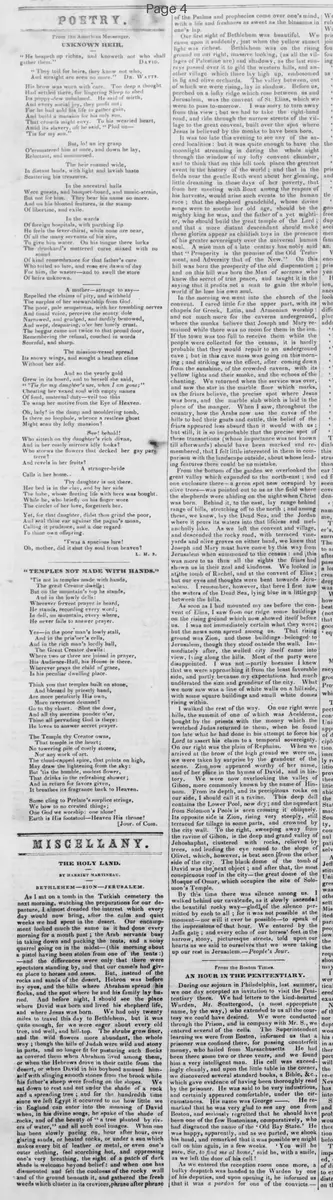
MISCELLANY.
THE HOLY LAND.
BY HARRIET MARTINEAU.
BETHLEHEM—ZION—JERUSALEM.
As I sat on a tomb in the Turkish cemetery the next morning, watching the preparations for our departure, I almost dreaded the interest which every day would now bring, after the calm and quiet weeks we had spent in the desert. Our encampment looked much the same as it had done every morning for a month past; the Arab servants busy in taking down and packing the tents, and a noisy quarrel going on in the midst—this morning about a pistol having been stolen from one of the tents:—and the differences were only that there were spectators standing by, and that our camels had given place to horses and asses. But, instead of the rocks and sands of the desert, Hebron was before my eyes, and the hills where Abraham spread his flocks, and the spot where he and his family lay buried. And before night, I should see the place where David was born and lived his shepherd life, and where Jesus was born. We had only twenty miles to travel this day to Bethlehem, but it was quite enough, for we were eager about every old tree, and well, and hill-top. The shrubs grew finer, and the wild flowers more abundant, the whole way; though the hills of Judah were wild and stony in parts, and no longer fit for pasturing such flocks as covered them when Abraham lived among them, or when the Hebrews drove in their cattle from the desert, or when David in his boyhood amused himself with slinging smooth stones from the brook while his father's sheep were feeding on the slopes. We sat down to rest and eat under the shade of a rock and a spreading tree; and for the hundredth time since we left Egypt it occurred to me how little we in England can enter into the meaning of David when, in his divine songs, he spake of the shade of rocks, and of the beauty of a tree planted by rivers of water, and all such cool images. When one has been slowly pacing on, hour after hour, over glaring sands, or heated rocks, or under a sun which makes every bit of leather or metal, or even one's outer clothing, feel scorching hot, and oppressing one's very breathing, the sight of a patch of dark shade is welcome beyond belief: and when one has dismounted and felt the coolness of the rocky wall and of the ground beneath it, and gathered the fresh weeds which cluster in its crevices, phrase after phrase of the Psalms and prophecies come over one's mind, with a life and freshness as sweet as the blossoms in one's lap.
Our first sight of Bethlehem was beautiful. We came upon it suddenly, just when the yellow sunset light was richest. Bethlehem was on the rising ground on our right, massive looking, (as all the villages of Palestine are) and shadowy, as the last sun-rays passed over it to gild the western hills, and another village which there lay high up, embosomed in fig and olive orchards. The valley between, out of which we were rising, lay in shadow. Before us, perched on a lofty ridge which rose between us and Jerusalem, was the convent of St Elias, which we were to pass to-morrow. I was sorry to turn away from this view; but we had to take the right-hand road, and ride through the narrow streets of the village to the great convent, built over the spot where Jesus is believed by the monks to have been born. It was too late this evening to see any of the sacred localities: but it was quite enough to have the moonlight streaming in during the whole night through the window of my lofty convent chamber, and to think that on this hill took place the greatest event in the history of the world; and that in the fields near the gentle Ruth went about her gleaning, little dreaming in those days of her poverty, that from her meeting with Boaz among the reapers of his harvests, would arise such events to the human race; that the shepherd grandchild, whose divine songs were to soothe her old age, should be the mighty king he was, and the father of a yet mightier, who should build the great temple of the Lord; and that a more distant descendant should make these glories appear as childish toys in the presence of his greater sovereignty over the universal human soul. A wise man of a late century has nobly said that "Prosperity is the promise of the Old Testament, and Adversity that of the New." On this hill was born the prosperity of the old dispensation; and on this hill was born the Man of sorrows who knew the secret of true peace, and taught it in the saying that it profits not a man to gain the whole world if he lose his own soul.
In the morning we went into the church of the convent. I cared little for the upper part, with its chapels for Greek, Latin, and Armenian worship: and not much more for the caverns underground, where the monks believe that Joseph and Mary remained while there was no room for them in the inn. If the town was too full to receive them while the people were collected for the census, it is hardly probable that they would repair to an underground cave; but in this cave mass was going on this morning; and striking was the effect, after coming down from the sunshine, of the crowded cavern, with its yellow lights and their smoke, and the echoes of the chanting. We returned when the service was over, and saw the star in the marble floor which marks, as the friars believe, the precise spot where Jesus was born, and the marble slab which is laid in the place of the manger. When I saw, throughout the country, how the Arabs now use the caves of the hills to bed their goats and cattle, this belief of the friars appeared less absurd than it would with us; but still, it is so improbable that the precise spot of these transactions (whose importance was not known till afterwards) should have been marked and remembered, that I felt little interested in them in comparison with the landscape outside, about whose leading features there could be no mistake.
From the bottom of the garden we overlooked the great valley which expanded to the north-east; and one enclosure there—a green spot now occupied by olive trees—was pointed out to us as the field where the shepherds were abiding on the night when Christ was born. Behind it, to the east, lay range behind range of hills, stretching off to the north; and among these, we knew, lay the Dead Sea, and the Jordan where it pours its waters into that lifeless and melancholy lake. As we left the convent and village, and descended the rocky road, with terraced vineyards and olive groves on either hand, we knew that Joseph and Mary must have come by this way from Jerusalem when summoned to the census: and (this was more to us than all the sights the friars had shown us in their zeal and kindness.) We looked in at the tomb of Rachel, and at the convent of Elias: but our eyes and thoughts were bent towards Jerusalem. I remember, however, that here I first saw the waters of the Dead Sea, lying blue in a little gap between the hills.
As soon as I had mounted my ass before the convent of Elias, I saw from our ridge some buildings on the rising ground which now showed itself before us. I was not immediately certain what they were; but the news soon spread among us. That rising ground was Zion, and those buildings belonged to Jerusalem, though they stood outside the wall. Immediately after, the walled city itself came into view, lying along the hills. Most of the party were disappointed. I was not—partly because I knew that we were approaching it from the least favorable side, and partly because my expectations had much underrated the size and grandeur of the city. What we now saw was a line of white walls on a hill side, with some square buildings and small white domes rising within.
I walked the rest of the way. On our right were hills, the summit of one of which was Aceldama, bought by the priests with the money which the wretched Judas returned to them, when he found too late what he had done in his attempt to force his Lord to assert his claim to a temporal sovereignty. On our right was the plain of Rephaim. When we arrived at the brow of the high ground we were on, we were taken by surprise by the grandeur of the scene. Zion now appeared worthy of her name, and of her place in the hymns of David, and in history. We were now overlooking the valley of Gihon, more commonly known by the name of Hinnom. From its depth, and its precipitous rocks on our side, I should call it a ravine. This deep dell contains the Lower Pool, now dry; and the aqueduct from Solomon's Pools is seen crossing it obliquely. Its opposite side is Zion, rising very steeply, still terraced for tillage in some parts, and crowned by the city wall. To the right, sweeping away from the ravine of Gihon, is the deep and grand valley of Jehoshaphat, clustered with rocks, relieved by trees, and leading the eye round to the slope of Olivet, which, however, is best seen from the other side of the city. The black dome of the tomb of David was the next object; and after that, the most conspicuous roof in the city—the great dome of the Mosque of Omar, which occupies the site of Solomon's Temple.
By this time there was silence among us. I walked behind our cavalcade, as it slowly ascended the beautiful rocky way—glad of the silence permitted by each to all; for it was not possible at the moment—nor will it ever be possible—to speak of the impressions of that hour. We entered by the Jaffa gate; and every echo of our horses' feet in the narrow, stony, picturesque streets, told upon our hearts as we said to ourselves that we were taking up our rest in Jerusalem.—People's Jour.
THE HOLY LAND.
BY HARRIET MARTINEAU.
BETHLEHEM—ZION—JERUSALEM.
As I sat on a tomb in the Turkish cemetery the next morning, watching the preparations for our departure, I almost dreaded the interest which every day would now bring, after the calm and quiet weeks we had spent in the desert. Our encampment looked much the same as it had done every morning for a month past; the Arab servants busy in taking down and packing the tents, and a noisy quarrel going on in the midst—this morning about a pistol having been stolen from one of the tents:—and the differences were only that there were spectators standing by, and that our camels had given place to horses and asses. But, instead of the rocks and sands of the desert, Hebron was before my eyes, and the hills where Abraham spread his flocks, and the spot where he and his family lay buried. And before night, I should see the place where David was born and lived his shepherd life, and where Jesus was born. We had only twenty miles to travel this day to Bethlehem, but it was quite enough, for we were eager about every old tree, and well, and hill-top. The shrubs grew finer, and the wild flowers more abundant, the whole way; though the hills of Judah were wild and stony in parts, and no longer fit for pasturing such flocks as covered them when Abraham lived among them, or when the Hebrews drove in their cattle from the desert, or when David in his boyhood amused himself with slinging smooth stones from the brook while his father's sheep were feeding on the slopes. We sat down to rest and eat under the shade of a rock and a spreading tree; and for the hundredth time since we left Egypt it occurred to me how little we in England can enter into the meaning of David when, in his divine songs, he spake of the shade of rocks, and of the beauty of a tree planted by rivers of water, and all such cool images. When one has been slowly pacing on, hour after hour, over glaring sands, or heated rocks, or under a sun which makes every bit of leather or metal, or even one's outer clothing, feel scorching hot, and oppressing one's very breathing, the sight of a patch of dark shade is welcome beyond belief: and when one has dismounted and felt the coolness of the rocky wall and of the ground beneath it, and gathered the fresh weeds which cluster in its crevices, phrase after phrase of the Psalms and prophecies come over one's mind, with a life and freshness as sweet as the blossoms in one's lap.
Our first sight of Bethlehem was beautiful. We came upon it suddenly, just when the yellow sunset light was richest. Bethlehem was on the rising ground on our right, massive looking, (as all the villages of Palestine are) and shadowy, as the last sun-rays passed over it to gild the western hills, and another village which there lay high up, embosomed in fig and olive orchards. The valley between, out of which we were rising, lay in shadow. Before us, perched on a lofty ridge which rose between us and Jerusalem, was the convent of St Elias, which we were to pass to-morrow. I was sorry to turn away from this view; but we had to take the right-hand road, and ride through the narrow streets of the village to the great convent, built over the spot where Jesus is believed by the monks to have been born. It was too late this evening to see any of the sacred localities: but it was quite enough to have the moonlight streaming in during the whole night through the window of my lofty convent chamber, and to think that on this hill took place the greatest event in the history of the world; and that in the fields near the gentle Ruth went about her gleaning, little dreaming in those days of her poverty, that from her meeting with Boaz among the reapers of his harvests, would arise such events to the human race; that the shepherd grandchild, whose divine songs were to soothe her old age, should be the mighty king he was, and the father of a yet mightier, who should build the great temple of the Lord; and that a more distant descendant should make these glories appear as childish toys in the presence of his greater sovereignty over the universal human soul. A wise man of a late century has nobly said that "Prosperity is the promise of the Old Testament, and Adversity that of the New." On this hill was born the prosperity of the old dispensation; and on this hill was born the Man of sorrows who knew the secret of true peace, and taught it in the saying that it profits not a man to gain the whole world if he lose his own soul.
In the morning we went into the church of the convent. I cared little for the upper part, with its chapels for Greek, Latin, and Armenian worship: and not much more for the caverns underground, where the monks believe that Joseph and Mary remained while there was no room for them in the inn. If the town was too full to receive them while the people were collected for the census, it is hardly probable that they would repair to an underground cave; but in this cave mass was going on this morning; and striking was the effect, after coming down from the sunshine, of the crowded cavern, with its yellow lights and their smoke, and the echoes of the chanting. We returned when the service was over, and saw the star in the marble floor which marks, as the friars believe, the precise spot where Jesus was born, and the marble slab which is laid in the place of the manger. When I saw, throughout the country, how the Arabs now use the caves of the hills to bed their goats and cattle, this belief of the friars appeared less absurd than it would with us; but still, it is so improbable that the precise spot of these transactions (whose importance was not known till afterwards) should have been marked and remembered, that I felt little interested in them in comparison with the landscape outside, about whose leading features there could be no mistake.
From the bottom of the garden we overlooked the great valley which expanded to the north-east; and one enclosure there—a green spot now occupied by olive trees—was pointed out to us as the field where the shepherds were abiding on the night when Christ was born. Behind it, to the east, lay range behind range of hills, stretching off to the north; and among these, we knew, lay the Dead Sea, and the Jordan where it pours its waters into that lifeless and melancholy lake. As we left the convent and village, and descended the rocky road, with terraced vineyards and olive groves on either hand, we knew that Joseph and Mary must have come by this way from Jerusalem when summoned to the census: and (this was more to us than all the sights the friars had shown us in their zeal and kindness.) We looked in at the tomb of Rachel, and at the convent of Elias: but our eyes and thoughts were bent towards Jerusalem. I remember, however, that here I first saw the waters of the Dead Sea, lying blue in a little gap between the hills.
As soon as I had mounted my ass before the convent of Elias, I saw from our ridge some buildings on the rising ground which now showed itself before us. I was not immediately certain what they were; but the news soon spread among us. That rising ground was Zion, and those buildings belonged to Jerusalem, though they stood outside the wall. Immediately after, the walled city itself came into view, lying along the hills. Most of the party were disappointed. I was not—partly because I knew that we were approaching it from the least favorable side, and partly because my expectations had much underrated the size and grandeur of the city. What we now saw was a line of white walls on a hill side, with some square buildings and small white domes rising within.
I walked the rest of the way. On our right were hills, the summit of one of which was Aceldama, bought by the priests with the money which the wretched Judas returned to them, when he found too late what he had done in his attempt to force his Lord to assert his claim to a temporal sovereignty. On our right was the plain of Rephaim. When we arrived at the brow of the high ground we were on, we were taken by surprise by the grandeur of the scene. Zion now appeared worthy of her name, and of her place in the hymns of David, and in history. We were now overlooking the valley of Gihon, more commonly known by the name of Hinnom. From its depth, and its precipitous rocks on our side, I should call it a ravine. This deep dell contains the Lower Pool, now dry; and the aqueduct from Solomon's Pools is seen crossing it obliquely. Its opposite side is Zion, rising very steeply, still terraced for tillage in some parts, and crowned by the city wall. To the right, sweeping away from the ravine of Gihon, is the deep and grand valley of Jehoshaphat, clustered with rocks, relieved by trees, and leading the eye round to the slope of Olivet, which, however, is best seen from the other side of the city. The black dome of the tomb of David was the next object; and after that, the most conspicuous roof in the city—the great dome of the Mosque of Omar, which occupies the site of Solomon's Temple.
By this time there was silence among us. I walked behind our cavalcade, as it slowly ascended the beautiful rocky way—glad of the silence permitted by each to all; for it was not possible at the moment—nor will it ever be possible—to speak of the impressions of that hour. We entered by the Jaffa gate; and every echo of our horses' feet in the narrow, stony, picturesque streets, told upon our hearts as we said to ourselves that we were taking up our rest in Jerusalem.—People's Jour.
What sub-type of article is it?
Journey Narrative
Essay
What themes does it cover?
Religious
Nature
What keywords are associated?
Holy Land
Bethlehem
Jerusalem
Harriet Martineau
Biblical Sites
Travel Narrative
Psalms Reflection
Religious History
What entities or persons were involved?
By Harriet Martineau
Literary Details
Title
Bethlehem—Zion—Jerusalem
Author
By Harriet Martineau
Subject
Journey To The Holy Land
Key Lines
As I Sat On A Tomb In The Turkish Cemetery The Next Morning, Watching The Preparations For Our Departure, I Almost Dreaded The Interest Which Every Day Would Now Bring, After The Calm And Quiet Weeks We Had Spent In The Desert.
Our First Sight Of Bethlehem Was Beautiful. We Came Upon It Suddenly, Just When The Yellow Sunset Light Was Richest.
A Wise Man Of A Late Century Has Nobly Said That "Prosperity Is The Promise Of The Old Testament, And Adversity That Of The New." On This Hill Was Born The Prosperity Of The Old Dispensation; And On This Hill Was Born The Man Of Sorrows Who Knew The Secret Of True Peace, And Taught It In The Saying That It Profits Not A Man To Gain The Whole World If He Lose His Own Soul.
Zion Now Appeared Worthy Of Her Name, And Of Her Place In The Hymns Of David, And In History.
We Entered By The Jaffa Gate; And Every Echo Of Our Horses' Feet In The Narrow, Stony, Picturesque Streets, Told Upon Our Hearts As We Said To Ourselves That We Were Taking Up Our Rest In Jerusalem.