Thank you for visiting SNEWPapers!
Sign up free
Herald Of The Valley
Fincastle, Botetourt County, Virginia
What is this article about?
In the U.S. House of Representatives, Mr. Floyd of Virginia delivers a speech supporting a bill to occupy the Columbia River, citing historical westward population expansion, the lucrative fur trade potential, British competition, and benefits to U.S. commerce and seafaring.
Merged-components note: These two components form a single continuous political debate story spanning pages 1 and 2, with sequential reading orders and direct textual continuation from 'pro-' to 'cure many of our supplies'.
Clippings
1 of 2
OCR Quality
Full Text
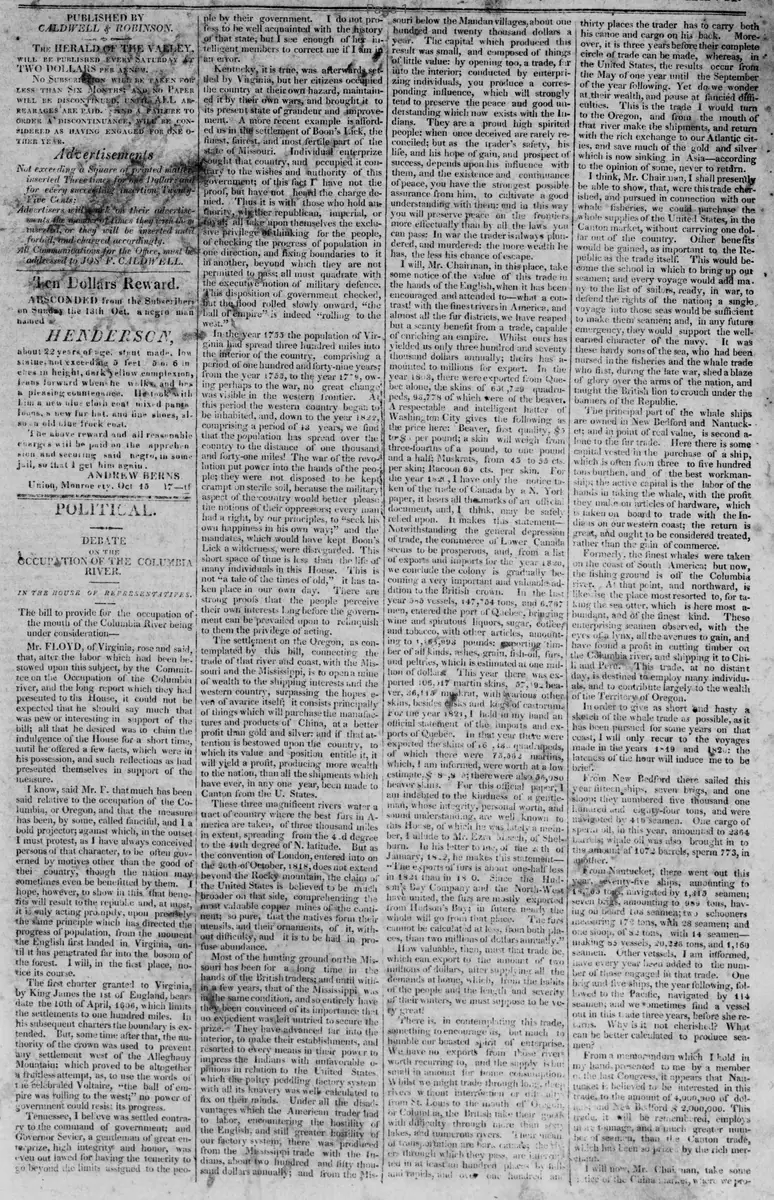
DEBATE
ON THE
OCCUPATION OF THE COLUMBIA
RIVER.
IN THE HOUSE OF REPRESENTATIVES.
The bill to provide for the occupation of the mouth of the Columbia River being under consideration-
Mr. FLOYD, of Virginia, rose and said that, after the labor which had been bestowed upon this subject, by the Committee on the Occupation of the Columbia river, and the long report which they had presented to the House, it could not be expected that he should say much that was new or interesting in support of the bill; all that he desired was to claim the indulgence of the House for a short time, until he offered a few facts, which were in his possession, and such reflections as had presented themselves in support of the measure.
I know, said Mr. F. that much has been said relative to the occupation of the Columbia, or Oregon, and that the measure has been, by some, called fanciful, and I a bold projector; against which, in the outset I must protest, as I have always conceived persons of that character, to be often governed by motives other than the good of their country, though the nation may sometimes even be benefitted by them. I hope, however, to show in this that benefits will result to the republic and, at most, it is only acting promptly, upon precisely the same principle which has directed the progress of population, from the moment the English first landed in Virginia, until it has penetrated far into the bosom of the forest. I will, in the first place, notice its course.
The first charter granted to Virginia, by King James the Ist of England, bears date the 10th of April, 1606, which limits the settlements to one hundred miles. In his subsequent charters the boundary is extended. But, some time after that, the authority of the crown was used to prevent any settlement west of the Alleghany Mountain; which proved to be altogether a fruitless attempt, as, to use the words of the celebrated Voltaire, the ball of empire was rolling to the west; no power of government could resist its progress.
Tennessee, I believe was settled contrary to the command of government; and Governor Sevier, a gentleman of great enterprise, high integrity and honor, was even outlawed for having the temerity to go beyond the limits assigned to the people by their government. I do not profess to be well acquainted with the history of that state; but I see enough of her intelligent members to correct me if I am in an error.
Kentucky, it is true, was afterwards settled by Virginia, but her citizens occupied the country at their own hazard, maintained it by their own wars, and brought it to its present state of grandeur and improvement. A more recent example is afforded us in the settlement of Boon's Lick, the finest, fairest, and most fertile part of the state of Missouri. Individual enterprise sought that country, and occupied it contrary to the wishes and authority of this government; of this fact I have not the proof, but have not heard the charge denied. Thus it is with those who hold authority, whether republican, imperial, or royal all take upon themselves the exclusive privilege of thinking for the people, of checking the progress of population in one direction, and fixing boundaries to it in another, beyond which they are not permitted to pass; all must quadrate with the executive notion of military defence. This disposition of government checked, but the flood rolled slowly onward, the ball of empire is indeed rolling to the west.
In the year 1755 the population of Virginia had spread three hundred miles into the interior of the country, comprising a period of one hundred and forty-nine years; from the year 1755, to the year 1790, owing perhaps to the war, no great change was visible in the western frontier. At this period the western country began to be inhabited, and, down to the year 1822, comprising a period of 32 years, we find that the population has spread over the country to the distance of one thousand and forty-one miles! The war of the revolution put power into the hands of the people; they were not disposed to be kept cramt on sterile soil, because the military aspect of the country would better please the notions of their oppressors; every man had a right, by our principles, to seek his own happiness in his own way; and the mandates, which would have kept Boon's Lick a wilderness, were disregarded. This short space of time is less than the life of many individuals in this House. This is not a tale of the times of old, it has taken place in our own day. There are strong proofs that the people perceive their own interests long before the government can be prevailed upon to relinquish to them the privilege of acting.
The settlement on the Oregon, as contemplated by this bill, connecting the trade of that river and coast, with the Missouri and the Mississippi, is to open a mine of wealth to the shipping interests and the western country, surpassing the hopes even of avarice itself; it consists principally of things which will purchase the manufactures and products of China, at a better profit than gold and silver: and if that attention is bestowed upon the country, to which its value and position entitle it, it will yield a profit, producing more wealth to the nation, than all the shipments which have ever, in any one year, been made to Canton from the U. States.
These three magnificent rivers water a tract of country where the best furs in America are taken, of three thousand miles in extent, spreading from the 42d degree to the 40th degree of N. latitude. But as the convention of London, entered into on the 20th of October, 1818, does not extend beyond the Rocky mountain, the claim of the United States is believed to be much broader on that side, comprehending the most valuable copper mines of the continent; so pure, that the natives form their utensils, and their ornaments, of it, without difficulty, and it is to be had in profuse abundance.
Most of the hunting ground on the Missouri has been for a long time in the hands of the British traders: and until within a few years, that of the Mississippi was in the same condition, and so entirely have they been convinced of its importance that no expedient was left untried to secure the prize. They have advanced far into the interior, to make their establishments, and resorted to every means in their power to impress the Indians with unfavorable opinions in relation to the United States, which the paltry peddling factory system with all its knavery was well calculated to fix on their minds. Under all the disadvantages which the American trader had to labor, encountering the hostility of the English, and still greater hostility of our factory system, there was produced from the Mississippi trade with the Indians, about two hundred and fifty thousand dollars annually; and from the Missouri below the Mandan villages, about one hundred and twenty thousand dollars a year. The capital which produced this result was small, and composed of things of little value: by opening too, a trade, far into the interior; conducted by enterprising individuals, you produce a corresponding influence, which will strongly tend to preserve the peace and good understanding which now exists with the Indians. They are a proud high spirited people: when once deceived are rarely reconciled; but as the trader's safety, his life, and his hope of gain, and prospect of success, depends upon his influence with them, and the existence and continuance of peace, you have the strongest possible assurance from him, to cultivate a good understanding with them: and in this way you will preserve peace on the frontiers more effectually than by all the laws you can pass: In war the trader is always plundered, and murdered: the more wealth he has, the less his chance of escape.
I will, Mr. Chairman, in this place, take some notice of the value of this trade in the hands of the English, when it has been encouraged and attended to--what a contrast! with the finest rivers in America, and almost all the fur districts, we have reaped but a scanty benefit from a trade, capable of enriching an empire. Whilst ours has yielded us only three hundred and seventy thousand dollars annually; theirs has amounted to millions for export. In the year 1813, there were exported from Quebec alone, the skins of 63,729 quadrupeds, 98,778 of which were of the beaver. A respectable and intelligent hatter of Washington City gives the following as the price here: Beaver, first quality, $5 to $6 per pound; a skin will weigh from three-fourths of a pound, to one pound and a half; Muskrats, from 45 to 50 cts. per skin; Raccoon 65 cts. per skin. For the year 1821, I have only the notice taken of the trade of Canada by a N. York paper, it bears all the marks of an official document, and, I think, may be safely relied upon. It makes this statement-
Notwithstanding the general depression of trade, the commerce of Lower Canada seems to be prosperous, and, from a list of exports and imports for the year 1820, we conclude the colony is gradually becoming a very important and valuable addition to the British crown. In the last year 595 vessels, 147,754 tons, and 6,767 men, entered the port of Quebec, bringing wine and spirituous liquors, sugar, coffee, and tobacco, with other articles, amounting to 1,165,998 pounds: exporting timber of all kinds, ashes, grain, fish-oil, furs, and peltries, which is estimated at one million of dollars. This year there was exported 106,317 martin skins, 57,192 beaver, 36,115 muskrat, with various other skins, besides casks and kegs of castorum.
For the year 1821, I hold in my hand an official statement of the imports and exports of Quebec. In that year there were exported the skins of 63,333 quadrupeds, of which there were 75,562 martins, which, I am informed, were worth at a low estimate $85,000; there were also 56,080 beaver skins. For this official paper, I am indebted to the kindness of a gentleman, whose integrity, personal worth, and sound understanding, are well known to this House, of which he was lately a member, I allude to Mr. Ezra Mach, of Shelburn. In his letter to me, of the 4th of January, 1822, he makes this statement-
The exports of furs is about one-half less in 1821 than in 1820. Since the Hudson's Bay Company and the North-West have united, the furs are mostly exported from Hudson's Bay; in future nearly the whole will go from that place. The furs cannot be calculated at less, from both places, than two millions of dollars annually.
How valuable, then, must that trade be, which can export to the amount of two millions of dollars, after supplying all the demands at home, which, from the habits of the people and the length and severity of their winters, we must suppose to be very great!
There is, in contemplating this trade, something to encourage us, but much to humble our boasted spirit of enterprise. We have no exports from those rivers worth recurring to, and the supply is but small in amount for home consumption. Whilst we might trade through long, deep rivers without interruption or obstacle from St. Louis to the mouth of Oregon or Columbia, the British take their goods with difficulty through more than six lakes, and numerous rivers. Their means of transportation are hard. Canadian; the rivers through which they pass, are intersected in at least an hundred places by falls and rapids, and over one hundred and thirty places the trader has to carry both his canoe and cargo on his back. Moreover, it is three years before their complete circle of trade can be made, whereas, in the United States, the results occur from the May of one year until the September of the year following. Yet do we wonder at their wealth, and pause at fancied difficulties. This is the trade I would turn to the Oregon, and for the mouth of that river make the shipments, and return with the rich exchange to our Atlantic cities, and save much of the gold and silver which is now sinking in Asia--according to the opinion of some, never to return.
I think, Mr. Chairman, I shall presently be able to show, that, were this trade cherished, and pursued in connection with our whale fisheries, we could purchase the whole supplies of the United States, in the Canton market, without carrying one dollar out of the country. Other benefits would be gained, as important to the Republic as the trade itself. This would become the school in which to bring up our seamen; and every voyage would add many to the list of sailors, ready, in war, to defend the rights of the nation; a single voyage into those seas would be sufficient to make them seamen; and, in any future emergency, they would support the well-earned character of the navy. It was these hardy sons of the sea, who had been nursed in the fisheries and the whale trade who first, during the late war, shed a blaze of glory over the arms of the nation, and taught the British lion to crouch under the banners of the Republic.
The principal part of the whale ships are owned in New Bedford and Nantucket: and in point of real value, is second alone to the fur trade. Here there is some capital vested in the purchase of a ship, which is often from three to five hundred tons burthen, and of the best workmanship; the active capital is the labor of the hands in taking the whale, with the profit they make on articles of hardware, which is taken on board to trade with the Indians on our western coast; the return is great, and ought to be considered treated, rather than the gain of commerce.
Formerly, the finest whales were taken on the coast of South America; but now, the fishing ground is off the Columbia river. At that point, and northward, is likewise the place most resorted to, for taking the sea otter, which is here most abundant, and of the finest kind. These enterprising seamen observed, with the eyes of a lynx, all the avenues to gain, and have found a profit in cutting timber on the Columbia river, and shipping it to China and Peru. This trade, at no distant day, is destined to employ many individuals, and to contribute largely to the wealth of the Territory of Oregon.
In order to give as short and hasty a sketch of the whale trade as possible, as it has been pursued for some years on that coast, I will only recur to the voyages made in the years 1819 and 1820: the lateness of the hour will induce me to be brief.
From New Bedford there sailed this year fifteen ships, seven brigs, and one sloop; they numbered five thousand one hundred and eighty-four tons, and were navigated by 446 seamen. One cargo of spermaceti oil, in this year, amounted to 2364 barrels; whale oil was also brought in to the amount of 1072 barrels, sperm 773, in another.
From Nantucket, there went out this year, seventy-five ships, amounting to 14,703 tons, navigated by 1,315 seamen; seven brigs, amounting to 985 tons, having on board 105 seamen; two schooners measuring 175 tons, with 28 seamen; and one sloop, of 5 tons, with 14 seamen making 5 vessels, 20,226 tons, and 1,160 seamen. Other vessels, I am informed, have every year been added to the number of those engaged in that trade. One brig and five ships, the year following, followed to the Pacific, navigated by 114 seamen; and we sometimes find a vessel out in this trade three years, before she returns. Why is it not cherished? What can be better calculated to produce seamen?
From a memorandum which I hold in my hand, presented to me by a member of the last Congress, it appears that Nantucket is believed to be interested in this trade, to the amount of 4,000,000 of dollars, and New Bedford $2,000,000. This trade, it will be remembered, employs more tonnage, and a much greater number of seamen, than the Canton trade, which has been so prized by the rich merchants.
I will now, Mr. Chairman, take some notice of the China trade, where we procure many of our supplies. It has been severely remarked upon, throughout the country, more particularly by those engaged in the European trade, and even in this House, no very favourable impressions of it, at one time, existed. But, from aught I can see, it is a trade rather to be cherished than deprecated; and if it has not yielded us all we wanted, it has been owing to the manner in which we ourselves have carried it on. I hope the House will indulge me a short time, that I may take some notice of the document furnished by the Agent of the United States, at Canton, to this Government; it is official.
It appears from this paper, that the trade of China has fluctuated very considerably, from the season of 1804-5, to the present time, owing, no doubt, to the various causes which have influenced this government during that period. In the course of that year, there were thirty-four vessels, which made up the sum of 10,159 tons; they carried, in specie, $290,000, yet the total amount of value that year entered in Canton, was $555,818; the whole of which, exclusive of the specie, and excepting also $101 in ginseng, was furs, seal skins, ebony and sandal wood, making their value amount to $453,538. - In the season of 1805-6, the result is different--forty-two vessels entered that year, making the number of tons 12,180, carrying $476,060. The total value of the trade was, that year, $5,826,558, which was produced by the furs, seal skins, sandal wood, and ebony; making the amount $1,476,358; but in this must be reckoned 1,334 peculs of ginseng, 102 of opium, 48 of quicksilver, 140 of lead, 346 of iron, and 800 of copper. There were that year sent 1,415 sea-otter skins, and 40,291 seal skins. In the season of 1806-7, there were entered at that port, thirty-seven vessels, making 11,268 tons. They had on board $1,895,000. The total value of trade that year, was $3,877,362; of which, there was about the same proportion of ginseng, quicksilver, iron, lead, &c. that there was the season before; but this year, to $981,362. I will skip over some of these years, and present to the House a few of those most worthy of notice. Here is the return for the season of 1808-9; this year, as our difficulties in Europe increased, our trade declined, though the result is worthy to be remarked. There were but eight vessels entered at Canton, numbering 2,226 tons, carrying $70,000; the total amount of trade that year was $479,950; the amount this year, over the $70,000, was $409,950. The amount was produced by 7,944 sea-otter skins, 34,201 seal, 400 land otter, 5,170 beaver, 480 peculs of ebony, 2,050 of cotton, and 4,360 peculs of sandal wood.
The season of 1811-12 gives this result: $300,000 in specie, sent to that market; the total amount of the trade was $3,137,910; consequently the $2,837,910 was made up of furs, seal skins and sandal wood, with the exception of 557 p. of ginseng, 7 of opium, 29 of quicksilver, 1814 of iron, and 2798 of copper. In the season of 1812-13 there was taken to Canton $616,200, and the total amount of trade that season, was $1,603,000, made up of furs, seal skins, and sandal wood, with the exception likewise, of 21 peculs of ginseng, 10 of opium, and 5629 of copper.
During the whole of the years of 1813, 14, and 15, there was not one dollar sent to China-there was with the exception of 43 peculs of ginseng, nothing sent but furs, sea otter, seals, land otters, fox, beaver, and sandal wood, these were taken in the forest, or hewn down with the axe in the Sandwich Islands, yet the amount is $451,500.
The season of 1815-16 is favorable. That of 1816-17, gives $619,500, as the total amount of trade, though there was of this $4,545,000 in specie. The season of 1817-18 gives 39 vessels, 14,402 tons, $2,601 in specie; the total amount of trade that year was $7,073,228, making $2,672,228 in furs, sandal wood, &c. with 1601 peculs of ginseng, 418 of opium, 105 of steel, lead, quicksilver, iron, copper, nearly in the same proportions.
The estimate of our trade, for the season of 1818-19, states the amount in specie to be $6,414,000, and the total amount $10,217,151, of which sum, the sandal wood forms an item of $91,360; sea otter tails $10,136, beaver skins $70,965, seal $100,300, sea otter $124,600, besides all other furs, &c. with ginseng, lead, opium, &c. which forms this season large items in the imports.
In the season 1820-21, there was taken to Canton $2,905,000, though the total value of trade that year is $3,392,795; sandal wood this year amounted to $67,133; sea otter skins to $176,548; land otter to $44,400; beaver $68,000, and sea otter tails, to $14,422; seal $92,078, &c. &c.
Having sir, exhibited this view of the subject to the House, I will now trespass
What sub-type of article is it?
What themes does it cover?
What keywords are associated?
What entities or persons were involved?
Where did it happen?
Story Details
Key Persons
Location
House Of Representatives; Columbia River
Event Date
Circa 1822
Story Details
Mr. Floyd advocates for U.S. occupation of the Columbia River mouth, paralleling historical westward expansions like Virginia's settlement despite royal restrictions, emphasizing fur trade wealth surpassing British exports from Canada, whale fisheries off the coast, and potential to fund China trade without specie outflow, fostering seamen for the navy.