Thank you for visiting SNEWPapers!
Sign up free
Editorial
December 16, 1852
Lynchburg Daily Virginian
Lynchburg, Virginia
What is this article about?
An editorial examines the surplus revenue in the U.S. Treasury, deemed harmful to government theory and commerce. It critiques Democrats' free trade advocacy, suggesting they may need to support higher tariffs to reduce revenue, potentially shifting their position, while noting Whigs' preference for protective tariffs.
Clipping
OCR Quality
98%
Excellent
Full Text
Surplus Revenue.
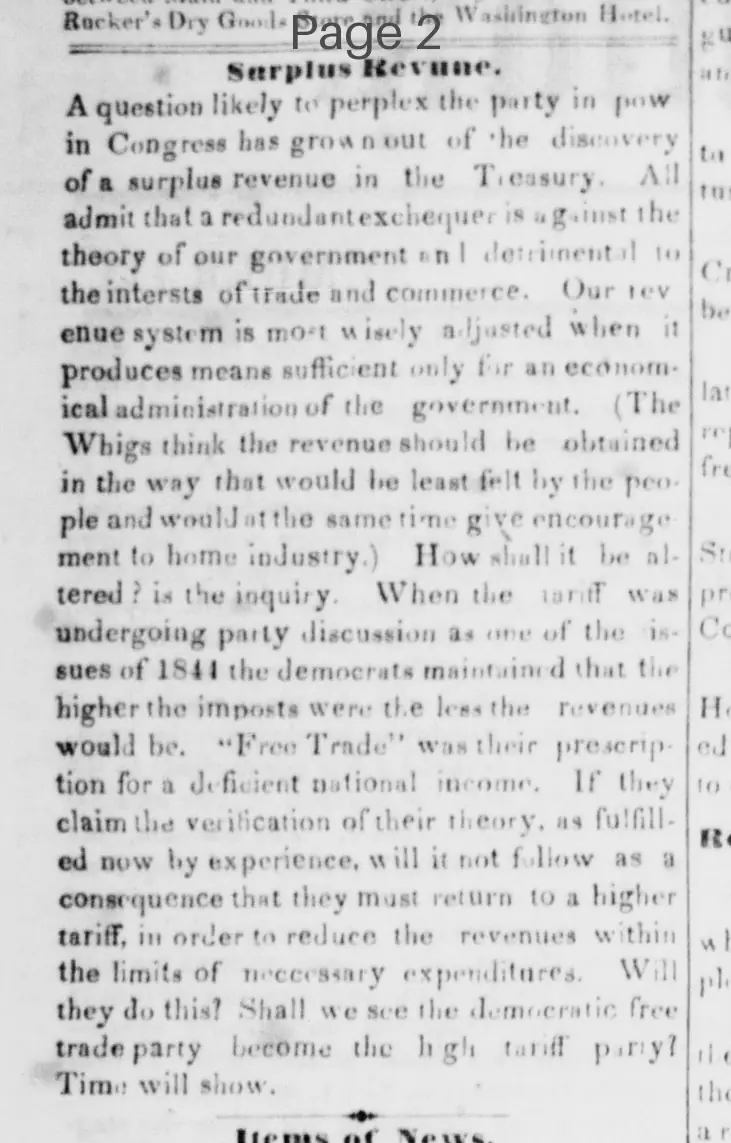
A question likely to perplex the party in power in Congress has grown out of the discovery of a surplus revenue in the Treasury. All admit that a redundant exchequer is against the theory of our government and detrimental to the interests of trade and commerce. Our revenue system is most wisely adjusted when it produces means sufficient only for an economical administration of the government. (The Whigs think the revenue should be obtained in the way that would be least felt by the people and would at the same time give encouragement to home industry.) How shall it be altered? is the inquiry. When the tariff was undergoing party discussion as one of the issues of 1844 the democrats maintained that the higher the imposts were the less the revenues would be. "Free Trade" was their prescription for a deficient national income. If they claim the verification of their theory, as fulfilled now by experience, will it not follow as a consequence that they must return to a higher tariff, in order to reduce the revenues within the limits of necessary expenditures. Will they do this? Shall we see the democratic free trade party become the high tariff party? Time will show.
A question likely to perplex the party in power in Congress has grown out of the discovery of a surplus revenue in the Treasury. All admit that a redundant exchequer is against the theory of our government and detrimental to the interests of trade and commerce. Our revenue system is most wisely adjusted when it produces means sufficient only for an economical administration of the government. (The Whigs think the revenue should be obtained in the way that would be least felt by the people and would at the same time give encouragement to home industry.) How shall it be altered? is the inquiry. When the tariff was undergoing party discussion as one of the issues of 1844 the democrats maintained that the higher the imposts were the less the revenues would be. "Free Trade" was their prescription for a deficient national income. If they claim the verification of their theory, as fulfilled now by experience, will it not follow as a consequence that they must return to a higher tariff, in order to reduce the revenues within the limits of necessary expenditures. Will they do this? Shall we see the democratic free trade party become the high tariff party? Time will show.
What sub-type of article is it?
Economic Policy
Partisan Politics
Trade Or Commerce
What keywords are associated?
Surplus Revenue
Tariff Policy
Free Trade
Democrats
Whigs
Trade Commerce
Revenue System
What entities or persons were involved?
Whigs
Democrats
Congress
Treasury
Editorial Details
Primary Topic
Surplus Revenue And Tariff Policy
Stance / Tone
Critical Of Democratic Free Trade Position
Key Figures
Whigs
Democrats
Congress
Treasury
Key Arguments
Surplus Revenue Is Detrimental To Government Theory And Trade Interests.
Revenue Should Suffice Only For Economical Government Administration.
Whigs Favor Tariffs That Minimally Burden People And Encourage Home Industry.
Democrats Claimed Higher Tariffs Reduce Revenue, Advocating Free Trade For Deficits.
Current Surplus Verifies Democratic Theory, Implying Need For Higher Tariffs To Cut Revenue.
Questions If Democrats Will Adopt High Tariff Stance.