Thank you for visiting SNEWPapers!
Sign up free
The Virginia Gazette
Richmond, Williamsburg, Richmond County, Virginia
What is this article about?
Richard Bland defends his character against Samuel Henley's accusation of falsely charging him with Socinianism during a vestry election for Bruton Parish minister in Williamsburg. He recounts a conversation where Henley explained Hebrews 1 in a way denying Christ's divinity, his testimony to the treasurer, and proceedings at the vestry meeting, supported by Mrs. Nicholas's evidence.
Merged-components note: Continuation of the same letter to the editor regarding the dispute with Mr. Henley, split across pages.
Clippings
1 of 2
OCR Quality
Full Text
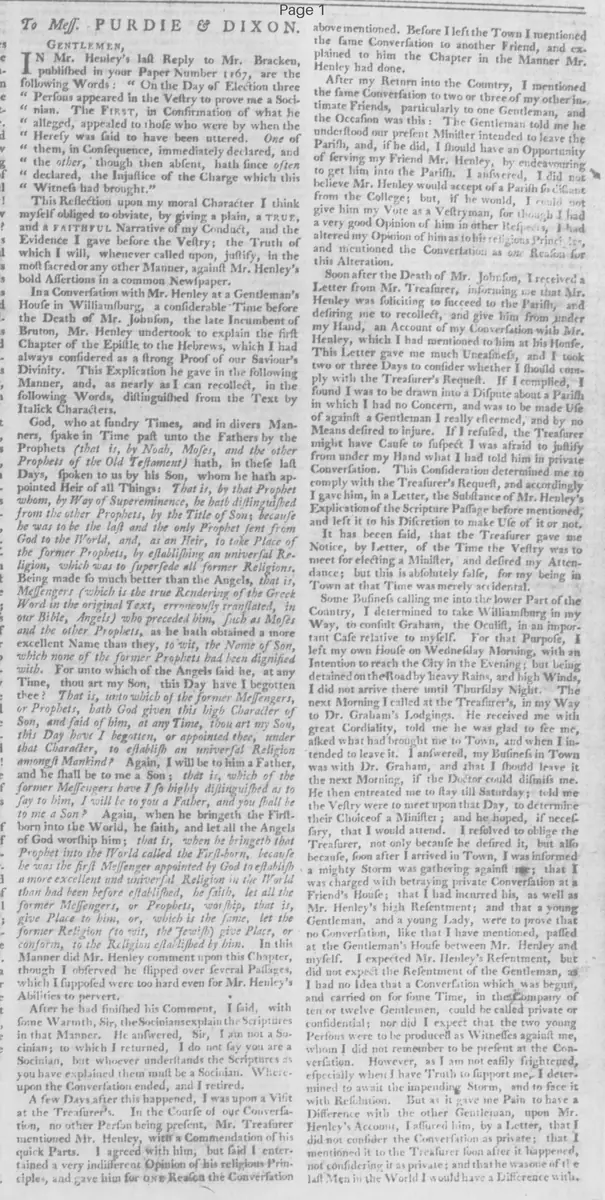
GENTLEMEN,
In Mr. Henley's last Reply to Mr. Bracken, published in your Paper Number 1167, are the following Words: "On the Day of Election three Persons appeared in the Vestry to prove me a Socinian. The First, in Confirmation of what he alleged, appealed to those who were by when the Heresy was Said to have been uttered. One of them, in Consequence, immediately declared, and the other, though then absent, hath since often declared, the Injustice of the Charge which this Witness had brought."
This Reflection upon my moral Character I think myself obliged to obviate, by giving a plain, a TRUE, and a FAITHFUL Narrative of my Conduct, and the Evidence I gave before the Vestry; the Truth of which I will, whenever called upon, justify, in the most sacred or any other Manner, against Mr. Henley's bold Assertions in a common Newspaper.
In a Conversation with Mr. Henley at a Gentleman's House in Williamsburg, a considerable Time before the Death of Mr. Johnson, the late Incumbent of Bruton, Mr. Henley undertook to explain the first Chapter of the Epistle to the Hebrews, which I had always considered as a strong Proof of our Saviour's Divinity. This Explication he gave in the following Manner, and, as nearly as I can recollect, in the following Words, distinguished from the Text by Italic Characters.
God, who at sundry Times, and in divers Manners, spake in Time past unto the Fathers by the Prophets (that is, by Noah, Moses, and the other Prophets of the Old Testament) hath, in these last Days, spoken to us by his Son, whom he hath appointed Heir of all Things: That is, by that Prophet whom, by Way of Supereminence, he hath distinguished from the other Prophets, by the Title of Son; because he was to be the last and the only Prophet sent from God to the World, and, as an Heir, to take Place of the former Prophets, by establishing an universal Religion, which was to supersede all former Religions.
Being made so much better than the Angels, that is, Messengers (which is the true Rendering of the Greek Word in the original Text, erroneously translated, in our Bible, Angels) who preceded him, such as Moses and the other Prophets, as he hath obtained a more excellent Name than they, to wit, the Name of Son, which none of the former Prophets had been dignified with. For unto which of the Angels said he, at any Time, thou art my Son, this Day have I begotten thee? That is, unto which of the former Messengers, or Prophets, hath God given this high Character of Son, and said of him, at any Time, thou art my Son, this Day have I begotten, or appointed thee, under that Character, to establish an universal Religion amongst Mankind? Again, I will be to him a Father, and he shall be to me a Son; that is, which of the former Messengers have I so highly distinguished as to say to him, I will be to you a Father, and you shall be to me a Son? Again, when he bringeth the First-born into the World, he saith, and let all the Angels of God worship him; that is, when he bringeth that Prophet into the World called the First-born, because he was the first Messenger appointed by God to establish a more excellent and universal Religion in the World than had been before established, he saith, let all the former Messengers, or Prophets, worship, that is, give Place to him, or, which is the same, let the former Religion (to wit, the Jewish) give Place, or conform, to the Religion established by him. In this Manner did Mr. Henley comment upon this Chapter, though I observed he skipped over several Passages, which I supposed were too hard even for Mr. Henley's Abilities to pervert.
After he had finished his Comment, I said, with some Warmth, Sir, the Socinians explain the Scriptures in that Manner. He answered, Sir, I am not a Socinian; to which I returned, I don't say you are a Socinian, but whoever understands the Scriptures as you have explained them must be a Socinian. Whereupon the Conversation ended, and I retired.
A few Days after this happened, I was upon a Visit at the Treasurer's, In the Course of our Conversation, no other Person being present, Mr. Treasurer mentioned Mr. Henley, with a Commendation of his quick Parts. I agreed with him, but said I entertained a very indifferent Opinion of his religious Principles, and gave him for One Reason the Conversation above mentioned. Before I left the Town I mentioned the same Conversation to another Friend, and explained to him the Chapter in the Manner Mr. Henley had done.
After my Return into the Country, I mentioned the same Conversation to two or three of my other intimate Friends, particularly to one Gentleman, and the Occasion was this: The Gentleman told me he understood our present Minister intended to leave the Parish, and, if he did, I should have an Opportunity of serving my Friend Mr. Henley, by endeavoring to get him into the Parish. I answered, I did not believe Mr. Henley would accept of a Parish so distant from the College; but, if he would, I would not give him my Vote as a Vestryman, for though I had a very good Opinion of him in other Respects, I had altered my Opinion of him as to his religious Principles, and mentioned the Conversation as one Reason of this Alteration.
Soon after the Death of Mr. Johnson, I received a Letter from Mr. Treasurer, informing me that Mr. Henley was soliciting to succeed to the Parish, and desiring me to recollect, and give him from under my Hand, an Account of my Conversation with Mr. Henley, which I had mentioned to him at his House.
This Letter gave me much Uneasiness, and I took two or three Days to consider whether I should comply with the Treasurer's Request. If I complied, I found I was to be drawn into a Dispute about a Parish in which I had no Concern, and was to be made Use of against a Gentleman I really esteemed, and by no Means desired to injure. If I refused, the Treasurer might have Cause to suspect I was afraid to justify from under my Hand what I had told him in private Conversation. This Consideration determined me to comply with the Treasurer's Request, and accordingly I gave him, in a Letter, the Substance of Mr. Henley's Explication of the Scripture Passage before mentioned, and left it to his Discretion to make Use of it or not.
It has been said, that the Treasurer gave me Notice, by Letter, of the Time the Vestry was to meet for electing a Minister, and desired my Attendance; but this is absolutely false, for my being in Town at that Time was merely accidental.
Some Business calling me into the lower Part of the Country, I determined to take Williamsburg in my Way, to consult Graham, the Oculist, in an important Case relative to myself. For that Purpose, I left my own House on Wednesday Morning, with an Intention to reach the City in the Evening; but being detained on the Road by heavy Rains, and high Winds, I did not arrive there until Thursday Night. The next Morning I called at the Treasurer's, in my Way to Dr. Graham's Lodgings. He received me with great Cordiality, told me he was glad to see me, asked what had brought me to Town, and when I intended to leave it. I answered, my Business in Town was with Dr. Graham, and that I should leave it the next Morning, if the Doctor could dismiss me.
He then entreated me to stay till Saturday; told me the Vestry were to meet upon that Day, to determine their Choice of a Minister; and he hoped, if necessary, that I would attend. I resolved to oblige the Treasurer, not only because he desired it, but also because, soon after I arrived in Town, I was informed a mighty Storm was gathering against me; that I was charged with betraying private Conversation at a Friend's House; that I had incurred his, as well as Mr. Henley's high Resentment; and that a young Gentleman, and a young Lady, were to prove that no Conversation, like that I have mentioned, passed at the Gentleman's House between Mr. Henley and myself. I expected Mr. Henley's Resentment, but did not expect the Resentment of the Gentleman, as I had no Idea that a Conversation which was begun, and carried on for some Time, in the Company of ten or twelve Gentlemen, could be called private or confidential; nor did I expect that the two young Persons were to be produced as Witnesses against me, whom I did not remember to be present at the Conversation. However, as I am not easily frightened, especially when I have Truth to support me, I determined to await the impending Storm, and to face it with Resolution. But as it gave me Pain to have a Difference with the other Gentleman, upon Mr. Henley's Account, I assured him, by a Letter, that I did not consider the Conversation as private; that I mentioned it to the Treasurer soon after it happened, not considering it as private; and that he was one of the last Men in the World I would have a Difference with.
Some time after the Vestry had met, Mr. Henley, Mrs. Nicholas, Mrs. Ambler, and myself, were sent for; but the two young Persons, I had been told of, did not appear. Mr. Treasurer then drew my Letter from his Pocket, and gave it to Mr. Henley, who read it with an audible Voice. After he had read it, he told me I had reflected upon his moral Character: I denied it. He then read this Passage from my Letter: I have always considered Mr. Henley as a Gentleman of good but not rigid Morals, only I think he is too fond of Egotisms. I thought the Expression too fond of Egotism had given the Offence; but I was mistaken, the Terms not rigid Morals being the criminal Words. He dwelt upon them, and said they were a Reflection upon him. I told him I intended them rather as a Compliment; that by the Term not rigid I meant not stiff, not formal, not precise, though, in a private Letter to a Friend, I might not attend to the strict Import of a particular Word. But, Sir, said I, every Syllable in that Letter is TRUTH. I then gave a general Account of the Conversation, and appealed to the Gentleman at whose House it happened whether such Conversation did not pass. He acknowledged it in the general, but said he thought I misunderstood Mr. Henley. I then asked him if I did not tell Mr. Henley at the Time he explained the Scriptures as a Socinian: He acknowledged I did, but differed from me in Opinion upon some of Mr. Henley's Expressions. I was positive; they had made a deep Impression upon my Mind; I had frequently reflected upon them, and remembered them well. The Gentleman then said, he asked me one Evening whether I intended to go to the Play: My Answer was, I would not, but would spend the Evening with Mr. Henley, with whom I had rather converse than see a Play. I acknowledged I did tell him so; but that this Declaration was prior to the Conversation then under Examination, and was occasioned by a Conversation some Time before, at the same Gentleman's House. He then concluded with saying, he thought Mr. Henley proved himself to be an able Divine. To this I made no Answer, being unwilling to aggravate; but thought very differently, and that Mr. Henley proved himself to be a mere Caviller and Perverter of the sacred Text, in one of the most important Doctrines of the established Church, which it was his Duty to defend.
Mr. Henley also acknowledged the Conversation in the general, but said I mistook his Meaning. I replied, if I did mistake your Meaning I am sorry for it, but I am certain of the contrary; I am certain you explained the Chapter so as to deprive our Saviour of his Divinity. I was then of that Opinion, and remain at this Time of the same Opinion, and that you hold Principles derogatory to his Divinity. Mr. Henley then desired Leave of the Vestry to explain the Chapter, and said he would do it as he had done to me. He obtained Leave; but whether he explained it to the Satisfaction of the Majority of the Vestry, their Vote may, I think, determine. But, let this be as it may, I affirm he varied very materially from his former Explication. I will give one Instance of it, and that an important One: In his former Explication, he made the Term Son, in the first Verse, an Appellation of Dignity, and not of Relationship. In his last, he read the Word, but did not explain it. I took Notice of it, and told him his former Explication of that Word was what first struck me, and made me particularly attentive to his Explication of the subsequent Part of the Chapter. I therefore desired him to explain that Word once more. Whether he complied with this Request, may perhaps be remembered by the Gentlemen of the Vestry; but as to myself, I do not remember that he did.
Mr. Henley then asked me if I knew any Thing farther relative to his Principles: I desired him not to ask me any more Questions; I told him I had been drawn into the Dispute unexpectedly, and wished to have no farther Concern in it. Mr. Henley said, Sir, my Character is at Stake, and I must insist upon an Answer. I was a little offended at his peremptory Manner, and replied, do you really insist upon it? He answered, I do. Then, said I, I do know more of your Principles; you hold the Doctrine of Annihilation, and that the Wicked, in the next Life, will, by Means of their Punishments, be totally destroyed, as if they had never existed. If Mr. Henley made any Reply, unless to justify the Doctrine, I do not remember it.
One of the Gentlemen of the Vestry, whose Vote afterwards was not in Favour of Mr. Henley, then said, we have heard enough upon this Point; let us examine another Witness.
Mrs. Nicholas was then called upon; and as her Evidence will justify my Opinion of Mr. Henley's religious Principles, I will take the Liberty to recite it. This Lady declared, with great Clearness and Perspicuity of Expression, that, in a Conversation with Mr. Henley, he said he did not believe Jesus Christ was the Son of God, or he did not believe in the Divinity of Jesus Christ; that she could not positively say which Expression he made use of, but she was certain it was the one or the other, though, in her Opinion, it was immaterial, as she considered them to be synonymous, and of the same Meaning; that this Declaration surprised her, and she asked Mr. Henley, if that was his Opinion, how it was possible for him to take Orders in the Church of England, and subscribe to her Articles? To which Mr. Henley answered, one of the Articles declares, that whatever is not contained in the Scriptures, or may be proved from them, is not to be believed as an Article of Faith, or necessary to Salvation; so that he had a Right to exercise his private Judgment, and might, with a safe Conscience, subscribe to the Articles. She then asked him, whether there really was such an Article, for she did not remember it; to which he answered, there was. By the Bye, if the Author of the Confessional understands the Meaning of this Article, Mr. Henley mistakes the Sense of it.
Before Mrs. Ambler was examined, I had left the Vestry, so that I know Nothing of her Evidence.
Thus have I given you a candid and ingenuous Detail of my Conduct, and of the Transactions in the Vestry, so far as I am acquainted with them. It is long, but Mr Henley's severe Reflection made this Length necessary. As it is with Reluctance I appear in Publick upon this Occasion, I assure you I will give you no farther Trouble, although Mr. Henley should endeavour to provoke me to it with his most virulent Style.
But, it seems, he is at length determined to put on some Part of the divine Armour. I sincerely congratulate him upon this Resolution, but beg Leave to remind him, that he has forgot some necessary Parts of it; that his Loins ought to be girt about with Truth; that he ought to put on the Breastplate of Righteousness, and be shod with the Preparation of the Gospel of Peace. These the Apostle makes necessary Parts of the Armour of God, and if he will clothe himself with them, as well as with the Parts he mentions, and if, when he is investing himself with the Sword, he will at the Same Time invest himself with the Meekness and Humility of the Spirit, I am persuaded many valuable Qualities he possesses, which are now darkened by the Pencil of Self-Adulation and Vanity, will shine forth in their proper Lustre, to the Reputation of himself, and Improvement of others.
I am yours, &c.
RICHARD BLAND.
What sub-type of article is it?
What themes does it cover?
What keywords are associated?
What entities or persons were involved?
Letter to Editor Details
Author
Richard Bland
Recipient
Messrs. Purdie & Dixon
Main Argument
richard bland provides a detailed narrative to refute samuel henley's accusation that he falsely charged henley with socinianism during the vestry election, asserting the truth of his testimony regarding henley's explanation of hebrews 1 as denying christ's divinity and supporting it with additional evidence from mrs. nicholas.
Notable Details