Thank you for visiting SNEWPapers!
Sign up free
The Western News
Libby, Lincoln County, Montana
What is this article about?
In Libby, a fire department demonstration taught citizens how to combat incendiary bomb fires using sand and shovels, and protect against gas attacks by moving upwind and to higher ground. Speakers included Wayne Shanahan, J.A. Krall, and Joe Devich.
Merged-components note: Caption describes fire fighting equipment directly related to the incendiary bombs story.
Clipping
OCR Quality
Full Text
Libby citizens who turned out for the fire department demonstration Monday evening learned how to fight fires caused by incendiary bombs and how to protect one's self if in an area subjected to a gas attack.
The demonstration was conducted by the Libby fire department and was staged on vacant lots just east of the court house. A goodly number was present.
Wayne Shanahan presided and told the purposes of the demonstration. While probably there is little danger of incendiary bombs being dropped here, he said, yet no one knows when he may be within a district under attack and protective knowledge then would be very valuable. He called on J. A. Krall, chairman of the Lincoln county Preparedness and Advisory commission, for a few remarks.
Mr. Krall spoke briefly, thanking the various organizations that had cooperated so wholeheartedly in local defense work. He especially thanked the American Legion men for their assistance and remarked that probably few people knew that the Legion has squads organized to assist in most every line of defense work should occasion arise. The war experience of many of these men fit them particularly for that work.
The next speaker was Joe Devich, who holds a lieutenant's commission in the chemical warfare division of the army. Mr. Devich gave much interesting information relative to use of gas in war and how to protect one's self. He said the first thing to realize is that gas is nothing to become hysterical about, that it is quite easily combated.
First, he said, do not begin to run wildly around if under a gas attack—one might thus run into a worse condition. Second, proceed up-wind as the wind will then carry the gas away from one. Third, get into a higher terrain as most of the gases settle onto low ground. If burned by some form of gas, use plenty of water in removing it from the flesh.
Mr. Devich had experience in this respect during the World war and his training since then has added to his knowledge of the subject.
His talk was followed by the lighting of a few home-made magnesium bombs and showing how they should be extinguished. The best way is first to smother the flame with sand, then shovel up both the sand and the burning magnesium, place in a pail of sand and remove to a place of safety. Water can be later used to extinguish burning woodwork. Frnie Wood had charge of that part of the program.
It is understood the fire department is sending for a couple of magnesium bombs for educational purposes and a second demonstration will be given later if they are secured.
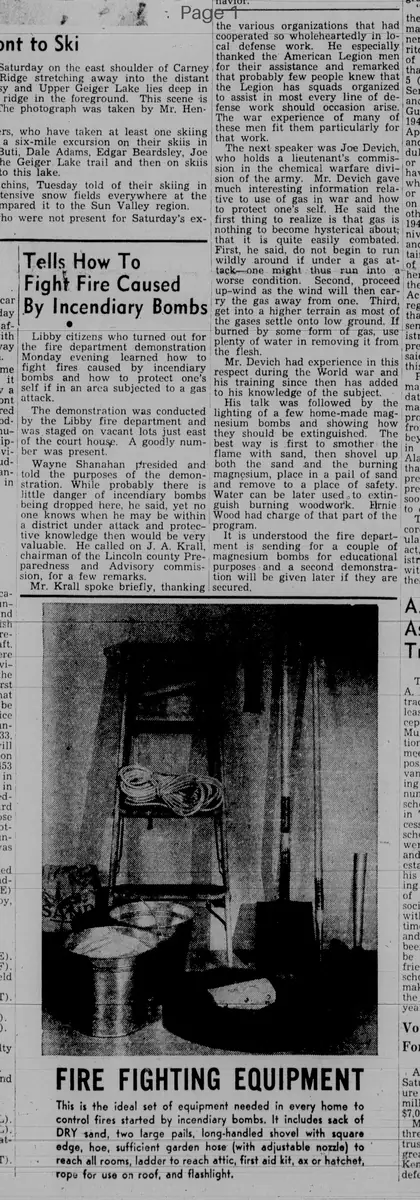
FIRE FIGHTING EQUIPMENT
This is the ideal set of equipment needed in every home to control fires started by incendiary bombs. It includes sack of DRY sand, two large pails, long-handled shovel with square edge, hoe, sufficient garden hose (with adjustable nozzle) to reach all rooms, ladder to reach attic, first aid kit, ax or hatchet, rope for use on roof, and flashlight.
What sub-type of article is it?
What themes does it cover?
What keywords are associated?
What entities or persons were involved?
Where did it happen?
Story Details
Key Persons
Location
Libby, Vacant Lots Just East Of The Courthouse
Event Date
Monday Evening
Story Details
Libby fire department demonstration on fighting incendiary bomb fires and protecting against gas attacks, featuring speakers on preparedness and practical extinguishing methods using sand and shovels.