Thank you for visiting SNEWPapers!
Sign up free
Domestic News
August 19, 1949
The East Hartford Gazette
New Britain, Hartford County, Connecticut
What is this article about?
Connecticut officials informed of new school bus law effective Oct. 1, 1949, mandating yellow paint, specific markings, and stop signals by Commissioner Mulvihill.
Clipping
OCR Quality
100%
Excellent
Full Text
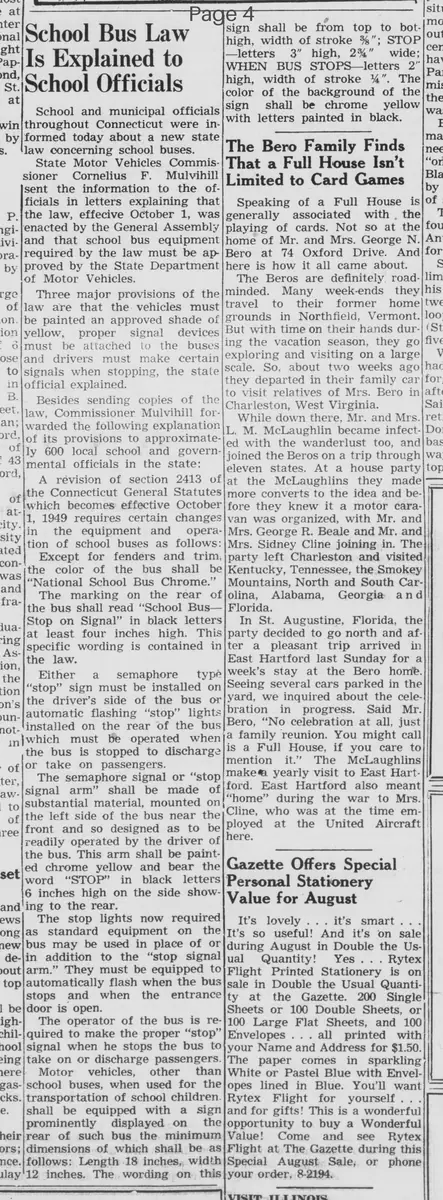
School Bus Law Is Explained to School Officials
School and municipal officials throughout Connecticut were informed today about a new state law concerning school buses.
State Motor Vehicles Commissioner Cornelius F. Mulvihill sent the information to the officials in letters explaining that the law, effective October 1, was enacted by the General Assembly and that school bus equipment required by the law must be approved by the State Department of Motor Vehicles.
Three major provisions of the law are that the vehicles must be painted an approved shade of yellow, proper signal devices must be attached to the buses and drivers must make certain signals when stopping, the state official explained.
Besides sending copies of the law, Commissioner Mulvihill forwarded the following explanation of its provisions to approximately 600 local school and governmental officials in the state:
A revision of section 2413 of the Connecticut General Statutes which becomes effective October 1, 1949 requires certain changes in the equipment and operation of school buses as follows:
Except for fenders and trim, the color of the bus shall be "National School Bus Chrome."
The marking on the rear of the bus shall read "School Bus Stop on Signal" in black letters at least four inches high. This specific wording is contained in the law.
Either a semaphore type "stop" sign must be installed on the driver's side of the bus or automatic flashing "stop" lights installed on the rear of the bus which must be operated when the bus is stopped to discharge or take on passengers.
The semaphore signal or "stop signal arm" shall be made of substantial material, mounted on the left side of the bus near the front and so designed as to be readily operated by the driver of the bus. This arm shall be painted chrome yellow and bear the word "STOP" in black letters 6 inches high on the side showing to the rear.
The stop lights now required as standard equipment on the bus may be used in place of or in addition to the "stop signal arm." They must be equipped to automatically flash when the bus stops and when the entrance door is open.
The operator of the bus is required to make the proper "stop" signal when he stops the bus to take on or discharge passengers.
Motor vehicles, other than school buses, when used for the transportation of school children shall be equipped with a sign prominently displayed on the rear of such bus the minimum dimensions of which shall be as follows: Length 18 inches, width 12 inches. The wording on this sign shall be from top to bottom high, width of stroke 3"; STOP —letters 3" high, 2 1/4" wide; WHEN BUS STOPS -letters 2" high, width of stroke 1/4". The color of the background of the sign shall be chrome yellow with letters painted in black.
School and municipal officials throughout Connecticut were informed today about a new state law concerning school buses.
State Motor Vehicles Commissioner Cornelius F. Mulvihill sent the information to the officials in letters explaining that the law, effective October 1, was enacted by the General Assembly and that school bus equipment required by the law must be approved by the State Department of Motor Vehicles.
Three major provisions of the law are that the vehicles must be painted an approved shade of yellow, proper signal devices must be attached to the buses and drivers must make certain signals when stopping, the state official explained.
Besides sending copies of the law, Commissioner Mulvihill forwarded the following explanation of its provisions to approximately 600 local school and governmental officials in the state:
A revision of section 2413 of the Connecticut General Statutes which becomes effective October 1, 1949 requires certain changes in the equipment and operation of school buses as follows:
Except for fenders and trim, the color of the bus shall be "National School Bus Chrome."
The marking on the rear of the bus shall read "School Bus Stop on Signal" in black letters at least four inches high. This specific wording is contained in the law.
Either a semaphore type "stop" sign must be installed on the driver's side of the bus or automatic flashing "stop" lights installed on the rear of the bus which must be operated when the bus is stopped to discharge or take on passengers.
The semaphore signal or "stop signal arm" shall be made of substantial material, mounted on the left side of the bus near the front and so designed as to be readily operated by the driver of the bus. This arm shall be painted chrome yellow and bear the word "STOP" in black letters 6 inches high on the side showing to the rear.
The stop lights now required as standard equipment on the bus may be used in place of or in addition to the "stop signal arm." They must be equipped to automatically flash when the bus stops and when the entrance door is open.
The operator of the bus is required to make the proper "stop" signal when he stops the bus to take on or discharge passengers.
Motor vehicles, other than school buses, when used for the transportation of school children shall be equipped with a sign prominently displayed on the rear of such bus the minimum dimensions of which shall be as follows: Length 18 inches, width 12 inches. The wording on this sign shall be from top to bottom high, width of stroke 3"; STOP —letters 3" high, 2 1/4" wide; WHEN BUS STOPS -letters 2" high, width of stroke 1/4". The color of the background of the sign shall be chrome yellow with letters painted in black.
What sub-type of article is it?
Legal Or Court
Education
Transportation
What keywords are associated?
School Bus Law
Connecticut
Motor Vehicles
Bus Equipment
Stop Signals
What entities or persons were involved?
Cornelius F. Mulvihill
Where did it happen?
Connecticut
Domestic News Details
Primary Location
Connecticut
Event Date
Effective October 1, 1949
Key Persons
Cornelius F. Mulvihill
Event Details
State Motor Vehicles Commissioner Cornelius F. Mulvihill informed school and municipal officials about a new state law on school buses, enacted by the General Assembly, requiring specific color, markings, and stop signals. Letters were sent to approximately 600 officials with explanations of the provisions.