Thank you for visiting SNEWPapers!
Sign up free
Editorial
December 7, 1939
The Potters Herald
East Liverpool, Columbiana County, Ohio
What is this article about?
Editorial in The Potters Herald by Philip Pearl urges support for AFL in the labor split with CIO, highlighting ILGWU president David Dubinsky's repeated peace efforts rejected by John L. Lewis, suggesting ILGWU may rejoin AFL if no unity by 1940.
Clipping
OCR Quality
98%
Excellent
Full Text
THE POTTERS HERALD
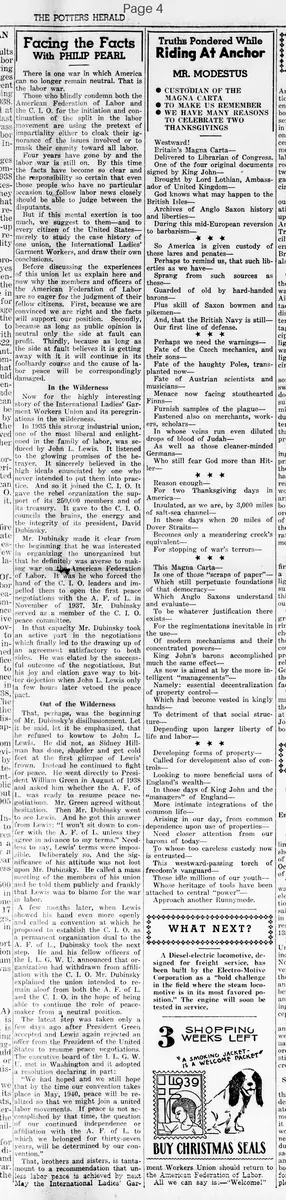
Facing the Facts
With PHILIP PEARL
There is one war in which America
can no longer remain neutral. That is
the labor war.
Those who blindly condemn both the
American Federation of Labor and
the C. I. O. for the initiation and continuation of the split in the labor
movement are using the pretext of
impartiality either to cloak their ignorance of the issues involved or to
mask their enmity toward all labor.
Four years have gone by and the
labor war is still on. By this time
the facts have become so clear and
the responsibility so certain that even
those people who have no particular
occasion to follow labor news closely
should be able to judge between the
disputants.
But if this mental exertion is too
much, we suggest to them-and to
every citizen of the United States-
merely to study the case history of
one union, the International Ladies
Garment Workers, and draw their own
conclusions.
Before discussing the experiences
of this union let us explain here and
now why the members and officers of
the American Federation of Labor
are so eager for the judgment of their
fellow citizens. First, because we are
convinced we are right and the facts
will support our position. Secondly,
because as long as public opinion is
neutral only the side at fault can
profit. Thirdly, because as long as
the side at fault believes it is getting
away with it it will continue in its
foolhardy course and the cause of labor peace will be correspondingly
damaged.
In the Wilderness
Now
for the highly interesting
story of the International Ladies' Garment Workers Union and its peregrinations in the wilderness.
In 1935 this strong industrial union,
one of the most liberal and enlightened in the family of labor, was seduced by John L. Lewis. It listened to the glowing promises of the betrayer. It sincerely believed in the
high ideals enunciated by one who
never intended to put them into practice. And so it joined the C. I. O. It
gave the rebel organization the support of its 250,000 members and of
its treasury. It gave to the C. I. O.
councils the brains, the energy and
the integrity of its president, David
Dubinsky.
Mr. Dubinsky made it clear from
the beginning that he was interested
in organizing the unorganized but
that he definitely was averse to making war on the American Federation
of Labor. It was he who forced the
hand of the C. I. O. leaders and impelled them to open the first peace
negotiations with the A. F. of L. in
November of 1937. Mr. Dubinsky
served as a member of the C. I. O.
peace committee.
In that capacity Mr. Dubinsky took
an active part in the negotiations
which finally led to the drawing up of
an agreement satisfactory to both
sides. He was elated by the successful outcome of the negotiations. But
his joy and elation gave way to bitter dejection when John L. Lewis only
a few hours later vetoed the peace
pact.
Out of the Wilderness
That, perhaps, was the beginning
of Mr. Dubinsky's disillusionment, Let
it be said, let it be emphasized, that
he refused to kowtow to John L.
Lewis, He did not, as Sidney Hillman has done, shudder and get cold
feet at the first glimpse of Lewis'
frown, Instead he continued to fight
for peace. He went directly to President William Green in August of 1938 and asked him whether the A. F. of
L. was ready to resume peace negotiations, Mr. Green agreed without
hesitation, Then Mr, Dubinsky went
to see Lewis. And he got this answer
from Lewis; "I won't sit down to confer with the A. F. of L., unless they
agree in advance to my terms." Needless to say, Lewis' terms were impossible. Deliberately so. And the significance of his attitude was not lost
upon Mr, Dubinsky, He called a mass
meeting of the members of his union
and he told them publicly and frankly
that Lewis was to blame for the war
in labor.
A few months later, when Lewis
showed his hand even more openly
and called a convention at which he
proposed to establish the C. I. O. as
a permanent organization dual to the
A. F. of L., Dubinsky took the next
step. He and his fellow officers of
the I. L. G. W. U. announced that organization had withdrawn from affiliation with the C. I. O. Mr. Dubinsky explained the union intended to remain aloof from both the A. F. of L.
and the C. I. O. in the hope of being
able to continue the role of peace-
makermaker from a neutral position.
The latest step was taken only
a
few days ago after President Green
accepted and Lewis again rejected an
offer from the President of the United
States to resume peace negotiations.
The executive board of the I. L. G. W.
U. met in Washington and it adopted
a resolution declaring in part:
"We had hoped and we still hope
that by the time our convention takes
place in May, 1940, peace will be realized so that we might join a united
labor movements. If peace is not accomplished by that time, the question
of
our
continued independence
or
affiliation with the A. F. of L. to
which we belonged for thirty-seven
years, will be determined by our convention."
That. brothers and sisters, is tantamount to a recommendation that unless labor peace is achieved by next
May the International Ladies
Garment Workers Union should return to
the American Federation of Labor
All we can say is:--"Welcome!'
Facing the Facts
With PHILIP PEARL
There is one war in which America
can no longer remain neutral. That is
the labor war.
Those who blindly condemn both the
American Federation of Labor and
the C. I. O. for the initiation and continuation of the split in the labor
movement are using the pretext of
impartiality either to cloak their ignorance of the issues involved or to
mask their enmity toward all labor.
Four years have gone by and the
labor war is still on. By this time
the facts have become so clear and
the responsibility so certain that even
those people who have no particular
occasion to follow labor news closely
should be able to judge between the
disputants.
But if this mental exertion is too
much, we suggest to them-and to
every citizen of the United States-
merely to study the case history of
one union, the International Ladies
Garment Workers, and draw their own
conclusions.
Before discussing the experiences
of this union let us explain here and
now why the members and officers of
the American Federation of Labor
are so eager for the judgment of their
fellow citizens. First, because we are
convinced we are right and the facts
will support our position. Secondly,
because as long as public opinion is
neutral only the side at fault can
profit. Thirdly, because as long as
the side at fault believes it is getting
away with it it will continue in its
foolhardy course and the cause of labor peace will be correspondingly
damaged.
In the Wilderness
Now
for the highly interesting
story of the International Ladies' Garment Workers Union and its peregrinations in the wilderness.
In 1935 this strong industrial union,
one of the most liberal and enlightened in the family of labor, was seduced by John L. Lewis. It listened to the glowing promises of the betrayer. It sincerely believed in the
high ideals enunciated by one who
never intended to put them into practice. And so it joined the C. I. O. It
gave the rebel organization the support of its 250,000 members and of
its treasury. It gave to the C. I. O.
councils the brains, the energy and
the integrity of its president, David
Dubinsky.
Mr. Dubinsky made it clear from
the beginning that he was interested
in organizing the unorganized but
that he definitely was averse to making war on the American Federation
of Labor. It was he who forced the
hand of the C. I. O. leaders and impelled them to open the first peace
negotiations with the A. F. of L. in
November of 1937. Mr. Dubinsky
served as a member of the C. I. O.
peace committee.
In that capacity Mr. Dubinsky took
an active part in the negotiations
which finally led to the drawing up of
an agreement satisfactory to both
sides. He was elated by the successful outcome of the negotiations. But
his joy and elation gave way to bitter dejection when John L. Lewis only
a few hours later vetoed the peace
pact.
Out of the Wilderness
That, perhaps, was the beginning
of Mr. Dubinsky's disillusionment, Let
it be said, let it be emphasized, that
he refused to kowtow to John L.
Lewis, He did not, as Sidney Hillman has done, shudder and get cold
feet at the first glimpse of Lewis'
frown, Instead he continued to fight
for peace. He went directly to President William Green in August of 1938 and asked him whether the A. F. of
L. was ready to resume peace negotiations, Mr. Green agreed without
hesitation, Then Mr, Dubinsky went
to see Lewis. And he got this answer
from Lewis; "I won't sit down to confer with the A. F. of L., unless they
agree in advance to my terms." Needless to say, Lewis' terms were impossible. Deliberately so. And the significance of his attitude was not lost
upon Mr, Dubinsky, He called a mass
meeting of the members of his union
and he told them publicly and frankly
that Lewis was to blame for the war
in labor.
A few months later, when Lewis
showed his hand even more openly
and called a convention at which he
proposed to establish the C. I. O. as
a permanent organization dual to the
A. F. of L., Dubinsky took the next
step. He and his fellow officers of
the I. L. G. W. U. announced that organization had withdrawn from affiliation with the C. I. O. Mr. Dubinsky explained the union intended to remain aloof from both the A. F. of L.
and the C. I. O. in the hope of being
able to continue the role of peace-
makermaker from a neutral position.
The latest step was taken only
a
few days ago after President Green
accepted and Lewis again rejected an
offer from the President of the United
States to resume peace negotiations.
The executive board of the I. L. G. W.
U. met in Washington and it adopted
a resolution declaring in part:
"We had hoped and we still hope
that by the time our convention takes
place in May, 1940, peace will be realized so that we might join a united
labor movements. If peace is not accomplished by that time, the question
of
our
continued independence
or
affiliation with the A. F. of L. to
which we belonged for thirty-seven
years, will be determined by our convention."
That. brothers and sisters, is tantamount to a recommendation that unless labor peace is achieved by next
May the International Ladies
Garment Workers Union should return to
the American Federation of Labor
All we can say is:--"Welcome!'
What sub-type of article is it?
Labor
Partisan Politics
What keywords are associated?
Labor War
Afl Cio Split
Ilgwu
David Dubinsky
John L Lewis
Labor Peace
Union Withdrawal
What entities or persons were involved?
American Federation Of Labor
C. I. O.
International Ladies' Garment Workers Union
John L. Lewis
David Dubinsky
William Green
Sidney Hillman
Philip Pearl
Editorial Details
Primary Topic
Efforts For Labor Peace And Criticism Of Cio Split
Stance / Tone
Pro Afl And Pro Peace, Anti John L. Lewis
Key Figures
American Federation Of Labor
C. I. O.
International Ladies' Garment Workers Union
John L. Lewis
David Dubinsky
William Green
Sidney Hillman
Philip Pearl
Key Arguments
America Cannot Remain Neutral In The Labor War
Blaming Both Afl And Cio Masks Enmity Toward Labor
Ilgwu Joined Cio In 1935 But Dubinsky Pushed For Peace
Lewis Vetoed 1937 Peace Agreement
Dubinsky Sought Peace In 1938 But Lewis Refused
Ilgwu Withdrew From Cio To Act As Neutral Peacemaker
Ilgwu May Rejoin Afl By May 1940 If No Peace
Facts Show Lewis And Cio At Fault For Split