Thank you for visiting SNEWPapers!
Sign up free
Literary
June 16, 1790
Gazette Of The United States
New York, New York County, New York
What is this article about?
This essay argues that European nobles are generally less happy than common people, evidenced by their declining populations and debts, while kings are the greatest slaves despite their power. It explores humanity's natural admiration and deference to the powerful, which underpins social ranks, often overriding reason.
Clipping
OCR Quality
95%
Excellent
Full Text
FOR THE GAZETTE OF THE UNITED STATES.
DISCOURSES ON DAVILA.-NO. X.
Wise if a minister, but if a king
More wise, more learn'd, more just, more every thing
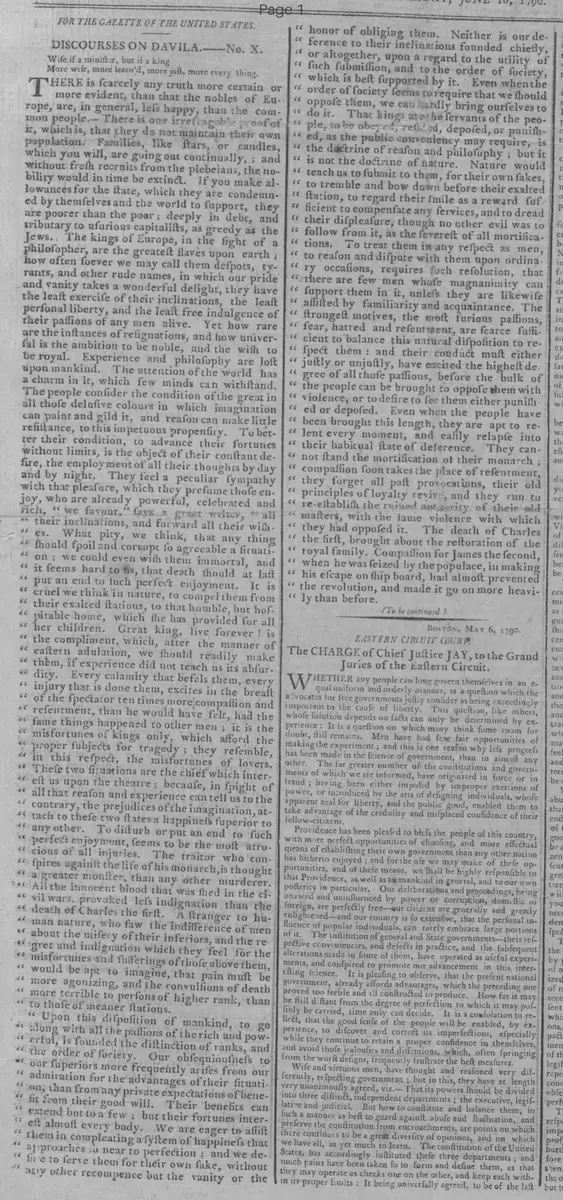
There is scarcely any truth more certain or more evident, than that the nobles of Europe, are, in general, less happy, than the common people. There is one irrefragable proof of it, which is, that they do not maintain their own population. Families, like stars, or candles, which you will, are going out continually; and without fresh recruits from the plebeians, the nobility would in time be extinct. If you make allowances for the state, which they are condemned by themselves and the world to support, they are poorer than the poor; deeply in debt, and tributary to usurious capitalists, as greedy as the Jews. The kings of Europe, in the sight of a philosopher, are the greatest slaves upon earth; how often soever we may call them despots, tyrants, and other rude names, in which our pride and vanity takes a wonderful delight, they have the least exercise of their inclinations, the least personal liberty, and the least free indulgence of their passions of any men alive. Yet how rare are the instances of resignations, and how universal is the ambition to be noble, and the wish to be royal. Experience and philosophy are lost upon mankind. The attention of the world has a charm in it, which few minds can withstand.
The people consider the condition of the great in all those delusive colours in which imagination can paint and gild it, and reason can make little resistance, to this impetuous propensity. To better their condition, to advance their fortunes without limits, is the object of their constant desire, the employment of all their thoughts by day and by night. They feel a peculiar sympathy with that pleasure, which they presume those enjoy, who are already powerful, celebrated and rich, " we favour, " says a great writer, " all their inclinations, and forward all their wishes. What pity, we think, that any thing should spoil and corrupt so agreeable a situation; we could even wish them immortal, and it seems hard to us, that death should at last put an end to such perfect enjoyment. It is cruel we think in nature, to compel them from their exalted stations, to that humble, but hospitable home, which she has provided for all her children. Great king, live forever! is the compliment, which, after the manner of eastern adulation, we should readily make to them, if experience did not teach us its absurdity. Every calamity that befalls them, every injury that is done them, excites in the breast of the spectator ten times more compassion and resentment, than he would have felt, had the same things happened to other men; it is the misfortunes of kings only, which afford the proper subjects for tragedy; they resemble, in this respect, the misfortunes of lovers. These two situations are the chief which interest us upon the theatre; because, in spite of all that reason and experience can tell us to the contrary, the prejudices of the imagination, attach to these two states a happiness superior to any other. To disturb or put an end to such perfect enjoyment, seems to be the most atrocious of all injuries. The traitor who conspire against the life of his monarch, is thought a greater monster, than any other murderer. All the innocent blood that was shed in the civil wars, provoked less indignation than the death of Charles the first. A stranger to human nature, who saw the indifference of men about the misery of their inferiors, and the regret and indignation which they feel for the misfortunes and sufferings of those above them, would be apt to imagine, that pain must be more agonizing, and the convulsions of death more terrible to persons of higher rank, than to those of meaner stations.
Upon this disposition of mankind, to go along with all the passions of the rich and powerful, is founded the distinction of ranks, and the order of society. Our obsequies to our superiors more frequently arises from our admiration for the advantages of their situation, than from any private expectations of benefit from their good will. Their benefits can extend but to a few; but their fortunes interest almost every body. We are eager to assist them in completing a system of happiness that approaches so near to perfection; and we desire to serve them for their own sake, without any other recompence but the vanity or the honor of obliging them. Neither is our deference to their inclinations founded chiefly, or altogether, upon a regard to the utility of such submission, and to the order of society, which is best supported by it. Even when the order of society seems to require that we should oppose them, we can hardly bring ourselves to do it. That kings are the servants of the people, to be obeyed, resisted, deposed, or punished, as the public conveniency may require, is the doctrine of reason and philosophy; but it is not the doctrine of nature. Nature would teach us to submit to them, for their own sakes, to tremble and bow down before their exalted station, to regard their smile as a reward sufficient to compensate any services, and to dread their displeasure, though no other evil was to follow from it, as the severest of all mortifications. To treat them in any respect as men, to reason and dispute with them upon ordinary occasions, requires such resolution, that there are few men whose magnanimity can support them in it, unless they are likewise assisted by familiarity and acquaintance. The strongest motives, the most furious passions, fear, hatred and resentment, are scarce sufficient to balance this natural disposition to respect them: and their conduct must either justly or unjustly, have excited the highest degree of all those passions, before the bulk of the people can be brought to oppose them with violence, or to desire to see them either punished or deposed. Even when the people have been brought this length, they are apt to relent every moment, and easily relapse into their habitual state of deference. They cannot stand the mortification of their monarch; compassion soon takes the place of resentment, they forget all past provocations, their old principles of loyalty revive, and they run to re-establish the ruined authority of their old masters, with the same violence with which they had opposed it. The death of Charles the first, brought about the restoration of the royal family. Compassion for James the second, when he was seized by the populace, in making his escape on ship board, had almost prevented the revolution, and made it go on more heavily than before.
(To be continued.)
DISCOURSES ON DAVILA.-NO. X.
Wise if a minister, but if a king
More wise, more learn'd, more just, more every thing
There is scarcely any truth more certain or more evident, than that the nobles of Europe, are, in general, less happy, than the common people. There is one irrefragable proof of it, which is, that they do not maintain their own population. Families, like stars, or candles, which you will, are going out continually; and without fresh recruits from the plebeians, the nobility would in time be extinct. If you make allowances for the state, which they are condemned by themselves and the world to support, they are poorer than the poor; deeply in debt, and tributary to usurious capitalists, as greedy as the Jews. The kings of Europe, in the sight of a philosopher, are the greatest slaves upon earth; how often soever we may call them despots, tyrants, and other rude names, in which our pride and vanity takes a wonderful delight, they have the least exercise of their inclinations, the least personal liberty, and the least free indulgence of their passions of any men alive. Yet how rare are the instances of resignations, and how universal is the ambition to be noble, and the wish to be royal. Experience and philosophy are lost upon mankind. The attention of the world has a charm in it, which few minds can withstand.
The people consider the condition of the great in all those delusive colours in which imagination can paint and gild it, and reason can make little resistance, to this impetuous propensity. To better their condition, to advance their fortunes without limits, is the object of their constant desire, the employment of all their thoughts by day and by night. They feel a peculiar sympathy with that pleasure, which they presume those enjoy, who are already powerful, celebrated and rich, " we favour, " says a great writer, " all their inclinations, and forward all their wishes. What pity, we think, that any thing should spoil and corrupt so agreeable a situation; we could even wish them immortal, and it seems hard to us, that death should at last put an end to such perfect enjoyment. It is cruel we think in nature, to compel them from their exalted stations, to that humble, but hospitable home, which she has provided for all her children. Great king, live forever! is the compliment, which, after the manner of eastern adulation, we should readily make to them, if experience did not teach us its absurdity. Every calamity that befalls them, every injury that is done them, excites in the breast of the spectator ten times more compassion and resentment, than he would have felt, had the same things happened to other men; it is the misfortunes of kings only, which afford the proper subjects for tragedy; they resemble, in this respect, the misfortunes of lovers. These two situations are the chief which interest us upon the theatre; because, in spite of all that reason and experience can tell us to the contrary, the prejudices of the imagination, attach to these two states a happiness superior to any other. To disturb or put an end to such perfect enjoyment, seems to be the most atrocious of all injuries. The traitor who conspire against the life of his monarch, is thought a greater monster, than any other murderer. All the innocent blood that was shed in the civil wars, provoked less indignation than the death of Charles the first. A stranger to human nature, who saw the indifference of men about the misery of their inferiors, and the regret and indignation which they feel for the misfortunes and sufferings of those above them, would be apt to imagine, that pain must be more agonizing, and the convulsions of death more terrible to persons of higher rank, than to those of meaner stations.
Upon this disposition of mankind, to go along with all the passions of the rich and powerful, is founded the distinction of ranks, and the order of society. Our obsequies to our superiors more frequently arises from our admiration for the advantages of their situation, than from any private expectations of benefit from their good will. Their benefits can extend but to a few; but their fortunes interest almost every body. We are eager to assist them in completing a system of happiness that approaches so near to perfection; and we desire to serve them for their own sake, without any other recompence but the vanity or the honor of obliging them. Neither is our deference to their inclinations founded chiefly, or altogether, upon a regard to the utility of such submission, and to the order of society, which is best supported by it. Even when the order of society seems to require that we should oppose them, we can hardly bring ourselves to do it. That kings are the servants of the people, to be obeyed, resisted, deposed, or punished, as the public conveniency may require, is the doctrine of reason and philosophy; but it is not the doctrine of nature. Nature would teach us to submit to them, for their own sakes, to tremble and bow down before their exalted station, to regard their smile as a reward sufficient to compensate any services, and to dread their displeasure, though no other evil was to follow from it, as the severest of all mortifications. To treat them in any respect as men, to reason and dispute with them upon ordinary occasions, requires such resolution, that there are few men whose magnanimity can support them in it, unless they are likewise assisted by familiarity and acquaintance. The strongest motives, the most furious passions, fear, hatred and resentment, are scarce sufficient to balance this natural disposition to respect them: and their conduct must either justly or unjustly, have excited the highest degree of all those passions, before the bulk of the people can be brought to oppose them with violence, or to desire to see them either punished or deposed. Even when the people have been brought this length, they are apt to relent every moment, and easily relapse into their habitual state of deference. They cannot stand the mortification of their monarch; compassion soon takes the place of resentment, they forget all past provocations, their old principles of loyalty revive, and they run to re-establish the ruined authority of their old masters, with the same violence with which they had opposed it. The death of Charles the first, brought about the restoration of the royal family. Compassion for James the second, when he was seized by the populace, in making his escape on ship board, had almost prevented the revolution, and made it go on more heavily than before.
(To be continued.)
What sub-type of article is it?
Essay
What themes does it cover?
Political
Social Manners
What keywords are associated?
Nobility
Kings
Deference
Social Order
Human Nature
Political Philosophy
European Society
Literary Details
Title
Discourses On Davila. No. X.
Key Lines
Wise If A Minister, But If A King
More Wise, More Learn'd, More Just, More Every Thing
There Is Scarcely Any Truth More Certain Or
More Evident, Than That The Nobles Of Eu
Rope, Are, In General, Less Happy, Than The Com
Mon People.
The Kings Of Europe, In The Sight Of A
Philosopher, Are The Greatest Slaves Upon Earth
Upon This Disposition Of Mankind, To Go
Along With All The Passions Of The Rich And Pow
.Erful, Is Founded The Distinction Of Ranks, And
The Order Of Society.
Nature Would
.Teach Us To Submit To Them, For Their Own Sakes,
.To Tremble And Bow Down Before Their Exalted
.Station