Thank you for visiting SNEWPapers!
Sign up free
The National Intelligencer And Washington Advertiser
Washington, District Of Columbia
What is this article about?
Report from London on May 20, 1802, discusses diplomatic tensions over German indemnities and secularizations following the Peace of Luneville. Austria and France prioritize indemnifying the Grand Duke of Tuscany, alarming Prussia, Russia, and German princes, potentially leading to a new continental war.
Clipping
OCR Quality
Full Text
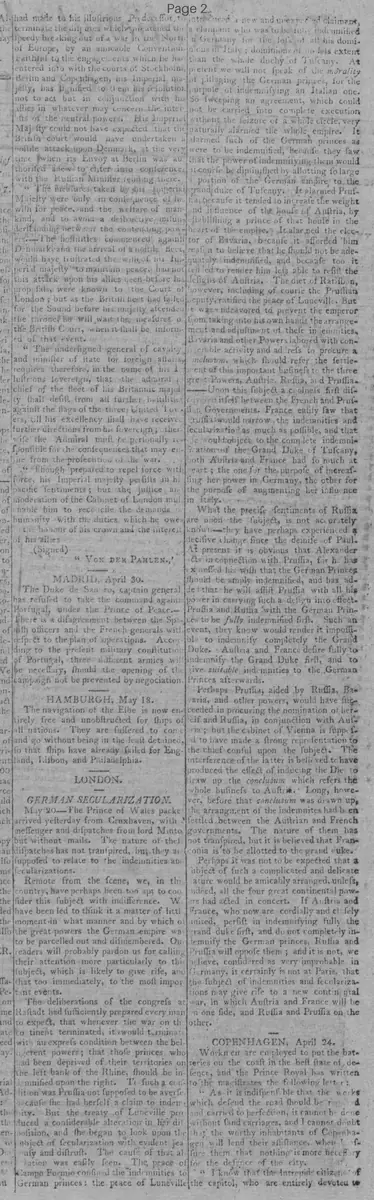
GERMAN SECULARIZATION.
May 20—The Prince of Wales packet arrived yesterday from Cuxhaven, with messenger and dispatches from lord Minto but without mails. The nature of these dispatches has not transpired, but they are supposed to relate to the indemnities and secularizations.
Remote from the scene, we, in this country, have perhaps been too apt to consider this subject with indifference. We have been led to think it a matter of little moment in what manner and by which of the great powers the German empire was to be parcelled out and dismembered. Our readers will probably pardon us for calling their attention more particularly to this subject, which is likely to give rise, and that too immediately, to the most important events.
The deliberations of the congress at Rastadt had sufficiently prepared every man to expect, that whenever the war on the continent terminated, it would terminate with an express condition between the belligerent powers; that those princes who had been deprived of their territories on the left bank of the Rhine, should be indemnified upon the right. To such a condition Prussia was not supposed to be averse because she had herself a claim to indemnity. But the treaty of Luneville produced a considerable alteration in her disposition, and she began to look upon the subject of secularization with evident jealousy and distrust. The cause of that alteration was easily seen. The peace of Campo Formio confined the indemnities to German princes: the peace of Luneville introduced a new and unforeseen claimant, a grand duke who was to be fully indemnified in Germany for the loss of all his dominions in Italy; dominions of no less extent than the whole duchy of Tuscany. At present we will not speak of the morality of pillaging the German princes, for the purpose of indemnifying an Italian one.
So sweeping an agreement, which could not be carried into complete execution without the seizure of a whole circle, very naturally alarmed the whole empire. It alarmed such of the German princes as were to be indemnified, because they saw that the power of indemnifying them would of course be diminished by allotting so large a portion of the German empire to the grand duke of Tuscany. It alarmed Prussia, because it tended to increase the weight and influence of the house of Austria, by establishing a prince of that house in the heart of the empire. It alarmed the elector of Bavaria, because it afforded him reason to believe that he should not be adequately indemnified, and because too it tended to render him less able to resist the designs of Austria. The diet of Ratibon, however, including of course the Prussian deputy, ratified the peace of Luneville. But was endeavored to prevent the emperor from taking into his own hands the arrangement and adjustment of these indemnities. Bavaria and other Powers labored with considerable activity and address to procure a conclusion, which should refer the settlement of this important business to the three great Powers, Austria, Russia, and Prussia.
Upon this subject a coolness first discovered itself between the French and Prussian Governments. France easily saw that Russia would narrow the indemnities and secularizations as much as possible, and that she would object to the complete indemnification of the Grand Duke of Tuscany, both Austria and France had so much at heart; the one for the purpose of increasing her power in Germany, the other for the purpose of augmenting her influence in Italy.
What the precise sentiments of Russia are upon the subject, is not accurately known—they have perhaps experienced a decisive change since the demise of Paul. At present it is obvious that Alexander acts in connection with Prussia, for he has received his with that the German Princes should be amply indemnified, and has added that he will assist Prussia with all his power in carrying such a design into effect.
Prussia and Russia with the German Princes to be fully indemnified first. Such an event, they know would render it impossible to indemnify completely the Grand Duke. Austria and France desire fully to indemnify the Grand Duke first, and to give suitable indemnities to the German Princes afterwards.
Perhaps Prussia, aided by Russia, Bavaria, and other powers, would have succeeded in procuring the nomination of herself and Russia, in conjunction with Austria; but the cabinet of Vienna is supposed to have made a strong representation to the chief consul upon the subject. The interference of the latter is believed to have produced the effect of inducing the Diet to draw up the conclusion which refers the whole business to Austria. Long, however, before that conclusion was drawn up, the arrangement of the indemnities had been settled between the Austrian and French governments. The nature of them has not transpired, but it is believed that Franconia is to be allotted to the grand duke.
Perhaps it was not to be expected that a subject of such a complicated and delicate nature would be amicably arranged, unless, indeed, all the four great continental powers had acted in concert. If Austria and France, who now are cordially and closely united, persist in indemnifying fully the grand duke first, and do not completely indemnify the German princes, Russia and Prussia will oppose them; and it is not, we believe, considered as very improbable in Germany, it certainly is not at Paris, that the subject of indemnities and secularizations may give rise to a new continental war, in which Austria and France will be on one side, and Russia and Prussia on the other.
What sub-type of article is it?
What keywords are associated?
What entities or persons were involved?
Where did it happen?
Foreign News Details
Primary Location
German Empire
Event Date
May 20
Key Persons
Outcome
potential new continental war between austria/france and russia/prussia; believed arrangement to allot franconia to the grand duke of tuscany.
Event Details
Dispatches from Lord Minto relate to German indemnities and secularizations post-Peace of Luneville. Tensions arise as Austria and France prioritize indemnifying the Grand Duke of Tuscany in Germany for Italian losses, alarming Prussia, Russia, and German princes who seek prior full indemnification for Rhine territories. The Diet of Ratibon refers settlement to Austria after French influence; Prussia and Russia oppose, potentially leading to war.