Thank you for visiting SNEWPapers!
Sign up free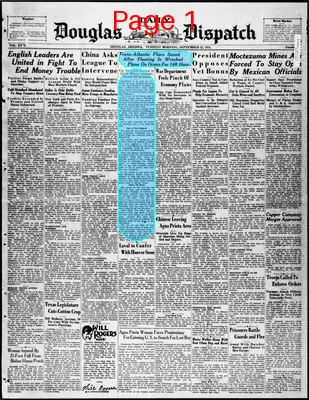
Douglas Daily Dispatch
Douglas, Cochise County, Arizona
What is this article about?
Three aviators, two Germans and a Portuguese, survived 148 hours adrift on their wrecked trans-Atlantic plane off Newfoundland after compass failure caused fuel exhaustion; rescued by Norwegian ship Belmoira with one leg injury.
Clipping
OCR Quality
Full Text
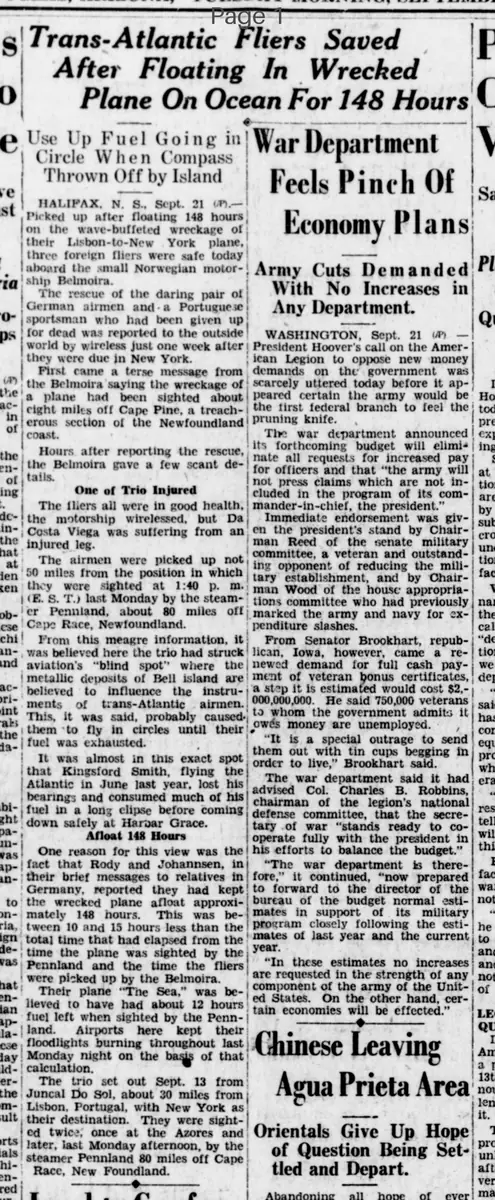
Use Up Fuel Going in Circle When Compass Thrown Off by Island
HALIFAX, N. S., Sept. 21 (P). Picked up after floating 148 hours on the wave-buffeted wreckage of their Lisbon-to-New York plane, three foreign fliers were safe today aboard the small Norwegian motor-ship Belmoira.
The rescue of the daring pair of German airmen and a Portuguese sportsman who had been given up for dead was reported to the outside world by wireless just one week after they were due in New York.
First came a terse message from the Belmoira saying the wreckage of a plane had been sighted about eight miles off Cape Pine, a treacherous section of the Newfoundland coast.
Hours after reporting the rescue, the Belmoira gave a few scant details.
One of Trio Injured
The fliers all were in good health, the motorship wirelessed, but Da Costa Viega was suffering from an injured leg.
The airmen were picked up not 50 miles from the position in which they were sighted at 1:40 p. m. (E. S. T.) last Monday by the steamer Pennland, about 80 miles off Cape Race, Newfoundland.
From this meagre information, it was believed here the trio had struck aviation's "blind spot" where the metallic deposits of Bell Island are believed to influence the instruments of trans-Atlantic airmen.
This, it was said, probably caused them to fly in circles until their fuel was exhausted.
It was almost in this exact spot that Kingsford Smith, flying the Atlantic in June last year, lost his bearings and consumed much of his fuel in a long ellipse before coming down safely at Harbor Grace.
Afloat 148 Hours
One reason for this view was the fact that Rody and Johannsen, in their brief messages to relatives in Germany, reported they had kept the wrecked plane afloat approximately 148 hours.
This was between 10 and 15 hours less than the total time that had elapsed from the time the plane was sighted by the Pennland and the time the fliers were picked up by the Belmoira.
Their plane "The Sea," was believed to have had about 12 hours fuel left when sighted by the Pennland. Airports here kept their floodlights burning throughout last Monday night on the basis of that calculation.
The trio set out Sept. 13 from Juncal Do Sol, about 30 miles from Lisbon, Portugal, with New York as their destination. They were sighted twice, once at the Azores and later, last Monday afternoon, by the steamer Pennland 80 miles off Cape Race, New Foundland.
What sub-type of article is it?
What keywords are associated?
What entities or persons were involved?
Where did it happen?
Foreign News Details
Primary Location
Off Cape Race, Newfoundland
Event Date
Sept. 13
Key Persons
Outcome
rescued safely after 148 hours afloat; da costa viega suffered injured leg; no fatalities
Event Details
Three fliers—two German airmen (Rody and Johannsen) and a Portuguese sportsman (Da Costa Viega)—departed from Juncal Do Sol near Lisbon, Portugal, on Sept. 13 bound for New York in their plane 'The Sea.' Sighted by the steamer Pennland 80 miles off Cape Race, Newfoundland, on the afternoon of last Monday. Believed to have flown in circles due to compass interference from Bell Island's metallic deposits, exhausting their fuel. Plane wrecked; they floated on wreckage for approximately 148 hours until picked up by the Norwegian motor-ship Belmoira about eight miles off Cape Pine, Newfoundland.