Thank you for visiting SNEWPapers!
Sign up free
Letter to Editor
May 24, 1819
Daily National Intelligencer
Washington, District Of Columbia
What is this article about?
A letter advocating for reducing bank interest rates to 5% to support manufacturers and national capital accumulation through compound interest. The author promotes paper currency over specie payments, critiques economic policies causing poverty and emigration, and compares U.S. prospects to Britain's success with low interest and machinery.
Clipping
OCR Quality
98%
Excellent
Full Text
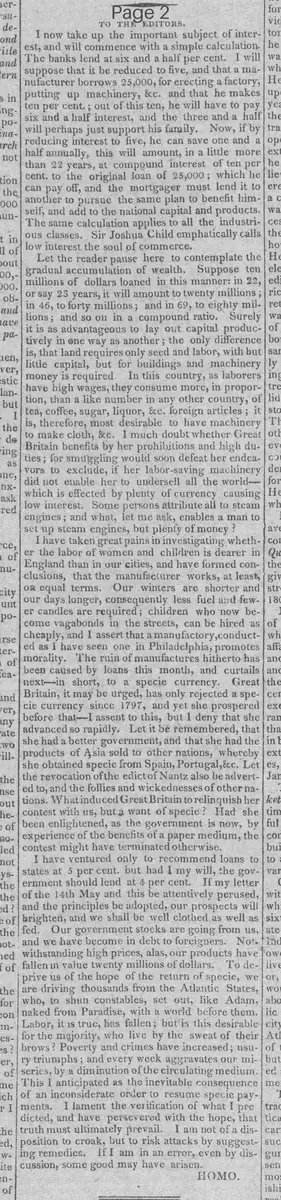
TO THE EDITORS.
I now take up the important subject of interest, and will commence with a simple calculation.
The banks lend at six and a half per cent. I will suppose that it be reduced to five, and that a manufacturer borrows 25,000, for erecting a factory, putting up machinery, &c. and that he makes ten per cent.; out of this ten, he will have to pay six and a half interest, and the three and a half will perhaps just support his family. Now, if by reducing interest to five, he can save one and a half annually, this will amount, in a little more than 22 years, at compound interest of ten per cent. to the original loan of 25,000; which he can pay off, and the mortgager must lend it to another to pursue the same plan to benefit himself, and add to the national capital and products.
The same calculation applies to all the industrious classes. Sir Joshua Child emphatically calls low interest the soul of commerce.
Let the reader pause here to contemplate the gradual accumulation of wealth. Suppose ten millions of dollars loaned in this manner: in 22, or say 23 years, it will amount to twenty millions; in 46, to forty millions; and in 69, to eighty millions; and so on in a compound ratio. Surely it is as advantageous to lay out capital productively in one way as another; the only difference is, that land requires only seed and labor, with but little capital, but for buildings and machinery money is required. In this country, as laborers have high wages, they consume more, in proportion, than a like number in any other country, of tea, coffee, sugar, liquor, &c. foreign articles; it is, therefore, most desirable to have machinery to make cloth, &c. I much doubt whether Great Britain benefits by her prohibitions and high duties; for smuggling would soon defeat her endeavors to exclude, if her labor-saving machinery did not enable her to undersell all the world—which is effected by plenty of currency causing low interest. Some persons attribute all to steam engines: and what, let me ask, enables a man to set up steam engines, but plenty of money?
I have taken great pains in investigating whether the labor of women and children is dearer in England than in our cities, and have formed conclusions, that the manufacturer works, at least, on equal terms. Our winters are shorter and our days longer, consequently less fuel and fewer candles are required; children who now become vagabonds in the streets, can be hired as cheaply, and I assert that a manufactory, conducted as I have seen one in Philadelphia, promotes morality. The ruin of manufactures hitherto has been caused by loans this month, and curtailments next—in short, to a specie currency. Great Britain, it may be urged, has only rejected a specie currency since 1797, and yet she prospered before that—I assent to this, but I deny that she advanced so rapidly. Let it be remembered, that she had a better government, and that she had the products of Asia sold to other nations, whereby she obtained specie from Spain, Portugal, &c. Let the revocation of the edict of Nantz also be adverted to, and the follies and wickednesses of other nations. What induced Great Britain to relinquish her contest with us, but a want of specie? Had she been enlightened, as the government is now, by experience of the benefits of a paper medium, the contest might have terminated otherwise.
I have ventured only to recommend loans to states at 5 per cent. but had I my will, the government should lend at 4 per cent. If my letter of the 14th May and this be attentively perused, and the principles be adopted, our prospects will brighten, and we shall be well clothed as well as fed. Our government stocks are going from us, and we have become in debt to foreigners. Notwithstanding high prices, alas, our products have fallen in value twenty millions of dollars. To deprive us of the hope of the return of specie, we are driving thousands from the Atlantic States, who, to shun constables, set out, like Adam, naked from Paradise, with a world before them.
Labor, it is true, has fallen; but is this desirable for the majority, who live by the sweat of their brows? Poverty and crimes have increased; usury triumphs; and every week aggravates our miseries, by a diminution of the circulating medium.
This I anticipated as the inevitable consequence of an inconsiderate order to resume specie payments. I lament the verification of what I predicted, and have persevered with the hope, that truth must ultimately prevail. I am not of a disposition to croak, but to risk attacks by suggesting remedies. If I am in an error, even by discussion, some good may have arisen.
HOMO.
I now take up the important subject of interest, and will commence with a simple calculation.
The banks lend at six and a half per cent. I will suppose that it be reduced to five, and that a manufacturer borrows 25,000, for erecting a factory, putting up machinery, &c. and that he makes ten per cent.; out of this ten, he will have to pay six and a half interest, and the three and a half will perhaps just support his family. Now, if by reducing interest to five, he can save one and a half annually, this will amount, in a little more than 22 years, at compound interest of ten per cent. to the original loan of 25,000; which he can pay off, and the mortgager must lend it to another to pursue the same plan to benefit himself, and add to the national capital and products.
The same calculation applies to all the industrious classes. Sir Joshua Child emphatically calls low interest the soul of commerce.
Let the reader pause here to contemplate the gradual accumulation of wealth. Suppose ten millions of dollars loaned in this manner: in 22, or say 23 years, it will amount to twenty millions; in 46, to forty millions; and in 69, to eighty millions; and so on in a compound ratio. Surely it is as advantageous to lay out capital productively in one way as another; the only difference is, that land requires only seed and labor, with but little capital, but for buildings and machinery money is required. In this country, as laborers have high wages, they consume more, in proportion, than a like number in any other country, of tea, coffee, sugar, liquor, &c. foreign articles; it is, therefore, most desirable to have machinery to make cloth, &c. I much doubt whether Great Britain benefits by her prohibitions and high duties; for smuggling would soon defeat her endeavors to exclude, if her labor-saving machinery did not enable her to undersell all the world—which is effected by plenty of currency causing low interest. Some persons attribute all to steam engines: and what, let me ask, enables a man to set up steam engines, but plenty of money?
I have taken great pains in investigating whether the labor of women and children is dearer in England than in our cities, and have formed conclusions, that the manufacturer works, at least, on equal terms. Our winters are shorter and our days longer, consequently less fuel and fewer candles are required; children who now become vagabonds in the streets, can be hired as cheaply, and I assert that a manufactory, conducted as I have seen one in Philadelphia, promotes morality. The ruin of manufactures hitherto has been caused by loans this month, and curtailments next—in short, to a specie currency. Great Britain, it may be urged, has only rejected a specie currency since 1797, and yet she prospered before that—I assent to this, but I deny that she advanced so rapidly. Let it be remembered, that she had a better government, and that she had the products of Asia sold to other nations, whereby she obtained specie from Spain, Portugal, &c. Let the revocation of the edict of Nantz also be adverted to, and the follies and wickednesses of other nations. What induced Great Britain to relinquish her contest with us, but a want of specie? Had she been enlightened, as the government is now, by experience of the benefits of a paper medium, the contest might have terminated otherwise.
I have ventured only to recommend loans to states at 5 per cent. but had I my will, the government should lend at 4 per cent. If my letter of the 14th May and this be attentively perused, and the principles be adopted, our prospects will brighten, and we shall be well clothed as well as fed. Our government stocks are going from us, and we have become in debt to foreigners. Notwithstanding high prices, alas, our products have fallen in value twenty millions of dollars. To deprive us of the hope of the return of specie, we are driving thousands from the Atlantic States, who, to shun constables, set out, like Adam, naked from Paradise, with a world before them.
Labor, it is true, has fallen; but is this desirable for the majority, who live by the sweat of their brows? Poverty and crimes have increased; usury triumphs; and every week aggravates our miseries, by a diminution of the circulating medium.
This I anticipated as the inevitable consequence of an inconsiderate order to resume specie payments. I lament the verification of what I predicted, and have persevered with the hope, that truth must ultimately prevail. I am not of a disposition to croak, but to risk attacks by suggesting remedies. If I am in an error, even by discussion, some good may have arisen.
HOMO.
What sub-type of article is it?
Persuasive
Informative
What themes does it cover?
Economic Policy
Commerce Trade
What keywords are associated?
Interest Rates
Manufacturing
Paper Currency
Specie Payments
Compound Interest
Economic Policy
British Commerce
What entities or persons were involved?
Homo.
To The Editors.
Letter to Editor Details
Author
Homo.
Recipient
To The Editors.
Main Argument
reducing interest rates to 5% and adopting paper currency instead of specie payments will enable manufacturers to accumulate wealth, promote national industry and morality, and avert economic decline, as demonstrated by calculations and britain's example.
Notable Details
Simple Calculation Of Compound Interest Savings
Quote From Sir Joshua Child On Low Interest As Soul Of Commerce
Comparison To Great Britain's Economy And Machinery
Reference To Revocation Of Edict Of Nantes
Mention Of Prior Letter On 14th May
Critique Of Resumption Of Specie Payments