Thank you for visiting SNEWPapers!
Sign up free
Story
March 24, 1939
The Midland Journal
Rising Sun, Cecil County, Maryland
What is this article about?
Article describes the ancient Roman fortified line, Limes Romanus, built to protect against German tribes, stretching from Rheinbrohl on the Rhine to Eining on the Danube, initially a timber palisade later replaced by an earthen wall with stone towers in the late 2nd century AD.
Clipping
OCR Quality
98%
Excellent
Full Text
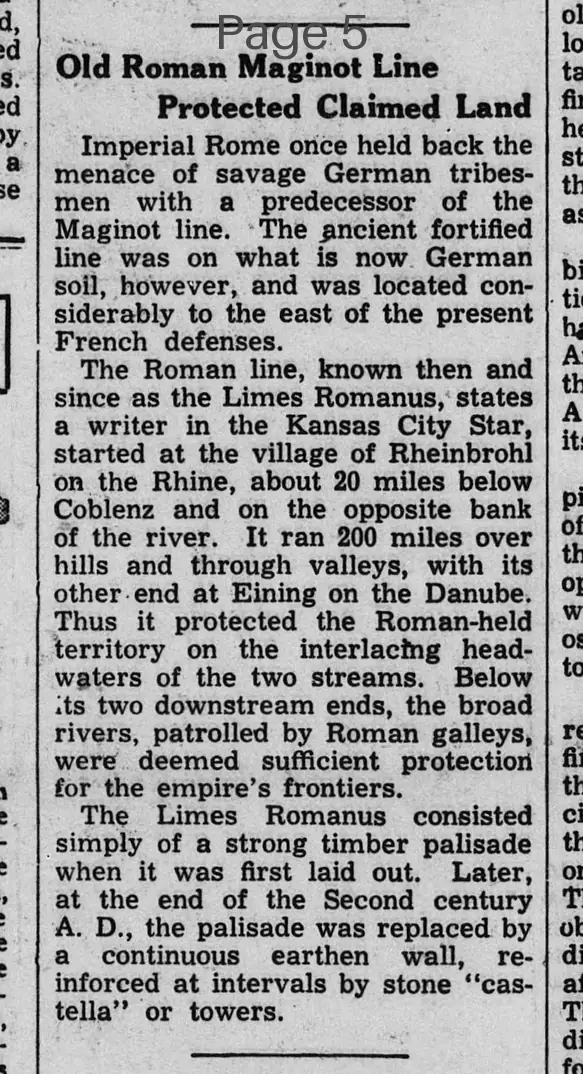
Old Roman Maginot Line Protected Claimed Land
Imperial Rome once held back the menace of savage German tribesmen with a predecessor of the Maginot line. The ancient fortified line was on what is now German soil, however, and was located considerably to the east of the present French defenses.
The Roman line, known then and since as the Limes Romanus, states a writer in the Kansas City Star, started at the village of Rheinbrohl on the Rhine, about 20 miles below Coblenz and on the opposite bank of the river. It ran 200 miles over hills and through valleys, with its other end at Eining on the Danube. Thus it protected the Roman-held territory on the interlacing head waters of the two streams. Below its two downstream ends, the broad rivers, patrolled by Roman galleys, were deemed sufficient protection for the empire's frontiers.
The Limes Romanus consisted simply of a strong timber palisade when it was first laid out. Later, at the end of the Second century A. D., the palisade was replaced by a continuous earthen wall, reinforced at intervals by stone "castella" or towers.
Imperial Rome once held back the menace of savage German tribesmen with a predecessor of the Maginot line. The ancient fortified line was on what is now German soil, however, and was located considerably to the east of the present French defenses.
The Roman line, known then and since as the Limes Romanus, states a writer in the Kansas City Star, started at the village of Rheinbrohl on the Rhine, about 20 miles below Coblenz and on the opposite bank of the river. It ran 200 miles over hills and through valleys, with its other end at Eining on the Danube. Thus it protected the Roman-held territory on the interlacing head waters of the two streams. Below its two downstream ends, the broad rivers, patrolled by Roman galleys, were deemed sufficient protection for the empire's frontiers.
The Limes Romanus consisted simply of a strong timber palisade when it was first laid out. Later, at the end of the Second century A. D., the palisade was replaced by a continuous earthen wall, reinforced at intervals by stone "castella" or towers.
What sub-type of article is it?
Historical Event
Curiosity
What themes does it cover?
Survival
Triumph
What keywords are associated?
Limes Romanus
Roman Fortifications
German Tribes
Rhine Danube
Imperial Rome
Where did it happen?
German Soil, From Rheinbrohl On The Rhine To Eining On The Danube
Story Details
Location
German Soil, From Rheinbrohl On The Rhine To Eining On The Danube
Event Date
Imperial Rome, End Of The Second Century A. D.
Story Details
Imperial Rome built the Limes Romanus, a fortified line starting at Rheinbrohl on the Rhine and ending at Eining on the Danube, to protect against German tribes; initially a timber palisade, later an earthen wall with stone towers.