Thank you for visiting SNEWPapers!
Sign up free
The National Intelligencer And Washington Advertiser
Washington, District Of Columbia
What is this article about?
An opinion piece opposing the proposed mausoleum for George Washington, arguing it is inappropriate for a republican hero, excessively costly amid national debt, and likely to become a general burial site. Advocates for a simpler marble monument as per congressional resolution, suggesting alternatives like a national hospital or university.
Merged-components note: Continuation of the editorial 'OCCASIONAL LETTERS, No. I. ON THE MAUSOLEUM.' from page 2 to page 3.
Clippings
1 of 2
OCR Quality
Full Text
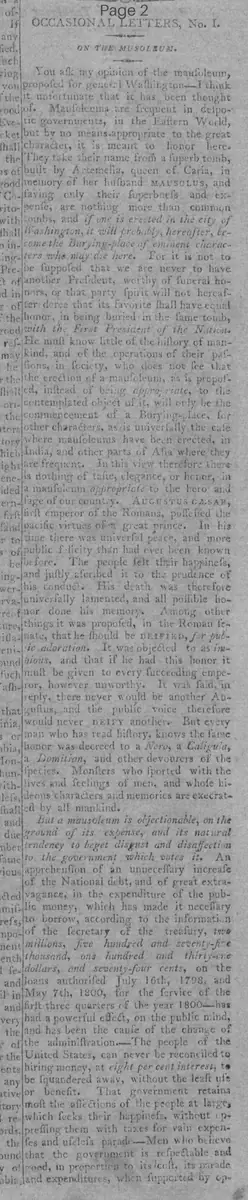
ON THE MAUSOLEUM.
You ask my opinion of the mausoleum, proposed for general Washington--I think it unfortunate that it has been thought of. Mausoleums are frequent in despotic governments, in the Eastern World, but by no means appropriate to the great character, it is meant to honor here. They take their name from a superb tomb, built by Artemisia, queen of Caria, in memory of her husband Mausolus, and having only their superbness and expense, are nothing more than common tombs, and if one is erected in the city of Washington, it will probably, hereafter, become the Burying-place of eminent characters who may die here. For it is not to be supposed that we are never to have another President, worthy of funeral honors, or that party spirit will not hereafter decree that its favorite shall have equal honor, in being buried in the same tomb, with the First President of the Nation. He must know little of the history of mankind, and of the operations of their passions, in society, who does not see that the erection of a mausoleum, as is proposed, instead of being appropriate, to the contemplated object of it, will only be the commencement of a Burying-place, for other characters, as is universally the case where mausoleums have been erected, in India, and other parts of Asia where they are frequent. In this view therefore there is nothing of taste, elegance, or honor, in a mausoleum appropriate to the hero and sage of our country. Augustus Caesar, first emperor of the Romans, possessed the pacific virtues of a great prince. In his time there was universal peace, and more republican felicity than had ever been known it before. The people felt their happiness, and justly ascribed it to the prudence of this conduct. His death was therefore universally lamented, and all possible honor done his memory. Among other things it was proposed, in the Roman senate, that he should be DEIFIED, for public adoration. It was objected to as impious, and that if he had this honor it must be given to every succeeding emperor, however unworthy. It was said, in reply, there never would be another Augustus, and the public voice therefore would never envy another. But every man who has read history, knows the same honor was decreed to a Nero, a Caligula, a Domitian, and other devourers of the species. Monsters who sported with the lives and feelings of men, and whose hideous characters and memories are execrated by all mankind.
But a mausoleum is objectionable, on the ground of its expense, and its natural tendency to beget disgust and disaffection to the government which votes it. An apprehension of an unnecessary increase of the National debt, and of great extravagance, in the expenditure of the public money, which has made it necessary to borrow, according to the information of the secretary of the treasury, two millions, five hundred and seventy thousand, one hundred and thirty-five dollars, and seventy-four cents, on the loans authorized July 16th, 1798, and May 7th, 1800, for the service of the first three quarters of the year 1800, has had a powerful effect, on the public mind, and has been the cause of the change of the administration. The people of the United States, can never be reconciled to hiring money, at eight per cent interest, to be squandered away, without the least use or benefit. That government retains most the affections of the people at large, which seeks their happiness, without oppressing them with taxes for vain expenses and useless parade--Men who believe that the government is respectable and good, in proportion to its cost, its parade and expenditures, when supported by oppression
Previous taxation, calculate on no better principles than dishonest men, who are bankrupts, and never expect to pay, but will buy goods to sell at auction, or who sell for cash bills of exchange which they know will not be accepted, or who get credit for goods, open shop, set up a carriage, and live like a prince, on the property of others, (a short time however) and then sink without pity in contempt, distress and ruin. Two hundred thousand dollars, is the sum proposed to be expended. The probability however is, that if the mausoleum is begun, on the dimension proposed, by the House of Representatives, that it will eventually cost more than a million of dollars. The willingness of the people to pay the expense, be it more or less, will depend on their opinion of the propriety and usefulness of the expenditure. A very great proportion of them think of it, as historians have universally thought of the pyramids of Egypt, who have called them "contemptible and ridiculous." "Regum pecuniae otiosae ac stultae ostentatio."—"A foolish and useless ostentation of wealth." And Pliny has remarked that by a just punishment the memory of those who erected them is buried in oblivion. He says historians do not agree amongst themselves about the names of those who raised those vain MONUMENTS—"Itaque eos non constat a quibus factae sint justissimo casu obliterate sunt, TANTE VANITATIS Auctores." But all the historians agree in this remarkable fact, which ought to be a warning against all similar folly ;—"That the public hatred, which the kings of Egypt incurred, by laying the task of building those pyramids upon their subjects, occasioned their being buried, in some obscure place, to prevent their bodies from being exposed to the fury and vengeance of the populace." Vid. Diod. lib. 1. p. 40. "This," says an excellent historian, "teaches us what judgment we ought to pass on these kind of edifices, and on those princes who considered as something grand, the raising by a multitude of hands, and by the help of money, immense structures, with the sole view of rendering their names immortal, and who did not scruple to destroy thousands of their subjects, to aggrandize their vain glory. They differed very much from the Romans, who, thought to immortalize themselves, by works of a magnificent kind, but at the same time of public utility."
These quotations from history are in point against the proposed mausoleum, and the feelings of our country are also against it. How otherwise can we account for the opposition of almost one half of the House of Representatives, and the general and universal reprobation it has met with, so far as the sentiments of the people are known. Supposing that this grand pile of rocks, wanted (by the way) for the canal, the cellars, the wharves, and the public buildings of the city, and which cannot be purchased in the adjacent beds where nature has placed them, unless at a high price, should with vast labour and expense, be dragged from the banks of the Potomac, and be placed pyramid like in some conspicuous square of the city, will not the first reflection of every visitant here, however he may love and revere the memory of its most illustrious founder, be like those of all persons who have viewed and spoken of the pyramids of Egypt! Will he not say, in spite of himself, how much better would it have been for our country, if the money expended in erecting this uncouth and useless pile of rocks, had been appropriated in the establishment and endowment of a NATIONAL HOSPITAL for our sick, wounded, or crippled seamen, or for the establishment and endowment of a NATIONAL UNIVERSITY in this city, so ardently wished for, and so repeatedly and strongly recommended by our beloved Washington in his address to congress. Will he not feel disagreeably and reprobate the mausoleum, as an ill-judged effort to show respect to a character exalted beyond the reach of obloquy or praise ; not to be honoured by a pile of rocks, however huge and massy, or however polished and ornamented. Will he not think that every attempt of this kind would be as useless and ridiculous, as lighting a candle in the full noon-day blaze of the sun, with a view of adding to its effulgence. No. So far from honouring the great name of Washington, it is dishonouring it. As if his virtues, his glory, and his fame, which have spread through the world a lustre, never to be tarnished or forgotten, and which will go down the long stream of time, with increasing honor and veneration to the latest ages of posterity, stood in need of an odious tax, to be remembered by his country.
Was he my father, was he my friend, to whose memory I wished to have all possible honor shown by his country, I would request no more than was proposed by the resolution of the two houses of Congress at the last session, "That a Marble Monument be erected by the United States, in the City of Washington, and his remains deposited under it, and so designed as to commemorate the great events of his military and public life." This should be neat, plain and simple, of no great expense, emblematical of the character of this great and illustrious man, who was wise and prudent, and on all occasions careful of the public money, in the expenditure of which, he often recommends the strictest frugality and economy. On this monument should be an inscription, similar to that on the tomb of the Great Frederic of Prussia, containing a sentiment ten thousand times more sublime than any which would be excited by the most superb and expensive Mausoleum.
GEORGIUS WASHINGTON,
Hic GENVS,
FAMA VBIQVE.
GEORGE WASHINGTON.
His remains are here—His Tomb pervades the Universe—
There is something inimitably sublime in an inscription like this, for so great a character. It makes the globe a place which he has honored, and the universe a monument of his glory.
In a testimonial of respect like this, the whole nation will unite—they have united in it. Why then violate the public feelings, by attempting what the nation and the world will reprobate?
It is said, and it is generally believed, that the much loved and much respected family connexions of general Washington—
are averse to the measure, and wish simply to have carried into effect the joint resolution of both houses of congress at the last session. To place his remains in the centre of the capitol the heart and bosom of the nation, in the place whence the longitude of our country is reckoned, and where its laws are discussed and agreed upon, would be expressive of our most affectionate regard, and by a natural association, would lead every legislator and every citizen often to contemplate those virtues which adorn the life OF WASHINGTON THE GREAT and to make them the models of their conduct.
These are my reflections on the subject of the mausoleum. Though written in great haste. I believe they are substantially correct.
I am, &c.
What sub-type of article is it?
What keywords are associated?
What entities or persons were involved?
Editorial Details
Primary Topic
Opposition To Proposed Mausoleum For George Washington
Stance / Tone
Strongly Opposed To Extravagant Mausoleum, Favors Simple Monument
Key Figures
Key Arguments