Thank you for visiting SNEWPapers!
Sign up free
The New York Herald
New York, New York County, New York
What is this article about?
Jamaica report highlights promising copper mining prospects at Stamford Hill and Charing Cross, overcoming past failures due to prejudices; local management key to success. Kingston markets as of July 10, 1856, list prices for imports like flour (35s-40s/bbl), sugar (21s-24s/100lbs), rum (5s 3d/gal).
Clipping
OCR Quality
Full Text
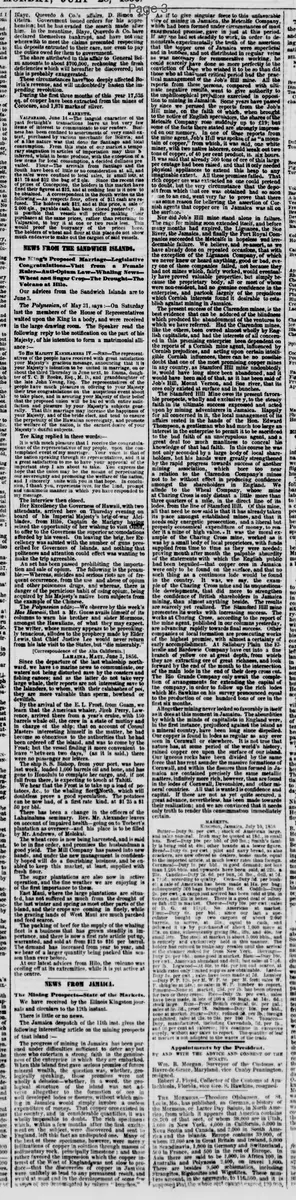
The Mining Prospects-State of the Markets.
We have received by the Illinois Kingston journals and circulars to the 12th instant.
There is little or no news.
The Jamaica despatch of the 11th inst. gives the following interesting article on the mining prospects of that island:-
The progress of mining in Jamaica has been pursued under difficulties sufficient to deter any but those who entertain a strong faith in the genuineness of the enterprise in which they are embarked.
When this island first gave serious promise of future mineral wealth, the question was, whether, geologically speaking, those promises were not wholly a delusion-whether, in a word, the geological structure of the island was not adverse altogether to the formation of ore in well developed lodes or fissures, without which mining in Jamaica would simply involve a useless expenditure of money. That copper ores existed in the country, and in considerable quantities, it was impossible to doubt, which, within a few months after the first excitement on the subject, were discovered and sent to England, left this fact an undisputed one. Many of the best of these specimens, however, were merely infiltrations of copper in solution through masses of sedimentary rock, principally limestone : and these rather favored the impression which the copper interest of the West of England was not slow to produce-that the discoveries of copper in Jamaica were unlikely to lead to any permanent result, and would at most end in the development of some few seams of ore denominated by miners "bunches."
As if to give singular force to this unfavorable view of mining in Jamaica, the Metcalfe Company, which had been formed under circumstances of most exaggerated promise, gave in just at this period.
If any one had set steadily to work, in order to demonstrate experimentally the truth of the assertion that the copper ores of Jamaica were superficial and in bunches, and not distributed in regular veins as was necessary for remunerative working, he could scarcely have done so more perfectly to the conviction of those who wished it to be so than did those who at that most critical period had the practical management of the Job's Hill mine. All the reports from these were, compared with ultimate negative results, went to give authority to the unphilosophical prejudices exercised in opposition to mining in Jamaica.
Some years have passed by since we perused the reports from the Job's Hill mine, on the faith of which, when brought to the notice of English speculators, the shares of the Metcalfe Company rose suddenly up to £19; but some of the facts there stated are strongly impressed on our memory.
In one of these reports from the mine agent, Job's Hill was spoken of as "a mountain of copper from which, it was said, one white miner, with two native laborers, could break out two tons of copper, of 40 per cent product, in six hours."
It was said that already 300 tons of ore of this large percentage had been raised, and that it only needed physical appliances to extend this heap to any imaginable extent. All these promises failed. That rich copper ore was extracted no one could pretend to doubt, but the very circumstance that the deposit from which that ore was obtained had so soon come to an end, went very far to prove that there was some reason for believing the assertion of Cornish agents that copper ore in Jamaica was all on the surface.
Nor did Job's Hill mine stand alone in failure. The rage for mining soon extended itself, and before many months had expired, the Liguanea, the Sue River, the Jamaica, and finally the Port Royal Companies succeeded the Metcalfe in hopeless and irredeemable failure. We believe, and re-assert, as we have already done on repeated occasions, that with the exception of the Liguanea Company, of which we never knew or heard anything, good or bad, every one of these companies failed, not because they had not mines which, fairly worked, would eventually have proved valuable properties, but simply because the proprietary body, all or most of whom were non-resident, had no genuine confidence in the enterprise, and partook largely of the prejudices which Cornish interests found it desirable to establish against mining in Jamaica.
The present success of the Clarendon mines, is the best evidence that can be adduced of the blindness which produced the abandonment of the ventures to which we have referred. Had the Clarendon mines, like the others, been owned almost wholly by English capitalists, and had the interests of all concerned in this promising enterprise been dependent on the reports of a Cornish mine agent, influenced by Cornish prejudices, and acting upon certain intelligible Cornish influences, there can be no possible doubt that one of the most promising copper mines in any country, as Stamford Hill mine undoubtedly is, would have long since been abandoned, and it would have been said of that, as it has been said of Job's Hill, Mount Vernon, and Sue river, that its ores only existed at surface and in bunches.
The Stamford Hill Mine owes its present favorable prospects, wholly and exclusively, to the steady faith in its ultimate success expressed and acted upon by mining adventurers in Jamaica. Happily for all concerned in it, the local management of its affairs rested in the hands of the Hon. Edward Thompson, a gentleman who had much too large an interest in the enterprise to permit it to be sacrificed to the bad faith of an unscrupulous agent, and a great deal too much manliness to conceal his knowledge of that bad faith. In this course he was not only seconded by a large body of local shareholders, but his hands were greatly strengthened by the rapid progress towards success of another mining association, which bore too near a relation to the Clarendon Company's mines not to be without effect in producing confidence amongst the shareholders in England. We allude to the Wheal Company, whose mine at Charing Cross is only distant a little more than three quarters of a mile, in the direct line of its lodes, from the line of Stamford Hill. Of this mine, all that need be now said is that it has already taken its place amongst established mines, and that it needs only energetic prosecution, and a liberal but properly economical expenditure of money, to render it a mine of high value. It was the moral example of the Charing Cross mine, worked as it was by a small body of local proprietors, with funds supplied from time to time as they were needed; proving month after month the palpable absurdity of the statements with which the English public had been beguiled-that copper ores in Jamaica were only to be found on the surface, and that no such thing as a continuous lode would be found in the country.
It was, we say, the example of the Charing Cross mine and its unquestionable developments, that did more to strengthen the confidence of British shareholders in Jamaica mining, than almost anything beside. The results are scarcely yet realized.
The Stamford Hill mine prosecutes its works with increasing success. The works at Charing Cross, according to the report of the mine agent, published in our columns yesterday, are advancing rapidly towards final success.
Other companies or local formation are prosecuting works of the highest promise, with almost a certainty of early accomplishment. At Salisbury Plain the Ellerslie and Bardowie Company have cut into a fine branch of yellow ore at great depth, from which they are extracting ore of great richness, and look forward by the end of the month to the intersection of the main lode in the end of their deep cross cut.
The Rio Grande Company only await the completion of arrangements for extending the capital of the company, in order to follow up the rich lodes which Mr. Sawkins on his survey pronounced equal to the production of one hundred tons of ore in the first six months.
Altogether mining never looked so favorably in itself as it does at this moment in Jamaica. The absurdities by which the minds of capitalists in England were in the first instance, prejudiced against the island as a mineral country, have been long since dispelled.
Our copper is found in lodes as regular as any ever seen in Cornwall or elsewhere. It is not true that nature has, at some period of the world's history, rained copper ore upon the surface of our island.
Our igneous rocks have been divided by the same force that has rent asunder the massive formations of Cornwall, and within the fissures thus formed in Jamaica are contained precisely the same metallic matters, infinitely more rich, however, than are found in the lodes of Cornwall, Devonshire, and other mineral countries. All that is wanted is confidence and capital. If these are not as yet quite secured, a great advance, nevertheless, has been made towards their realization; and we are convinced that it needs only truth to render this consummation immediately certain.
MARKETS.
Kingston, Jamaica, July 10, 1856
Butter-Duty 9s. per cwt.; stock of American large, and sales nominal. Irish may be quoted at 1s d., in small lots. Beef-Duty 10s per bbl. of 200 lbs.; Smith's family is being sold at 49s; other brands at a lower figure.
Bread-Duty 6s. per cwt.: pilot and navy bread, as also crackers, are now offered to dealers, home made, equal to the imported article, at much lower rates than foreign.
Cornmeal-Duty 1s. per bbl., in good demand; not less than 1,200 bbls. and upwards have been sold, at 22s. 23s. Candles-Duty 2s. 6d. per box, 56 lbs., dull, at 7d. a 7 1/2 d., according to quality Corn-Duty 3d per bushel; a sale of American has been made at 1s. per bag; subsequently 500 bags brought 1s. 6d. Codfish-Duty 2s. per cwt., a cargo just arrived has been sold at 20s. in tierces, and 22s in boxes.
There is a good deal of inferior fish still in market. Cheese-Duty 10s per cwt :sales of D. G. at 1 3d. No American at market.
Flour-Duty 6s. per bbl.: since our last a speculator bought up two cargoes of about 2,000 barrels, to arrive, at 35s., equal to cash, and followed it up by purchases of about 1,000 more at 36s. on time, subsequently giving 38s., 39s. and 40s. for small lots. The stock at market is about 5,000 bbls., and is entirely and exclusively held in this manner. The holder has refused to make any sales until the arrival of the steamer looked for from New York.
Herrings- Duty 2s. per bbl. : none good in market. Ham Duty 10s. per cwt. American abundant and dull; last sale at 7 1/2 d. per lb. Logwood-At 40s. to 44s. per ton and scarce, at which rates only limited supplies are obtainable. Lard- Duty 1s. per cwt , sales have been made at 1d. Lumber -Duty P.P. 1s. per M. W. P. S. per M. feet: sales W. P. shingles at 24s.; no sale in W.P. lumber to report.
Pimento-None at market, 2 1/2 d. per lb. has been offered for two or three crops. Rice-Duty 2s. per cwt.: sales have been made, in lots of 200 a 1,000 bags. at 14s. 6d. stock large Rum—Proof British colonial, 6s. per gal. sales at 5s. 3d., proof 1s. Salmon-Duty 10s. per bbl., none at market. Sugar-Duty. refined 2d. per lb.; foreign prohibited; sales at 21s. to 24s. per 100 lbs. Tobacco Duty, manufactured, including Cavendish, 1d. per lb., and 20 per cent ad valorem, lots continue in excessive supply, without any sales to report. The quantity of leaf at market is not adapted to the wants of the trade
What sub-type of article is it?
What keywords are associated?
What entities or persons were involved?
Where did it happen?
Foreign News Details
Primary Location
Jamaica
Event Date
July 10 12, 1856
Key Persons
Outcome
promising developments in copper mining at stamford hill, charing cross, ellerslie, bardowie, and rio grande; past mining companies failed due to lack of confidence; current markets show sales and prices for butter, beef, bread, cornmeal, candles, corn, codfish, cheese, flour, herrings, ham, logwood, lard, lumber, pimento, rice, rum, salmon, sugar, tobacco.
Event Details
Article discusses challenges and past failures in Jamaica's copper mining, attributing them to prejudices and poor management rather than lack of resources; highlights successes at Clarendon mines, particularly Stamford Hill under local management by Hon. Edward Thompson, and Charing Cross mine; other companies like Ellerslie and Bardowie, Rio Grande show promise; dispels myths about ore distribution; followed by market report from Kingston on July 10, 1856, detailing prices and sales for various imported goods.